Guides › Biggest cities in China
The biggest cities in China: which to visit and what to do in each
Maca Laoshi, Mandarin Chinese teacher
Updated October 27, 2026 · 13 min read
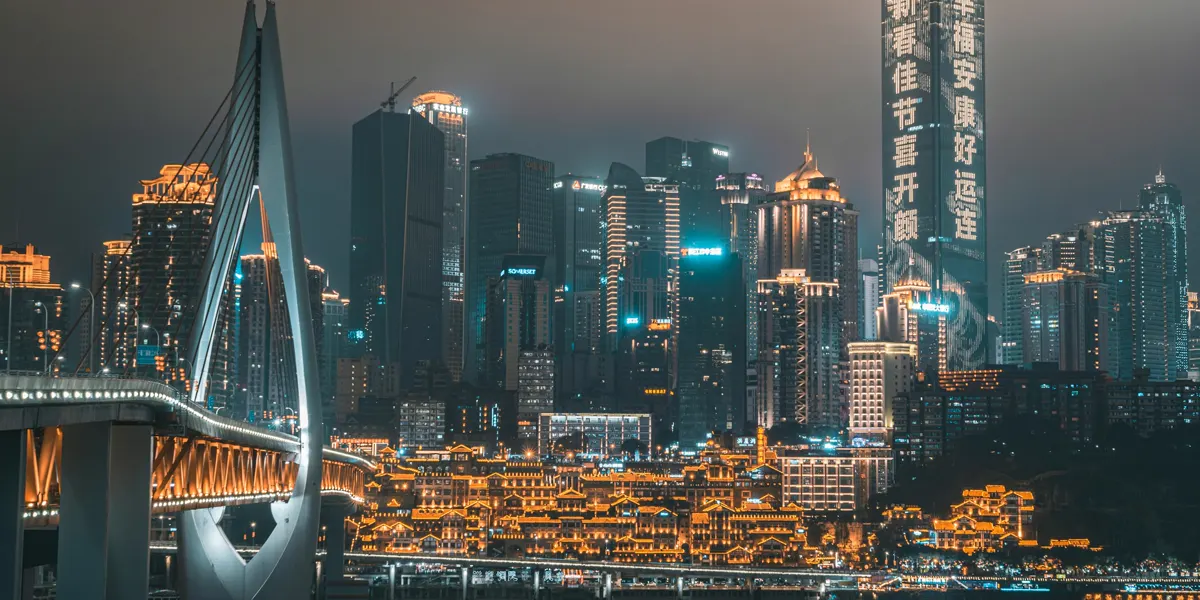
Seven megacities in mainland China sum up the country's urban life: Shanghai (skyscrapers, a classical garden and food), Beijing (the capital and its hutongs), Shenzhen (technology), Guangzhou (Cantonese food and culture), Chongqing (the city of hills, with a monorail that runs through a building), Chengdu (teahouses and Sichuan food) and Hangzhou (West Lake). Population figures are from the 2020 census and cover the whole municipality, not just the urban core. All seven have a metro, and in big cities people pay a lot by scanning codes with their phones. This guide covers mainland China.
The 7 cities at a glance
The stars are Macalaoshi's own rating, our editorial opinion: they are not user reviews or scores from other sites. They depend on how unique the place is, how easy it is to reach and how much you enjoy it on a first visit. The days are our own suggestion.
| City | Where | Rating | Best for | Days | Best time |
|---|---|---|---|---|---|
| Shanghai (上海, Shànghǎi) | Shanghai municipality | ★★★★★ | Skyscrapers, gardens, food | 2 to 3 days | Autumn |
| Beijing (北京, Běijīng) | Beijing municipality | ★★★★★ | History, hutongs | 3 to 4 days | Late March to May and September to mid-October |
| Shenzhen (深圳, Shēnzhèn) | Guangdong | ★★★☆☆ | Technology, design, walks | 1 to 2 days | October to December |
| Guangzhou (广州, Guǎngzhōu) | Guangdong | ★★★★☆ | Cantonese food, morning tea | 2 days | October–November and April–May |
| Chongqing (重庆, Chóngqìng) | Chongqing municipality | ★★★★☆ | Cityscape, hotpot | 2 days | Avoid July and August |
| Chengdu (成都, Chéngdū) | Sichuan | ★★★★★ | Teahouses, food, pandas | 3 days | Spring and autumn |
| Hangzhou (杭州, Hángzhōu) | Zhejiang | ★★★★☆ | West Lake, tea, strolling | 1 to 2 days | Spring and autumn |
Population: official figures from the 2020 census (1 November 2020). The figure for a Chinese "city" covers its whole administrative territory, with urban districts, satellite towns and countryside; it is not the same as the urban core.
The 7 cities, one by one
Each city is deliberately short; the big sightseeing visits are in what to see in China, historic China and natural landscapes. Opening hours, bookings and entry requirements for the country change: confirm them with the official channel or your embassy before you travel.
1. Shanghai (上海, Shànghǎi)
Why go. Shanghai has 24,870,895 inhabitants (2020 census, the whole municipality). In Pudong, the Shanghai Tower (632 m) is, according to Wikipedia, the tallest building in China, and from the Bund you can see the Lujiazui skyline. In the Old City, Yu Garden (豫园, Yùyuán) was begun in 1559, in the Ming dynasty, and finished in 1577; it covers about 2 hectares. The maglev train covers about 30 km from Pudong airport to Longyang Road station in about 8 minutes.
Macalaoshi rating: ★★★★★ — skyscrapers, a classical garden and food in one city; very easy for a first visit.
Practical tip. From Pudong airport to the centre there is the metro (Line 2) or the maglev, which connects at Longyang Road with Lines 2, 7, 16 and 18. Yu Garden is at Yuyuan Garden station (Lines 10 and 14). According to Wikivoyage, autumn is generally mild with warm, sunny weather; summer temperatures often pass 35 °C with very high humidity.
What to eat there: 葱油拌面 (cōngyóu bànmiàn, noodles tossed in scallion oil); 狮子头 (shīzitóu, a large pork meatball, the "lion's head")
Words you will see there
| Chinese | Pinyin | Meaning |
|---|---|---|
| 浦东 | Pǔdōng | Pudong, the district east of the Huangpu River |
| 磁悬浮 | cíxuánfú | magnetic levitation train (maglev) |
| 豫园 | Yùyuán | Yu Garden |
2. Beijing (北京, Běijīng)
Why go. Beijing has 21,893,095 inhabitants (2020 census, the whole municipality). Its hutongs (胡同, hútòng) are alleys formed by rows of courtyard houses (四合院, sìhéyuàn) and date from the Yuan dynasty (1279–1368). The Beijing Central Axis, 7.8 km long, with the Drum and Bell Towers to the north and Yongdingmen Gate to the south, has been a UNESCO World Heritage Site since 27 July 2024.
Macalaoshi rating: ★★★★★ — a capital with history, old streets and a good metro; it deserves several days.
Practical tip. According to the municipal government, since 13 September 2024 the gates on all 27 metro lines accept Visa and Mastercard cards issued abroad. Visit Beijing recommends travelling from late March to May and from September to mid-October.
What to eat there: 北京烤鸭 (Běijīng kǎoyā, Peking duck); 爆肚 (bàodǔ, tripe cooked on the spot)
Words you will see there
| Chinese | Pinyin | Meaning |
|---|---|---|
| 胡同 | hútòng | alley, hutong |
| 四合院 | sìhéyuàn | traditional courtyard house |
| 中轴线 | zhōngzhóuxiàn | central axis |
3. Shenzhen (深圳, Shēnzhèn)
Why go. Shenzhen has 17,560,061 inhabitants (2020 census, the whole municipality). Its special economic zone, the first in China, was approved in 1980, and today it is a city of technology and design; for the Huaqiangbei electronics district, see the guide to a business trip to China. For a stroll, OCT-LOFT is an art centre in Nanshan, Shenzhen Bay Park (opened in 2011) is good for watching migrating birds in winter, and Wutong Mountain has hiking trails with many steps that get very crowded on holidays.
Macalaoshi rating: ★★★☆☆ — a young, modern city, ideal if you are interested in technology; it has fewer monuments than others.
Practical tip. According to Wikivoyage, the metro runs until 23:00. The best time is October to December; from June to October there are typhoons. From Shenzhen to Guangzhou there is a high-speed train of about an hour.
What to eat there: 潮汕牛肉火锅 (Cháoshàn niúròu huǒguō, Chaoshan beef hotpot in a clear broth); 酿豆腐 (niàng dòufu, stuffed tofu, a Hakka dish)
Words you will see there
| Chinese | Pinyin | Meaning |
|---|---|---|
| 深圳湾 | Shēnzhèn Wān | Shenzhen Bay |
| 梧桐山 | Wútóng Shān | Wutong Mountain |
| 华强北 | Huáqiángběi | Huaqiangbei, the electronics district |
4. Guangzhou (广州, Guǎngzhōu)
Why go. Guangzhou (Canton) has 18,676,605 inhabitants (2020 census, the whole municipality). Morning tea (早茶, zǎochá) is part of daily life: according to Wikivoyage, many locals spend hours chatting over a small order. The Canton Tower (广州塔, Guǎngzhōu Tǎ), about 600 m tall, opened in 2010 and is nicknamed 小蛮腰 ("slim waist"). The Chen Clan Ancestral Hall (陈家祠), completed in 1894, now houses the Guangdong Folk Art Museum, and Shamian Island (沙面), of 0.3 km², keeps buildings from the era of the European concessions.
Macalaoshi rating: ★★★★☆ — food, Cantonese culture and a city that is easy to get around; less monumental than Beijing.
Practical tip. In Guangzhou the native language is Cantonese, but young people usually speak Mandarin too (Mandarin or Cantonese). The best months are October and November, and April and May are good too; summer is humid and can approach 40 °C, with typhoons from June to September. If you are going for the Canton Fair, see the guide to a business trip to China.
What to eat there: 虾饺 (xiājiǎo, steamed prawn dumplings); 肠粉 (chángfěn, steamed rice-flour rolls, with a filling)
Words you will see there
| Chinese | Pinyin | Meaning |
|---|---|---|
| 广州塔 | Guǎngzhōu Tǎ | Canton Tower |
| 早茶 | zǎochá | morning tea |
| 点心 | diǎnxin | dim sum, small bites |
5. Chongqing (重庆, Chóngqìng)
Why go. Chongqing has 32,054,159 inhabitants (2020 census), but it is a municipality of about 82,400 km², similar in size to Austria, with urban districts, satellite towns and countryside: that figure does not measure the central city alone. It is built on mountains and partly surrounded by the Yangtze and Jialing rivers, and you climb a lot of stairs. Hongyadong (洪崖洞, Hóngyádòng) is an 11-storey complex in the 吊脚楼 (diàojiǎolóu, stilt house) style beside the Jialing. At Liziba (李子坝), the Line 2 monorail station occupies floors 6 to 8 of a 19-storey residential building and opened on 18 June 2005.
Macalaoshi rating: ★★★★☆ — a unique cityscape, with slopes and a lot of summer heat; for those who do not mind stairs.
Practical tip. Avoid July and August: Chongqing is one of the Yangtze's "Three Furnaces", with highs of about 34 °C and a record of 43.7 °C in August 2022 (Wikipedia). From Chongqing North, high-speed trains reach Chengdu in about an hour and a half, and one-hour evening cruises leave from Chaotianmen, according to Wikivoyage.
What to eat there: 重庆火锅 (Chóngqìng huǒguō, spicy, numbing hotpot, born in the 1920s in Jiangbei); 重庆小面 (Chóngqìng xiǎomiàn, spicy noodles, a popular breakfast)
Words you will see there
| Chinese | Pinyin | Meaning |
|---|---|---|
| 洪崖洞 | Hóngyádòng | Hongyadong |
| 李子坝 | Lǐzǐbà | Liziba |
| 单轨 | dānguǐ | monorail |
6. Chengdu (成都, Chéngdū)
Why go. Chengdu has 20,937,757 inhabitants (2020 census, the whole municipality). It is famous for its pandas, its teahouses and its food: it is the first city in Asia named a City of Gastronomy by UNESCO. The Kuanzhai alleys (宽窄巷子, Kuānzhǎi Xiàngzi) are three (Kuan, Zhai and Jing) and the only Qing-dynasty streets left in the city; they date from 1718 and reopened to tourism in 2008 after renovation, so today they are rebuilt. People's Park (人民公园, Rénmín Gōngyuán), free to enter, has tea shops, restaurants and lakes with pedal boats.
Macalaoshi rating: ★★★★★ — tea, food and pandas in a relaxed city.
Practical tip. According to Wikivoyage, Chengdu is known for little sun and fog much of the year, and spring and autumn are the most comfortable seasons. On the metro, the machines have English and accept WeChat, Alipay or international cards. The city has two international airports, Shuangliu and Tianfu.
What to eat there: 四川火锅 (Sìchuān huǒguō, spicy, numbing hotpot); 夫妻肺片 (fūqī fèipiàn, slices of beef and offal in chilli sauce)
Words you will see there
| Chinese | Pinyin | Meaning |
|---|---|---|
| 宽窄巷子 | Kuānzhǎi Xiàngzi | Kuanzhai alleys |
| 茶馆 | cháguǎn | teahouse |
| 麻辣 | málà | spicy and numbing |
7. Hangzhou (杭州, Hángzhōu)
Why go. Hangzhou has 11,936,010 inhabitants (2020 census, the whole municipality). Its West Lake is in the list of what to see in China. According to tradition, Lingyin Temple (灵隐寺, Língyǐn Sì) was founded in 328, in the Eastern Jin dynasty; beside it, the Feilai Feng reliefs total 153 shrines and more than 470 carvings. Hangzhou is also Alibaba's city.
Macalaoshi rating: ★★★★☆ — a serene walk by the lake, under an hour from Shanghai.
Practical tip. From Shanghai Hongqiao, the high-speed train takes about 50 minutes and arrives at Hangzhou East. Lingyin Temple is visited inside a scenic area with a paid entrance. The Longjing tea fields are best seen at harvest, from March to shortly after 1 May. According to Wikivoyage, humidity is high from early June to early September.
What to eat there: 叫化鸡 (jiàohuājī, "beggar's chicken", popularised in Hangzhou); 西湖醋鱼 (Xīhú cùyú, fish in vinegar sauce)
Words you will see there
| Chinese | Pinyin | Meaning |
|---|---|---|
| 西湖 | Xīhú | West Lake |
| 灵隐寺 | Língyǐn Sì | Lingyin Temple |
| 龙井茶 | lóngjǐngchá | Longjing tea |
 Test your Chinese
Improve your Chinese with our app, Macalaoshi Flashcards: 1,300+ words and characters to practice like this.
See the appGetting around and paying in a big Chinese city
The phrases for taxis, restaurants and shopping are in 50 Chinese phrases for travel; here are the signs and the facts for big cities.
Metro (地铁, dìtiě). In Beijing, all passengers go through a security check (安检, ānjiǎn) before entering the station, and each item must not exceed 30 kg, 1.8 m in length or 0.5 m in width or height. Tickets are bought from machines that, according to the Beijing government, accept WeChat, Alipay, card or cash, and since 13 September 2024 the gates on all 27 lines accept foreign Visa and Mastercard cards. In Chengdu the machines have English, and in Shanghai the metro accepts international contactless cards and mobile payment, according to Wikivoyage.
Paying with your phone (扫码, sǎomǎ). The Chinese government's guide to working and living in the country (2025) says that Visa, Mastercard, UnionPay, American Express, JCB, Diners Club and Discover cards can be linked to payment apps, and that the issuer has to verify them. In March 2024 the People's Bank of China announced that the mobile payment limit for foreign visitors would rise from USD 1,000 to 5,000 per transaction and from USD 10,000 to 50,000 per year, and official policy asks that cash not be refused: carry some cash and a second way to pay.
Taxis and food delivery. According to the Beijing government, DiDi (滴滴, Dīdī) has an English interface, can be registered with a Chinese or foreign phone number and is paid by bank account, WeChat Pay or Alipay; it is not designed for cash, most drivers speak only Chinese, and hailing a taxi in the street is now very difficult. To order food (外卖, wàimài), the Shanghai government names Meituan (美团, Měituán) and Taobao Flash (淘宝闪购, Táobǎo Shǎngòu), the name used since December 2025 by the app that used to be called Ele.me.
Words for stations and payments
| Chinese | Pinyin | Meaning |
|---|---|---|
| 进站 | jìnzhàn | entering the station |
| 出站 | chūzhàn | leaving the station |
| 换乘 | huànchéng | transfer (between lines) |
| 出口 | chūkǒu | exit (with a letter or number) |
| 安检 | ānjiǎn | security check |
| 扫码 | sǎomǎ | to scan a code |
| 二维码 | èrwéimǎ | QR code |
| 支付宝 | Zhīfùbǎo | Alipay |
| 微信支付 | Wēixìn zhīfù | WeChat Pay |
| 滴滴 | Dīdī | DiDi, a taxi app |
| 美团 | Měituán | Meituan, a food delivery app |
To copy addresses in Chinese or type them on your phone, see how to set up a Chinese keyboard, and for prices, Chinese numbers.
Which city to choose for your trip
- First visit. Beijing and Shanghai; the high-speed train between them takes about 4 h 30 min on the fastest trains, according to Wikipedia. A 12-day route is in what to see in China.
- Food. Chengdu (Sichuan food and teahouses), Chongqing (hotpot) and Guangzhou (dim sum). From Chongqing to Chengdu it is about an hour and a half by train.
- Technology. Shenzhen, about an hour from Guangzhou by train.
- Quiet walks. Hangzhou, about 50 minutes from Shanghai, and Chengdu.
- History and nature. Beijing for history (historic China) and, for mountains and rivers, the natural landscapes.
Traveller's vocabulary
Many of these words are from HSK 1 and HSK 2, the levels Macalaoshi trains: learn them before the trip. To speak, there are 50 Chinese phrases for travel and numbers.
| Chinese | Pinyin | Meaning | HSK level |
|---|---|---|---|
| 地铁 | dìtiě | metro | HSK 2 |
| 公交车 | gōngjiāochē | city bus | HSK 2 |
| 出租车 | chūzūchē | taxi | HSK 1 |
| 打车 | dǎ chē | to take a taxi, to hail a taxi | HSK 2 |
| 车站 | chēzhàn | station (train or bus) | HSK 2 |
| 机场 | jīchǎng | airport | HSK 2 |
| 路 | lù | road, street | HSK 2 |
| 站 | zhàn | stop, station | HSK 2 |
| 票 | piào | ticket | HSK 2 |
| 手机 | shǒujī | mobile phone | HSK 1 |
| 现金 | xiànjīn | cash | — |
| 外卖 | wàimài | food delivery | — |
| 火锅 | huǒguō | hotpot | — |
| 茶馆 | cháguǎn | teahouse | — |
| 洗手间 | xǐshǒujiān | toilet, restroom | HSK 2 |
| 酒店 | jiǔdiàn | hotel | HSK 2 |
Pinyin is given as in the dictionary. In speech, when two third tones come together, the first becomes a second tone: 洗手间 sounds xíshǒujiān.
How Macalaoshi does it
Getting around a big city is easier when you recognise the characters on stations, menus and payment codes. In Macalaoshi you learn them through challenges to save the world from the Empress with the power of Chinese characters: more than 1300 words and characters from HSK 1 to 4, bosses, stroke-by-stroke writing in the correct order and story mode with Lili. Every character you get right goes up a level and what you miss comes back for you to review. Getting started is free; to lock in the vocabulary, see how to memorize vocabulary.
Payment conditions, metro hours and each city's rules change: confirm them with the official source.
Improve your Chinese with Macalaoshi Flashcards
Maca Laoshi's app for learning characters, with audio, pinyin and stroke-by-stroke writing.
- 1,300+words and characters
- HSK 1–4by level
- Freeto start





Learn with our songs
We made them for Macalaoshi. Singing along is a fun way to practice pronunciation and review vocabulary.

The Lighthouse of My Heart 我心里灯塔

Study With You 跟你一起学
Frequently asked questions
Which Chinese city should I visit first?
For a first visit, Beijing and Shanghai are usually the base: the first for its history and hutongs, the second for its skyscrapers, gardens and food. With more days, add Chengdu (teahouses and Sichuan food) or Hangzhou, about 50 minutes from Shanghai by high-speed train.
How many people live in China's biggest cities?
According to the 2020 census: Chongqing 32,054,159, Shanghai 24,870,895, Beijing 21,893,095, Chengdu 20,937,757, Guangzhou 18,676,605, Shenzhen 17,560,061 and Hangzhou 11,936,010. These are figures for the whole municipality, not just the urban core.
Why does Chongqing have more people than Shanghai?
Because it is a municipality of about 82,400 km², similar in size to Austria, that includes urban districts, satellite towns and rural areas. Its figure of 32,054,159 does not measure the central city alone.
Can I pay for the metro with a foreign card?
In Beijing, yes: since 13 September 2024 the gates on all 27 lines accept Visa and Mastercard cards issued abroad, according to the municipal government. In other cities the conditions vary: check at the station or on the metro's website.
Which apps do I need to get around and pay in a Chinese city?
To pay, Alipay or WeChat Pay with a linked foreign card; for taxis, DiDi, which has an English interface and accepts foreign phone numbers, according to the Beijing government. Also carry cash and a second way to pay.
Does this guide include Taiwan, Hong Kong or Macao?
No. It covers mainland China, where the simplified characters taught by Macalaoshi are used.
Maca Laoshi, born in Beijing, has taught Mandarin Chinese for more than 22 years and has had over 1,500 students. Together with her son Manu Shi, who has more than 93,000 subscribers on YouTube, she created Macalaoshi, an app that challenges you to push yourself one character at a time. Few Chinese teachers can show both: their own app and a channel like that.
Sources
- National Bureau of Statistics (11 May 2021): bulletin No. 3 of the 7th census, population by region (Beijing, Shanghai and Chongqing).
- Shenzhen Statistics Bureau (17 May 2021): census bulletin No. 1, 17,560,061 inhabitants.
- Guangzhou Statistics Bureau (18 May 2021): census bulletin No. 1, 18,676,605 inhabitants.
- Sichuan Statistics Bureau (26 May 2021): census bulletin No. 2, 20,937,757 inhabitants in Chengdu.
- Hangzhou.com.cn, with data from the Zhejiang census press conference (14 May 2021): 11,936,010 inhabitants in Hangzhou.
- Wikipedia: Shanghai Tower, 632 m and the tallest building in China.
- Wikipedia: Yu Garden, begun in 1559 and finished in 1577, about 2 hectares.
- Wikipedia: Shanghai maglev, about 30 km in about 8 minutes.
- Wikivoyage: Shanghai, metro, seasons and climate.
- Wikipedia: Shanghai cuisine, scallion oil noodles and "lion's head".
- Wikipedia: hutong, Yuan dynasty and courtyard houses.
- Beijing government (27 July 2024): the Beijing Central Axis, 7.8 km, a UNESCO World Heritage Site.
- Beijing government (14 September 2024): foreign Visa and Mastercard cards on all 27 metro lines.
- Beijing government: metro notice, security check and luggage limits.
- Beijing government (30 August 2024): DiDi, taxis and metro for new arrivals.
- Beijing government: basic information on the metro, tickets and payments.
- Wikipedia: Beijing cuisine, Peking duck and tripe.
- Visit Beijing (2013): best months to visit Beijing.
- Wikipedia: Beijing–Shanghai high-speed railway, 4 h 28 min.
- China Daily HK (25 August 2023): Shenzhen special economic zone approved in 1980.
- Wikivoyage: Shenzhen, OCT-LOFT, the bay, Wutong Mountain, metro, best season and train to Guangzhou.
- Wikipedia: Shenzhen, 12-line metro and Shenzhen Bay Park opened in 2011.
- Eye Shenzhen, the city's official English portal (22 July 2024): Chaoshan beef hotpot.
- Eye Shenzhen: Hakka cuisine and stuffed tofu.
- Wikivoyage: Guangzhou, morning tea, language, climate and best months.
- Wikipedia: Canton Tower, about 600 m, opened in 2010.
- Wikipedia: Chen Clan Ancestral Hall, completed in 1894.
- Wikipedia: Shamian Island, 0.3 km² and the European concessions.
- Wikipedia: Chongqing, 82,403 km², the Yangtze's "Three Furnaces" and a record of 43.7 °C.
- Wikipedia: Austria, 83,879 km², for comparison with the size of the Chongqing municipality.
- Wikipedia: Liziba station, on floors 6 to 8 of a 19-storey building, opened in 2005.
- Wikipedia: Hongyadong, an 11-storey complex beside the Jialing River.
- Wikivoyage: Chongqing, hills, evening cruises and train to Chengdu.
- Wikipedia: Chongqing hot pot, born in the 1920s in Jiangbei.
- Wikipedia: Chongqing xiaomian noodles.
- CGTN (1 June 2023): the Kuanzhai alleys, from 1718, reopened in 2008.
- Wikivoyage: Chengdu, teahouses, metro, climate and People's Park.
- Wikipedia: Chengdu, two international airports.
- Chengdu release via Kyodo (24 May 2019): first UNESCO City of Gastronomy in Asia.
- Wikipedia: Sichuan cuisine, hotpot and slices of beef and offal.
- Wikipedia: Lingyin Temple, founded in 328 according to tradition, and the Feilai Feng reliefs.
- Wikipedia: Hangzhou, e-commerce hub and Alibaba's headquarters.
- Wikivoyage: Hangzhou, train from Shanghai in about 50 minutes and tea harvest.
- Wikipedia: Hangzhou cuisine, beggar's chicken, originally from Jiangsu and popularised in Hangzhou.
- CGTN, republished by the Hangzhou municipal government (7 January 2026): 西湖醋鱼 (Xīhú cùyú), fish in vinegar sauce, made with grass carp, sugar and vinegar.
- People's Bank of China, press briefing of 1 March 2024: mobile payment limits for foreigners and cash.
- Chinese government: Guide to Working and Living in China (2025), cards that can be linked to mobile payments.
- Shanghai government: food delivery apps, Meituan and Taobao Flash.
- The Paper (5 December 2025): the Ele.me app is renamed Taobao Flash.
- CC-CEDICT (MDBG, version of 3 October 2026): pinyin and meaning of the words in the tables.
- CLEC (China): the new HSK syllabus (November 2025), basis of the HSK 1 and 2 lists in the level column.
This guide in other languages: Español · Português · Français · Deutsch · Italiano · 日本語 · 한국어