Guides › Business trip to China
Business trip to China: cities, trade fairs, meetings and key words
Maca Laoshi, Mandarin Chinese teacher
Updated October 27, 2026 · 13 min read
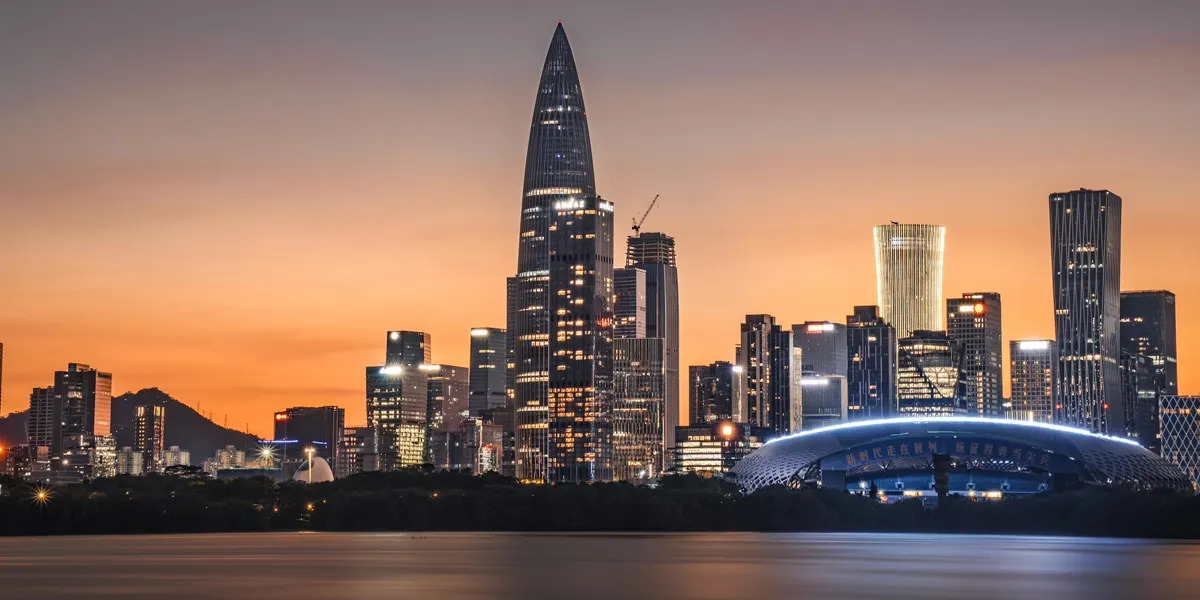
For a business trip to mainland China, six destinations cover the essentials: Shanghai (finance and the CIIE import fair), Shenzhen (electronics), Guangzhou (the Canton Fair, twice a year), Yiwu (wholesale market), Beijing (institutions and large groups) and Hangzhou (e-commerce). It helps to know how introductions work (a card with both hands, contact through WeChat) and what a 发票 (fāpiào) is, the official invoice companies ask for. This guide covers mainland China.
The 6 destinations at a glance
The stars are Macalaoshi's own rating, our editorial opinion: they are not user reviews or scores from other sites. Here they rate the destination "for business": how useful it is on a work trip, how easy it is to reach and organise, and how much a foreign visitor gets out of a first visit. The days are our own suggestion.
| Destination | Where | Rating | Best for | Days | When to go |
|---|---|---|---|---|---|
| Shanghai (上海, Shànghǎi) | Shanghai municipality | ★★★★★ | Finance, CIIE fair | 2 to 3 days | November (CIIE); autumn is mild |
| Shenzhen (深圳, Shēnzhèn) | Guangdong | ★★★★☆ | Electronics, technology | 2 to 3 days | October to December |
| Guangzhou (广州, Guǎngzhōu) | Guangdong | ★★★★★ | Canton Fair, buying from factories | 3 to 5 days | April–May and October–November (fairs) |
| Yiwu (义乌, Yìwū) | Zhejiang | ★★★★☆ | Small goods wholesale | 2 to 3 days | October (fair); avoid Chinese New Year |
| Beijing (北京, Běijīng) | Beijing municipality | ★★★★☆ | Institutions, large groups, technology | 2 to 4 days | Late March to May and September to mid-October |
| Hangzhou (杭州, Hángzhōu) | Zhejiang | ★★★★☆ | E-commerce | 1 to 2 days | Spring and autumn |
The 6 destinations, one by one
Each destination is deliberately short. For the sightseeing overview, see what to see in China, and for getting around and paying in big cities, Chinese cities. The fair dates in this guide are for the 2025 and 2026 editions, checked on 27 October 2026; they change every year, so confirm them on each fair's official website. Bookings and entry requirements for the country also change: confirm them with the official channel or your embassy before you travel.
1. Shanghai (上海, Shànghǎi)
Why go. Lujiazui (陆家嘴, Lùjiāzuǐ), in Pudong, has been developed since the early 1990s as Shanghai's new financial district, and it is home to the Shanghai Tower (632 m), the tallest building in China. The Shanghai Stock Exchange has been in operation since 19 December 1990. Every autumn since 2018 the CIIE (中国国际进口博览会, Zhōngguó Guójì Jìnkǒu Bólǎnhuì), an international import fair, is held here: the 9th edition was scheduled for 5–10 November 2026, with 4,142 overseas companies, according to CGTN.
Macalaoshi rating (for business): ★★★★★ — China's financial centre and home to a major import fair; easy to reach and to get around.
Practical tip. The CIIE takes place at the National Exhibition and Convention Center (国家会展中心) in Qingpu District, inside the Hongqiao transport hub (metro, high-speed rail and airport). The metro station of the same name serves Lines 2 and 17; for the 2025 edition, the Shanghai transport commission warned that the Line 2 station gets very crowded and suggested taking Line 10 to Hongqiao Railway Station and changing to Line 17. From Hongqiao, Hangzhou is about 50 minutes away by high-speed train.
What to eat there: 本帮菜 (běnbāngcài, local Shanghai cuisine); 小笼包 (xiǎolóngbāo, steamed soup dumplings)
Words you will see there
| Chinese | Pinyin | Meaning |
|---|---|---|
| 陆家嘴 | Lùjiāzuǐ | Pudong's financial district |
| 博览会 | bólǎnhuì | exposition, international fair |
| 进口 | jìnkǒu | to import; import |
2. Shenzhen (深圳, Shēnzhèn)
Why go. Shenzhen's special economic zone, the first in China, was approved in 1980, and today it is a city of technology and manufacturing: Tencent (headquartered in Nanshan), Huawei, DJI and BYD are all based here. In Futian District, Huaqiangbei (华强北, Huáqiángběi) is, according to Wikipedia, one of the largest electronics markets in the world, with about 38,000 businesses in 2020.
Macalaoshi rating (for business): ★★★★☆ — a must for electronics and hardware suppliers; less useful for other sectors.
Practical tip. According to Wikivoyage, WeChat Pay and Alipay are the most popular ways to pay in Shenzhen, and many circuit board makers and assembly houses offer tours if you ask. The best time is October to December, and Guangzhou is about an hour away by high-speed train.
What to eat there: 潮汕牛肉火锅 (Cháoshàn niúròu huǒguō, Chaoshan beef hotpot in a clear broth, with shacha sauce); 酿豆腐 (niàng dòufu, stuffed tofu with pork, mushrooms or shrimp, a Hakka dish)
Words you will see there
| Chinese | Pinyin | Meaning |
|---|---|---|
| 华强北 | Huáqiángběi | Huaqiangbei, the electronics market district |
| 电子 | diànzǐ | electronic |
| 市场 | shìchǎng | market |
3. Guangzhou (广州, Guǎngzhōu)
Why go. The Canton Fair (广交会, Guǎngjiāohuì; official name 中国进出口商品交易会) has been held since 1957, every spring and autumn. Each session has three five-day phases with breaks between them: the 139th ran from 15 April to 5 May 2026, and the 140th was scheduled for 15 October to 4 November 2026. At the 139th, phase 1 focused on advanced manufacturing (machinery, tools, electronics), phase 2 on the home (building materials and furniture, housewares, gifts) and phase 3 on health and leisure, toys and fashion. For the 140th, more than 30,000 companies were expected across 1.55 million m² of exhibition space.
Macalaoshi rating (for business): ★★★★★ — thousands of exhibitors from many sectors in one venue; it takes advance planning.
Practical tip. According to the notice for the 140th session, pre-registration on the official website is open all year and new overseas buyers can apply for a free badge; badges can also be applied for at alternative registration offices, such as Baiyun Airport, Guangzhou South station, the Pazhou ferry terminal or designated hotels. Wikivoyage warns that hotel prices rise sharply during the fair: book early. The venue, in Pazhou (Haizhu District), has a metro connection. Cantonese is the local language, but Mandarin gets you through almost everything (Mandarin or Cantonese).
What to eat there: 早茶 (zǎochá, morning tea with dim sum, a Cantonese tradition); 虾饺 (xiājiǎo, steamed prawn dumplings)
Words you will see there
| Chinese | Pinyin | Meaning |
|---|---|---|
| 广交会 | Guǎngjiāohuì | Canton Fair (short form) |
| 展位 | zhǎnwèi | booth, exhibition space |
| 买家 | mǎijiā | buyer |
4. Yiwu (义乌, Yìwū)
Why go. Xinhua called Yiwu "the world's largest hub for small commodities" (全球最大的小商品集散地) in February 2025: about 2.1 million products, with trade reaching more than 230 countries and regions. Its International Trade City (义乌国际商贸城, Yìwū Guójì Shāngmàochéng) reopened on 28 February 2026, after Chinese New Year, with about 80,000 shops, according to a press release. More than 30,000 foreigners live in the city, and a freight train links it to Madrid (13,052 km), a route that marked its tenth anniversary in 2024.
Macalaoshi rating (for business): ★★★★☆ — essential if you buy small goods wholesale; of little use for other sectors.
Practical tip. Avoid Chinese New Year: the market closes for the holiday (in 2026 it reopened on 28 February). The annual commodities fair is held at the Yiwu International Expo Center: the 31st edition was scheduled for 21 to 24 October 2025 (check each year's dates on the fair's website). From Hangzhou, Wikivoyage gives 30 to 40 minutes by high-speed train, and it lists Middle Eastern, Turkish, Indian, Korean and Japanese restaurants in the commercial districts.
What to eat there: 义乌红糖 (Yìwū hóngtáng, cane brown sugar with more than 300 years of history; foreigners who live there call it "Oriental chocolate"); 红糖麻花 (hóngtáng máhuā, fried twisted dough with brown sugar)
Words you will see there
| Chinese | Pinyin | Meaning |
|---|---|---|
| 批发 | pīfā | wholesale |
| 商品 | shāngpǐn | goods, merchandise |
| 现货 | xiànhuò | goods in stock |
5. Beijing (北京, Běijīng)
Why go. Beijing is the capital and the place for meetings with institutions and large groups. Zhongguancun (中关村, Zhōngguāncūn), in Haidian District, is known as "China's Silicon Valley" and sits next to Peking and Tsinghua universities. The China International Fair for Trade in Services (CIFTIS) took place on 9–13 September 2026 at Shougang Park. The high-speed train to Shanghai (1,318 km) opened in 2011 and, according to Wikipedia, takes about 4 h 30 min on the fastest trains.
Macalaoshi rating (for business): ★★★★☆ — for meetings with institutions and large companies and for the tech scene; less geared to buying from factories.
Practical tip. At formal meetings, bring bilingual business cards and respect hierarchy (see below). Visit Beijing recommends travelling from late March to May and from September to mid-October, and warns that everywhere is booked out during Chinese New Year: book your hotel three to four months ahead.
What to eat there: 北京烤鸭 (Běijīng kǎoyā, Peking duck); 涮羊肉 (shuàn yángròu, thinly sliced mutton cooked at the table in a hotpot)
Words you will see there
| Chinese | Pinyin | Meaning |
|---|---|---|
| 中关村 | Zhōngguāncūn | Zhongguancun, Beijing's tech district |
| 会议 | huìyì | meeting, conference |
| 高铁 | gāotiě | high-speed train |
6. Hangzhou (杭州, Hángzhōu)
Why go. Alibaba was founded in Hangzhou on 28 June 1999 and is headquartered there, in Yuhang District. In March 2015 the State Council approved the first cross-border e-commerce comprehensive pilot zone in Hangzhou; by February 2022 there were 132 across 30 provinces, autonomous regions and municipalities, according to China Daily. Outside work hours, West Lake is in the same city (see what to see in China).
Macalaoshi rating (for business): ★★★★☆ — for e-commerce and digital companies; combines well with Shanghai and Yiwu.
Practical tip. From Shanghai Hongqiao, the high-speed train takes about 50 minutes non-stop, according to Wikivoyage, and arrives at Hangzhou East, the main high-speed station. Yiwu is a short train ride away.
What to eat there: 叫化鸡 (jiàohuājī, "beggar's chicken", a dish popularised in Hangzhou); 西湖醋鱼 (Xīhú cùyú, fish in vinegar sauce)
Words you will see there
| Chinese | Pinyin | Meaning |
|---|---|---|
| 电商 | diànshāng | e-commerce |
| 阿里巴巴 | Ālǐbābā | Alibaba |
| 淘宝 | Táobǎo | Taobao, an online shopping platform |
 Test your Chinese
Improve your Chinese with our app, Macalaoshi Flashcards: 1,300+ words and characters to practice like this.
See the appWhat a business meeting in China is like
These pointers come from two official guides: the US Commercial Service's guide to China (25 September 2025) and the Canadian Trade Commissioner Service's (16 November 2021). They describe common customs, not rules, and every company is different.
- Business cards (名片, míngpiàn). Give and receive them with both hands; when you receive one, look at it for a moment before putting it away. Give yours first to the most senior person. Bring bilingual cards, with Chinese characters on one side and your language on the other; a new contact may not have a card.
- WeChat (微信, Wēixìn). Exchanging contacts on WeChat is increasingly common, especially among younger professionals; Weixin and WeChat had 1,439 million monthly active users in June 2026, according to Tencent. Install the app before you travel and ask for a contact with 我加下你微信吧 (wǒ jiā xià nǐ Wēixìn ba), "why don't I add you on WeChat?".
- Punctuality and calendar. Arrive on time or slightly early. Offices usually open Monday to Friday, 8:30 to 17:00, and some close for an hour or two at midday. Before fixing dates, check the public holidays: according to the State Council, since 2025 Chinese New Year has 4 days off (the eve and the first three days) and National Day has 3 (1 to 3 October).
- Introductions and hierarchy. The meeting starts with a handshake. The host leads, assigns the seats (often with name cards) and usually introduces themselves with company, title and name, in that order. Junior members rarely speak unless asked. The US guide stresses personal trust (关系, guānxi) and face-to-face meetings.
- Meals and toasts. The host chooses the menu, the seating and when to start eating; dinner is social, not for negotiating, and the host pays. Expect several toasts with 干杯 (gānbēi, literally "dry cup", i.e. "bottoms up"): the host toasts first and, a few courses later, the principal guest. They usually do not pressure you to drink; if you cannot, say so beforehand.
To choose a level for work, see what HSK level you need.
Paying and asking for an invoice (发票, fāpiào)
What it is. The Measures for the Administration of Invoices (发票管理办法) define a 发票 as the payment receipt issued and received in sales of goods, services and other business activities; in the text revised in 2023, an electronic invoice has the same legal effect as a paper one. Since 1 December 2024 the fully digitalised electronic invoice (数电发票, shùdiàn fāpiào) has been promoted nationwide.
Why companies ask for it. Under those measures, whoever collects payment must issue the invoice to the payer, and an invoice that does not meet the rules cannot be used as a voucher for expense reimbursement. China Briefing adds that the special VAT invoice (增值税专用发票) can be used to deduct tax and the ordinary one cannot.
How to ask for it. Ask when you pay: 请给我开发票 (qǐng gěi wǒ kāi fāpiào), "please issue me an invoice". Since 1 July 2017, when the buyer is a company and requests an ordinary VAT invoice, it must give the seller its taxpayer identification number (纳税人识别号) or unified social credit code (统一社会信用代码), according to a State Taxation Administration announcement. Which invoice you need and whether your company can deduct it depends on each case: check with your accountant.
Paying. Official Chinese policy sums it up as bank cards for large payments, QR codes for small ones and no refusing cash (People's Bank of China, 1 March 2024). At the same briefing it was announced that the mobile payment limit for foreign visitors was rising from USD 1,000 to 5,000 per transaction and from USD 10,000 to 50,000 per year (Alipay and Tenpay). A bank transfer is 转账 (zhuǎnzhàng); in a quotation or contract you will see 定金 (dìngjīn), the deposit, and 尾款 (wěikuǎn), the outstanding balance. For everyday phone payments, see 50 Chinese phrases for travel.
Business vocabulary
Some of these words are from HSK 1 and HSK 2, the levels Macalaoshi trains; the rest are business vocabulary worth recognising on a card, a quotation or a contract. To speak, there are greetings and numbers, essential for quantities and prices.
| Chinese | Pinyin | Meaning | HSK level |
|---|---|---|---|
| 名片 | míngpiàn | business card | — |
| 公司 | gōngsī | company | HSK 1 |
| 老板 | lǎobǎn | boss, owner | — |
| 开会 | kāi huì | to hold a meeting | — |
| 合同 | hétong | contract | — |
| 报价 | bàojià | quotation, quote | — |
| 样品 | yàngpǐn | sample | — |
| 批发 | pīfā | wholesale | — |
| 起订量 | qǐdìngliàng | minimum order quantity (MOQ) | — |
| 订单 | dìngdān | order (purchase order) | — |
| 定金 | dìngjīn | deposit, down payment | — |
| 付款 | fùkuǎn | to pay; payment | — |
| 发票 | fāpiào | official invoice | — |
| 展会 | zhǎnhuì | trade fair | — |
| 供应商 | gōngyìngshāng | supplier | — |
| 工厂 | gōngchǎng | factory | — |
| 加微信 | jiā Wēixìn | to add someone on WeChat | — |
| 干杯 | gānbēi | to toast; cheers! | — |
| 酒店 | jiǔdiàn | hotel | HSK 2 |
Pinyin is given as in the dictionary. In speech, when two third tones come together, the first becomes a second tone: 老板 sounds láobǎn. 起订量 appears on the product pages of wholesale platforms such as 1688, and 加微信 is not in dictionaries, but it is the usual way to ask for someone's contact.
How Macalaoshi does it
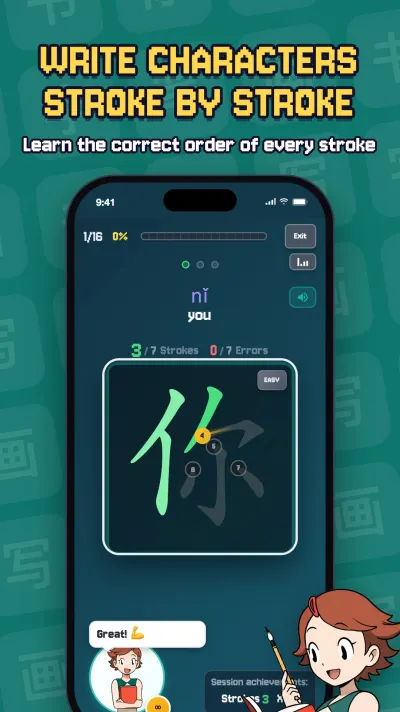
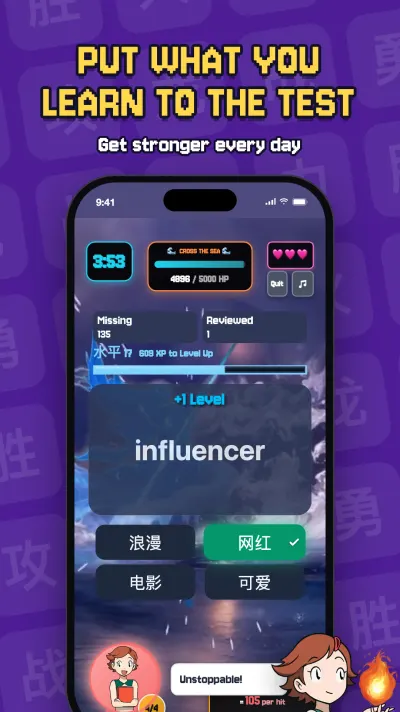
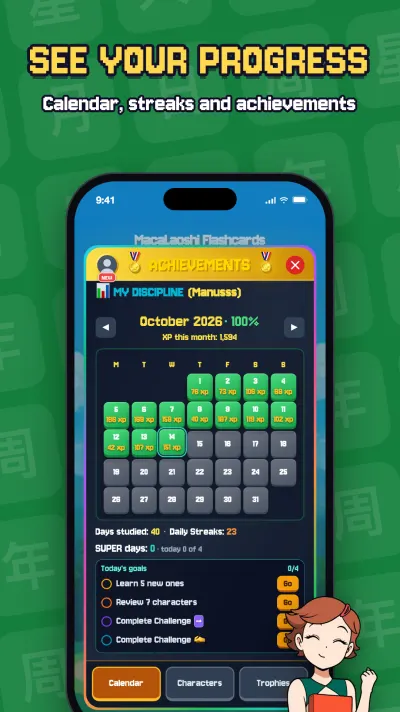
Being able to read a business card, a quotation or a sign in Chinese gives you confidence on a work trip. In Macalaoshi you learn them through challenges to save the world from the Empress with the power of Chinese characters: more than 1300 words and characters from HSK 1 to 4, bosses, stroke-by-stroke writing in the correct order and story mode with Lili. Every character you get right goes up a level and what you miss comes back for you to review. Getting started is free; to lock in the vocabulary, see how to memorize vocabulary.
Fair dates, tax rules and payment conditions change: confirm them with the official source. This guide is not tax or legal advice.
Improve your Chinese with Macalaoshi Flashcards
Maca Laoshi's app for learning characters, with audio, pinyin and stroke-by-stroke writing.
- 1,300+words and characters
- HSK 1–4by level
- Freeto start


Learn with our songs
We made them for Macalaoshi. Singing along is a fun way to practice pronunciation and review vocabulary.

The Lighthouse of My Heart 我心里灯塔

Study With You 跟你一起学
Frequently asked questions
When is the Canton Fair and how many phases does it have?
Twice a year in Guangzhou (Canton): in spring (mid-April to early May) and in autumn (mid-October to early November). Each session has three five-day phases; for reference, the 140th (autumn 2026) was scheduled for 15–19 and 23–27 October and 31 October–4 November. Dates change every year: check them on the fair's official website.
What is the difference between the Canton Fair and the CIIE in Shanghai?
The Canton Fair (China Import and Export Fair) has been held since 1957, every spring and autumn, and brings together more than 30,000 companies. The CIIE (China International Import Expo) is an international import fair held in Shanghai every autumn since 2018; for the 9th edition, on 5–10 November 2026, 4,142 overseas companies were announced.
What is a 发票 (fāpiào) and why do companies ask for it?
It is the official invoice or receipt for a sale or a service. Chinese regulations say that whoever collects payment must issue it, and that an invoice that does not meet the rules cannot be used to reimburse expenses. It also exists in electronic form, with the same legal effect as the paper one.
How do you hand over a business card in China?
With both hands, and take a moment to look at the one you are given before putting it away. Bring bilingual cards, with Chinese characters on one side and your language on the other. Exchanging contacts on WeChat is increasingly common.
Can I pay with my phone on a business trip?
Yes, with Alipay or WeChat Pay and a linked foreign card. In March 2024 the People's Bank of China announced that the mobile payment limit for foreign visitors would rise to USD 5,000 per transaction and USD 50,000 per year; for large amounts, official policy points to bank cards.
Does this guide include Taiwan, Hong Kong or Macao?
No. It covers mainland China, where the simplified characters taught by Macalaoshi are used.
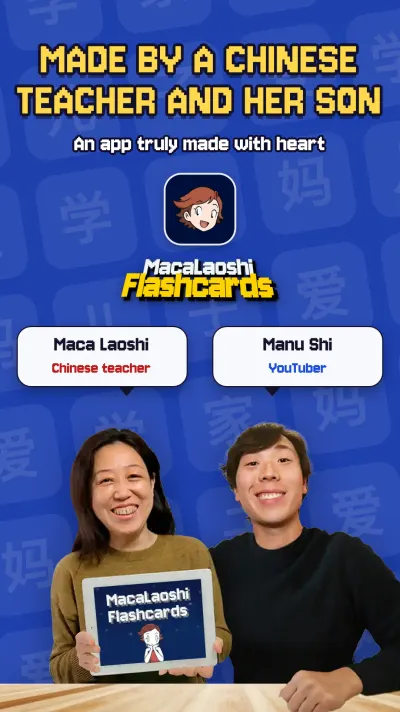
Maca Laoshi, born in Beijing, has taught Mandarin Chinese for more than 22 years and has had over 1,500 students. Together with her son Manu Shi, who has more than 93,000 subscribers on YouTube, she created Macalaoshi, an app that challenges you to push yourself one character at a time. Few Chinese teachers can show both: their own app and a channel like that.
Sources
- Canton Fair Organizing Committee, via the Ministry of Commerce (24 July 2026): 140th session, phases, 1.55 million m², more than 30,000 companies and free badges.
- Ministry of Commerce (25 February 2026): 139th session, dates of the three phases and the theme of each.
- Ministry of Commerce (22 July 2026): the fair has been held every spring and autumn since 1957; 314,000 overseas buyers at the 139th.
- Wikipedia: Canton Fair, the Pazhou venue in Haizhu District and the organisers.
- Wikivoyage: Guangzhou, fair dates, higher hotel prices, metro, language, climate and morning tea.
- CGTN (16 October 2026): 9th CIIE on 5–10 November 2026, 162 participants and 4,142 overseas companies.
- Wikipedia: CIIE, held every autumn since 2018 in Shanghai and organised by the Ministry of Commerce and the Shanghai government.
- Wikipedia: National Exhibition and Convention Center (Shanghai), in Qingpu, inside the Hongqiao hub.
- Shanghai Municipal Commission of Transportation (30 October 2025): getting to the CIIE venue by metro, Lines 2 and 17 and the Line 10 alternative.
- Wikipedia: Lujiazui, Pudong financial district developed since the early 1990s.
- Wikipedia: Shanghai Stock Exchange, re-established on 26 November 1990 and operating since 19 December.
- Wikipedia: Shanghai Tower, 632 m and the tallest building in China.
- Wikipedia: Shanghai cuisine, local (benbang) cooking and soup dumplings.
- Wikipedia: Huaqiangbei, Futian District, about 38,000 businesses in 2020 and three metro stations.
- Wikivoyage: Shenzhen, tips for Huaqiangbei, best season and train to Guangzhou.
- Wikipedia: Shenzhen, Tencent in Nanshan, Huawei, DJI and BYD.
- China Daily HK (25 August 2023): the special economic zones were approved on 26 August 1980, Shenzhen first.
- Eye Shenzhen, the city's official English portal (22 July 2024): Chaoshan beef hotpot, Hakka cuisine and Shajing oysters.
- Eye Shenzhen: Hakka cuisine and stuffed tofu.
- Xinhua via Science and Technology Daily (25 February 2025): Yiwu, largest small-commodity hub, 2.1 million products and more than 230 countries and regions.
- PR Newswire via TechNode (2 March 2026): the International Trade City reopened on 28 February with about 80,000 shops.
- China News Service (16 February 2026): more than 30,000 foreigners live in Yiwu, and the local brown sugar.
- Xinhua (15 November 2025): Yiwu brown sugar, with more than 300 years of history.
- Xinhua (23 July 2024): Yiwu–Madrid freight train, 13,052 km; the route marked its tenth anniversary in 2024.
- Yiwu Fair (26 August 2025): 31st edition on 21–24 October 2025 at the Yiwu International Expo Center.
- Wikivoyage: Yiwu, train from Hangzhou, foreign traders and restaurants.
- Wikipedia: Zhongguancun, Haidian tech hub next to Peking and Tsinghua universities.
- Beijing government (10 September 2026): CIFTIS 2026 opened on 9 September and ran through 13 September at Shougang Park.
- Wikipedia: Beijing–Shanghai high-speed railway, opened 30 June 2011, 1,318 km and 4 h 28 min.
- Wikipedia: Beijing cuisine, Peking duck and mutton hotpot.
- Visit Beijing (2013): best months for Beijing and long holidays.
- Wikipedia: Alibaba Group, founded in Hangzhou on 28 June 1999, headquartered in Yuhang.
- China Daily via the Xuchang government (10 August 2018): in March 2015 the State Council approved the first cross-border e-commerce pilot zone, in Hangzhou.
- China Daily (21 February 2022): 132 cross-border e-commerce pilot zones in 30 provinces, regions and municipalities.
- Wikivoyage: Hangzhou, train from Shanghai Hongqiao in about 50 minutes and Hangzhou East station.
- Wikipedia: Hangzhou cuisine, beggar's chicken, originally from Jiangsu and popularised in Hangzhou.
- CGTN, republished by the Hangzhou municipal government (7 January 2026): 西湖醋鱼 (Xīhú cùyú), fish in vinegar sauce, made with grass carp, sugar and vinegar.
- US Commercial Service (25 September 2025): business cards, WeChat, guanxi and office hours in China.
- Canadian Trade Commissioner Service (16 November 2021): business etiquette in China, introductions, meals, toasts and gifts.
- Tencent (12 August 2026): 1,439 million monthly active users of Weixin and WeChat at 30 June 2026.
- Hutong School: 加微信, 'add someone on WeChat'.
- State Council (published 12 November 2024, Order No. 795): from 1 January 2025, Spring Festival is 4 days off and National Day is 3 (1 to 3 October).
- State Taxation Administration: Measures for the Administration of Invoices, text revised on 20 July 2023.
- State Taxation Administration: Announcement No. 16 of 2017, taxpayer ID of a company buyer.
- China Daily (27 November 2024): fully digitalised electronic invoice, promoted nationwide from 1 December 2024.
- China Briefing (6 June 2019): what a fapiao is, special VAT invoice and ordinary invoice.
- ChinesePod, lesson "Your Receipt": the customer asks for the invoice with 请给我开发票.
- People's Bank of China, press briefing of 1 March 2024: mobile payment limits for foreigners and cash.
- Alibaba.com (Chinese supplier site): MOQ, the minimum order quantity the supplier accepts (最小订单量).
- Tencent Cloud Developer (8 September 2025): the product page on 1688, Alibaba's wholesale platform, includes the wholesale price and the 起订量 (minimum order quantity).
- CC-CEDICT (MDBG, version of 3 October 2026): pinyin and meaning of the words in the tables.
- CLEC (China): the new HSK syllabus (November 2025), basis of the HSK 1 and 2 lists in the level column.
This guide in other languages: Español · Português · Français · Deutsch · Italiano · 日本語 · 한국어