Guides › Memorizing Chinese vocabulary
How to Memorize Chinese Vocabulary (and Why Words Slip Away)

Maca Laoshi, Mandarin Chinese teacher
Updated October 25, 2026 · 7 min read
Chinese words slip away because they are learned in isolation: no sentence, no tone, no measure word. What works is learning each word inside a short sentence, with its tone and, for nouns, its measure word, leaning on the characters you already know, and reviewing what you miss. A realistic pace is 5 to 10 new words a day. This guide is about words; for single characters, see how to memorize Chinese characters.
Why you forget words
- You learn them without context. "To buy = 买" on a list does not tell you how it is used or what it combines with.
- You leave the tone for later. In Chinese the tone is part of the word. If you do not store it, the word is incomplete and hard to catch in conversation (more in the guide to the tones).
- You ignore the measure word. Chinese does not say "a book" plainly: between the number and the noun goes a measure word, and it changes with the noun.
- You only read, you do not try to recall. Seeing the answer again and again feels like knowing, but what fixes a word is the effort of recalling it before you look.
7 techniques to memorize Chinese vocabulary
1. Learn each word inside a short sentence
For every new word, write or find a sentence of four to six characters. The sentence shows the word at work and gives you something concrete to remember.
| Word | Short sentence | Pinyin | Meaning |
|---|---|---|---|
| 买 (to buy) | 他买了一本书。 | Tā mǎi le yì běn shū. | He bought a book. |
| 卖 (to sell) | 这里卖苹果。 | Zhèlǐ mài píngguǒ. | They sell apples here. |
| 学校 (school) | 我去学校。 | Wǒ qù xuéxiào. | I am going to school. |
2. Learn word families from one character
Many words are built by combining characters. Once you know one, the words that contain it get easier: you can guess part of the meaning and recognize the shape.
| Character | Word | Pinyin | Meaning |
|---|---|---|---|
| 学 (xué) | 学生 | xuésheng | student |
| 学校 | xuéxiào | school | |
| 大学 | dàxué | university | |
| 学习 | xuéxí | to study, to learn | |
| 同学 | tóngxué | classmate | |
| 留学 | liúxué | to study abroad | |
| 车 (chē) | 汽车 | qìchē | car |
| 火车 | huǒchē | train | |
| 自行车 | zìxíngchē | bicycle |
3. Learn the tone with the word, from day one
Always write word and pinyin with tone marks, and say them together. Some pairs differ only in tone: 买 mǎi is "to buy" and 卖 mài is "to sell". If you stored the word without its tone, you will have to guess which is which.
4. Learn the measure word with the noun
Between a number and a noun, Chinese puts a measure word. Store it as part of the word: "book" is not just 书, it is 一本书.
| With measure word | Pinyin | Meaning |
|---|---|---|
| 一本书 | yì běn shū | a book |
| 一杯水 | yì bēi shuǐ | a glass of water |
| 一只猫 | yì zhī māo | a cat |
| 一辆车 | yí liàng chē | a vehicle |
| 一张票 | yì zhāng piào | a ticket |
| 一个人 | yí ge rén | a person |
Here 一 ("one") is pronounced yì before 1st, 2nd and 3rd tone, and yí before 4th tone. The dictionary lists it as yī.
When in doubt, 个 (gè) is the most general measure word, but using it for everything sounds unnatural: better to learn the specific one for each noun.
5. Say them out loud
Silent reading does not train your mouth. Say the word and the whole sentence, with the tone, before moving to the next. It is the cheapest way to check that you really know it.
6. Review what you miss
You do not need to review everything equally: what you miss is what most needs to come back. Mark the words you did not recall and start the next session with them, before adding new ones.
7. Set a realistic pace
There is no magic number fixed by studies. As a rule of thumb, 5 to 10 new words a day, with review every day. Five words every day beat 70 on Sunday. Each new word adds review: if review starts to fill the whole session, slow down for a few days.
 Test your Chinese
Improve your Chinese with our app, Macalaoshi Flashcards: 1,300+ words and characters to practice like this.
See the appHow many words does each HSK level ask for?
The new HSK syllabus (November 2025) sets cumulative vocabulary per level. It is a useful way to know how far you have to go.
| Level | Cumulative words | New words at that level |
|---|---|---|
| HSK 1 | 300 | 300 |
| HSK 2 | 500 | 200 |
| HSK 3 | 1000 | 500 |
| HSK 4 | 2000 | 1000 |
| HSK 5 | 3600 | 1600 |
| HSK 6 | 5400 | 1800 |
| HSK 7 to 9 | 11,000 | 5600 |
To see the 300 words of the first level, here is the new HSK 1 list, and to work out which level suits you, which HSK level do I need. And if you want vocabulary to use right away, see the Chinese phrases for travel.
Common mistakes
- Building huge lists and never reviewing them. A list you never reopen is not learned vocabulary.
- Learning only the translation. If all you know is "买 = to buy", you cannot say "I bought a book".
- Starting with rare words. Begin with the most frequent ones (see the most frequent characters).
How Macalaoshi does it
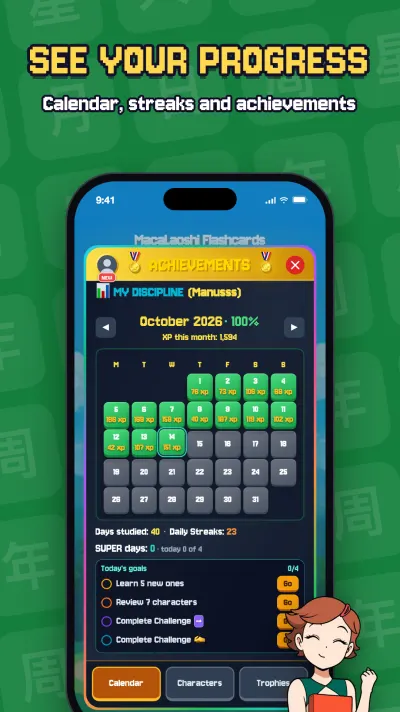
In Macalaoshi vocabulary becomes a challenge: you collect characters and words from HSK 1 to 4 (more than 1300 in all), every character you get right goes up a level, and what you miss comes back for you to review. The bosses only fall to what you truly remember, and story mode with Lili moves you forward through an adventure. You can also build your own notebooks with the vocabulary you need.
HSK figures can change. If you are preparing for the exam, confirm the current syllabus on the official site.
Improve your Chinese with Macalaoshi Flashcards
Maca Laoshi's app for learning characters, with audio, pinyin and stroke-by-stroke writing.
- 1,300+words and characters
- HSK 1–4by level
- Freeto start





Learn with our songs
We made them for Macalaoshi. Singing along is a fun way to practice pronunciation and review vocabulary.

The Lighthouse of My Heart 我心里灯塔

Study With You 跟你一起学
Frequently asked questions
How many new Chinese words should I learn per day?
No study has fixed a number. As a rule of thumb, 5 to 10 new words a day, as long as you review the earlier ones. At 10 a day, the 300 words of HSK 1 are about 30 days of new material, not counting review.
How many words does HSK 1 require?
300 words according to the new HSK syllabus, published in November 2025. Level 2 reaches 500 cumulative words and level 3 reaches 1000.
Is it better to learn single words or words inside sentences?
Inside short sentences. A sentence gives you the tone, the measure word and the context in which the word is used, exactly what a bare list loses.
Should I learn the tone together with every word?
Yes, from day one. In Chinese the tone is part of the word: mǎi (to buy) and mài (to sell) are written with different characters and mean opposite things.
How does knowing characters help me learn words?
Many words are built from characters you already know. If you know 学 (xué, to study), 学生, 学校 and 大学 become much easier.
Maca Laoshi, born in Beijing, has taught Mandarin Chinese for more than 22 years and has had over 1,500 students. Together with her son Manu Shi, who has more than 93,000 subscribers on YouTube, she created Macalaoshi, an app that challenges you to push yourself one character at a time. Few Chinese teachers can show both: their own app and a channel like that.
Sources
- CLEC (China): new HSK syllabus, November 2025; cumulative vocabulary per level (300, 500, 1000, 2000, 3600, 5400 and 11,000 for levels 7 to 9). The figures match those in our HSK level guide; we could not read the PDF as text, so they were cross-checked against secondary lists.
- MDBG dictionary (based on CC-CEDICT): meanings, pinyin and measure words for 学生, 学校, 大学, 学习, 同学, 留学, 买, 卖, 书, 杯, 猫, 车, 票 and 人.
- Wiktionary: look-ups of meanings and components of the characters cited.
This guide in other languages: Español · Português · Français · Deutsch · Italiano · 日本語 · 한국어