Guides › Natural landscapes of China
Natural landscapes of China: the most impressive ones
Maca Laoshi, Mandarin Chinese teacher
Updated October 27, 2026 · 11 min read
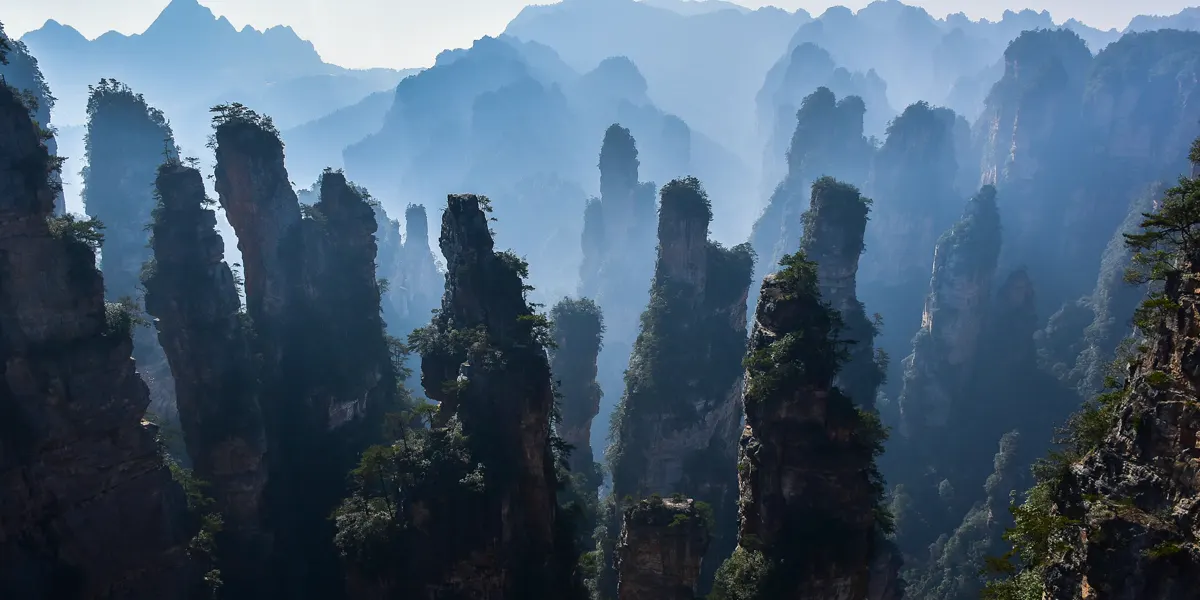
The most impressive natural landscapes of mainland China, in our selection, are Zhangjiajie, the Li River between Guilin and Yangshuo, Huangshan, Jiuzhaigou and Huanglong, Zhangye Danxia, Tiger Leaping Gorge, Jade Dragon Snow Mountain, the Longji rice terraces and Mount Emei. Spring and autumn are the most comfortable, several places are above 3,000 m, and Zhangjiajie, Huangshan, Emei and Jade Dragon Snow Mountain have cable cars.
The 9 landscapes at a glance
The stars are Macalaoshi's own rating, our editorial opinion: they are not user reviews or scores from other sites. They depend on how unique the place is, how easy it is to reach and how much you enjoy it on a first visit. The days are our own suggestion.
| Place | Where | Rating | Best for | Days | Best time |
|---|---|---|---|---|---|
| Zhangjiajie (张家界, Zhāngjiājiè) | Hunan | ★★★★★ | Rock pillars, cable cars | 2 to 3 days | Spring and autumn |
| The Li River, between Guilin and Yangshuo (漓江 / 阳朔, Lí Jiāng / Yángshuò) | Guangxi | ★★★★★ | Boats, rafts, karst | 2 to 3 days | Autumn (drier) |
| Huangshan, the Yellow Mountains (黄山, Huángshān) | Anhui | ★★★★☆ | Sunrises, hiking | 2 days | All year, depending on the weather |
| Jiuzhaigou and Huanglong (九寨沟 / 黄龙, Jiǔzhàigōu / Huánglóng) | Sichuan | ★★★★☆ | Coloured lakes | 2 to 3 days | Autumn, above all 15 to 30 October |
| Zhangye Danxia (张掖丹霞, Zhāngyè Dānxiá) | Gansu | ★★★★☆ | Photography, colours | Half a day | All year; best at dusk |
| Tiger Leaping Gorge (虎跳峡, Hǔtiàoxiá) | Yunnan | ★★★★☆ | Hiking | 2 days | March and April; avoid June to September |
| Jade Dragon Snow Mountain (玉龙雪山, Yùlóng Xuěshān) | Yunnan | ★★★★☆ | Snow, viewpoint | Half a day | Winter and spring |
| The Longji rice terraces (龙脊梯田, Lóngjǐ tītián) | Guangxi | ★★★★☆ | Rice fields, villages | 1 to 2 days | Late May (water) and autumn |
| Mount Emei and the Leshan Buddha (峨眉山, Éméi Shān) | Sichuan | ★★★★☆ | Sacred mountain, Buddhism | 1 to 2 days | Depends on the fog; snow from December to spring |
The 9 landscapes, one by one
Bookings, opening hours and entry requirements for the country change: confirm them with the official channel or your embassy before you travel. For the big picture, see our guide to what to see in China.
1. Zhangjiajie (张家界, Zhāngjiājiè)
Why go. Wulingyuan has been a UNESCO site since 1992: more than 3,000 quartz-sandstone pillars, many over 200 m. Its forest park was China's first (1982) and one mountain was renamed "Avatar Hallelujah Mountain" in 2010. On Tianmen, the "gate of heaven" is a natural arch 131.5 m high, reached by 999 steps.
Macalaoshi rating: ★★★★★ — a landscape like no other, with cable cars that save walking.
Practical tip. According to Wikivoyage, the Wulingyuan ticket is valid for four consecutive days and requires registration under your real name (facial recognition, ID or passport). Ticket validity can change, so check it when you buy. The Bailong Elevator (326 m) is paid separately and queues are shorter after 16:00. The glass bridge is in a different area, the Grand Canyon.
What to eat there: 三下锅 (sānxiàguō, spicy meat stew, the local dish); 莓茶 (méichá, berry tea)
Words you will see there
| Chinese | Pinyin | Meaning |
|---|---|---|
| 张家界 | Zhāngjiājiè | Zhangjiajie |
| 索道 | suǒdào | cable car |
| 玻璃桥 | bōlí qiáo | glass bridge |
2. The Li River, between Guilin and Yangshuo (漓江 / 阳朔, Lí Jiāng / Yángshuò)
Why go. The Li River is 164 km long and runs through karst towers of 30 to 80 m; the view on the 20 yuan note is near Xingping. Two areas of Yangshuo are part of UNESCO's South China Karst (2014 extension).
Macalaoshi rating: ★★★★★ — a classic landscape, easy to see by boat or raft.
Practical tip. The cruise from Guilin to Yangshuo takes 3.5 to 4 hours and leaves from Zhujiang Pier; in the dry winter season boats often start downriver. Avoid Yulong River bamboo rafts when the water is muddy or high. September to December is drier than May to July.
What to eat there: 桂林米粉 (Guìlín mǐfěn, Guilin rice noodles); 啤酒鱼 (píjiǔyú, fish in beer, famous in Yangshuo)
Words you will see there
| Chinese | Pinyin | Meaning |
|---|---|---|
| 漓江 | Lí Jiāng | Li River |
| 竹筏 | zhúfá | bamboo raft |
| 游船 | yóuchuán | tour boat |
3. Huangshan, the Yellow Mountains (黄山, Huángshān)
Why go. A UNESCO site since 1990 for its natural and cultural value. It has 72 named peaks; the highest, Lotus Peak, is 1,864 m. People speak of "four wonders": strange pines, odd rocks, a sea of clouds and hot springs.
Macalaoshi rating: ★★★★☆ — a postcard mountain; best with patience and a good forecast.
Practical tip. The summit is in cloud over 200 days a year and the sea of clouds often appears after rain or snow. Many people sleep on top to see the sunrise. Entry is under your real name and by time slot, on the official platform.
What to eat there: 臭鳜鱼 (chòu guìyú, fermented mandarin fish); 毛豆腐 (máodòufu, "hairy" tofu)
Words you will see there
| Chinese | Pinyin | Meaning |
|---|---|---|
| 黄山 | Huángshān | Huangshan |
| 云海 | yúnhǎi | sea of clouds |
| 日出 | rìchū | sunrise |
4. Jiuzhaigou and Huanglong (九寨沟 / 黄龙, Jiǔzhàigōu / Huánglóng)
Why go. Both have been UNESCO sites since 1992. Jiuzhaigou covers 720 km², between about 2,000 and 4,500 m, and its name refers to nine Tibetan villages; its lakes, such as Five Flower Lake, stand out for their colours. Huanglong lies about 370 km north-west of Chengdu; its Five-Colour Pond, at 3,576 m, has 693 pools.
Macalaoshi rating: ★★★★☆ — unique colours, with big crowds and altitude.
Practical tip. Jiuzhaigou caps entry at 41,000 visitors a day with time slots, and inside you use the park bus and the boardwalks. The main areas are above 3,100 m. Best in autumn, above all 15 to 30 October; in summer there is rain and many people.
What to eat there: 酥油茶 (sūyóuchá, Tibetan butter tea); 糌粑 (zānba, roasted barley flour (tsampa))
Words you will see there
| Chinese | Pinyin | Meaning |
|---|---|---|
| 九寨沟 | Jiǔzhàigōu | Jiuzhaigou |
| 观景台 | guānjǐngtái | viewpoint |
| 高原反应 | gāoyuán fǎnyìng | altitude sickness |
5. Zhangye Danxia (张掖丹霞, Zhāngyè Dānxiá)
Why go. Coloured sandstone hills in the foothills of the Qilian Mountains, in Gansu, about 30 to 40 km west of the city of Zhangye. Layers of sandstone and minerals were laid down over about 24 million years, tilted, and carved by wind and rain. It has been a UNESCO Global Geopark since 2020.
Macalaoshi rating: ★★★★☆ — colours from another planet, though very commercial.
Practical tip. You can walk only on four wooden structures, with an internal bus between the viewpoints. The colours look best at dusk on a clear day, and summer rains intensify them. Zhangye West high-speed station has trains to Lanzhou in 3 to 3.5 hours.
What to eat there: 牛肉面 (niúròu miàn, beef noodle soup, famous in Gansu (the Lanzhou kind)); 手抓羊肉 (shǒuzhuā yángròu, mutton eaten by hand)
Words you will see there
| Chinese | Pinyin | Meaning |
|---|---|---|
| 丹霞 | Dānxiá | Danxia |
| 观景台 | guānjǐngtái | viewpoint |
| 日落 | rìluò | sunset |
6. Tiger Leaping Gorge (虎跳峡, Hǔtiàoxiá)
Why go. A canyon on the Jinsha River, about 15 km long, some 60 km north of Lijiang. From the river to the peaks it is about 3,790 m, at the foot of Yulong (5,596 m) and Haba (5,396 m). It belongs to the Three Parallel Rivers of Yunnan, a UNESCO site since 2003.
Macalaoshi rating: ★★★★☆ — for those who enjoy walking among huge mountains.
Practical tip. From June to September there are rains and landslides; March and April are recommended for hiking. The trails have guesthouses with meals. From Lijiang, the bus to Qiaotou takes 2 to 2.5 hours and a passport may be asked for.
What to eat there: 过桥米线 (guòqiáo mǐxiàn, Yunnan rice-noodle soup)
Words you will see there
| Chinese | Pinyin | Meaning |
|---|---|---|
| 虎跳峡 | Hǔtiàoxiá | Tiger Leaping Gorge |
| 金沙江 | Jīnshā Jiāng | Jinsha River |
| 小心落石 | xiǎoxīn luòshí | beware: falling rocks |
7. Jade Dragon Snow Mountain (玉龙雪山, Yùlóng Xuěshān)
Why go. Its highest peak, Shanzidou, is 5,596 m and, according to Wikipedia, has been climbed only once, in 1987. It is snow-covered all year, and a cable car goes up to a viewpoint at 4,506 m. It lies next to Lijiang.
Macalaoshi rating: ★★★★☆ — snow at 4,500 m without climbing, but you need to acclimatize.
Practical tip. Go up slowly: the CDC puts the risk of altitude sickness at a sleeping altitude of about 2,450 m or more, and fitness does not protect you. Wind can stop the cable car. Lijiang is dry and sunny in winter and spring, and rainy from June to September.
What to eat there: 粑粑 (bābā, Naxi flatbread); 鸡豆凉粉 (jīdòu liángfěn, savoury chickpea-flour jelly)
Words you will see there
| Chinese | Pinyin | Meaning |
|---|---|---|
| 玉龙雪山 | Yùlóng Xuěshān | Jade Dragon Snow Mountain |
| 缆车 | lǎnchē | cable car |
| 雪 | xuě | snow |
8. The Longji rice terraces (龙脊梯田, Lóngjǐ tītián)
Why go. Rice terraces in Longsheng, about 100 km from Guilin, between 600 and 800 m above sea level, built mostly about 650 years ago. "Longji" means "dragon's backbone". Ping'an is the most popular village, with a direct road and the best viewpoints; Dazhai, quieter, has no cars.
Macalaoshi rating: ★★★★☆ — postcard rice fields, a day trip from Guilin.
Practical tip. From Guilin it is about two hours by road, with a direct bus from the train station. To see the flooded terraces, Wikivoyage recommends late May; in autumn the rice ripens and in winter it may snow.
What to eat there: 竹筒饭 (zhútǒngfàn, rice cooked in a bamboo tube)
Words you will see there
| Chinese | Pinyin | Meaning |
|---|---|---|
| 梯田 | tītián | terraced fields |
| 平安 | Píng'ān | Ping'an |
| 大寨 | Dàzhài | Dazhai |
9. Mount Emei and the Leshan Buddha (峨眉山 / 乐山大佛, Éméi Shān / Lèshān Dàfó)
Why go. Mount Emei, at 3,099 m, is one of the four sacred mountains of Chinese Buddhism. Together with the 71 m Leshan Giant Buddha, carved in the Tang dynasty, it has been a UNESCO site (cultural and natural) since 1996. The macaques along the path beg visitors for food.
Macalaoshi rating: ★★★★☆ — a sacred mountain with a cable car; the fog decides.
Practical tip. The mountain is in cloud over 330 days a year and snow lasts from December to mid-spring. Keep your food packed away: the monkeys can be aggressive. From Chengdu, Leshan is under 1 h 20 min by train and Emeishan about an hour.
What to eat there: 钵钵鸡 (bōbōjī, chicken in spicy sesame broth); 甜皮鸭 (tiánpíyā, sweet-skin duck)
Words you will see there
| Chinese | Pinyin | Meaning |
|---|---|---|
| 峨眉山 | Éméi Shān | Mount Emei |
| 金顶 | Jīndǐng | Golden Summit |
| 猴子 | hóuzi | monkey |
 Test your Chinese
Improve your Chinese with our app, Macalaoshi Flashcards: 1,300+ words and characters to practice like this.
See the appCable car or hike?
| Place | Cable car (索道) | Hiking |
|---|---|---|
| Zhangjiajie | Yes: three cable cars in the park, the Tianmen one (7,455 m) and the Bailong Elevator | Optional: boardwalks and stairs |
| Li River | No | Almost none: you go by boat or raft |
| Huangshan | Yes: Yungu, Yuping and Taiping | West route (14 km): 6 to 7 h; east route: 2 to 3 h |
| Jiuzhaigou and Huanglong | Not at Jiuzhaigou: park bus | Boardwalks; two days are advised |
| Zhangye Danxia | No: internal bus | Short boardwalks |
| Tiger Leaping Gorge | No | High trail of about 22 km, usually in two days |
| Jade Dragon | Yes, up to 4,506 m | Little |
| Longji | No | 1 to 3 h between villages |
| Emei | Yes: from Leidongping up to the Golden Summit | 50 km trail, several days |
Altitude and climate
Altitude. Lijiang is at about 2,400 m, Emei reaches 3,099 m, the main areas of Jiuzhaigou are above 3,100 m, Huanglong's Five-Colour Pond is at 3,576 m and the Jade Dragon viewpoint at 4,506 m. The CDC puts the risk of altitude sickness at a sleeping altitude of about 2,450 m or more; fitness does not protect you, so go up gradually.
Climate. Spring and autumn are the most comfortable in much of the country, because the monsoon concentrates the rain in summer. More seasonal detail in our guide to what to see in China and, for history, in historic China.
Traveller's vocabulary
Some of these words are from HSK 1 and HSK 2, the levels Macalaoshi trains, and help you understand the weather, signs and tickets. To speak, there are 50 Chinese phrases for travel, and for prices, the numbers.
| Chinese | Pinyin | Meaning | HSK level |
|---|---|---|---|
| 山 | shān | mountain | — |
| 湖 | hú | lake | — |
| 河 | hé | river | — |
| 瀑布 | pùbù | waterfall | — |
| 峡谷 | xiágǔ | canyon, gorge | — |
| 梯田 | tītián | terraced field | — |
| 索道 | suǒdào | cable car | — |
| 云海 | yúnhǎi | sea of clouds | — |
| 日出 | rìchū | sunrise | — |
| 门票 | ménpiào | entrance ticket | HSK 2 |
| 天气 | tiānqì | weather | HSK 1 |
| 下雨 | xià yǔ | to rain | HSK 1 |
| 雪 | xuě | snow | HSK 1 |
| 冷 | lěng | cold | HSK 1 |
| 累 | lèi | tired | HSK 2 |
| 小心 | xiǎoxīn | to be careful | — |
How Macalaoshi does it
Signs at parks, cable cars and stations are easier to read when you recognize the characters. In Macalaoshi you learn them through challenges to save the world from the Empress with the power of Chinese characters: more than 1300 words and characters from HSK 1 to 4, bosses, stroke-by-stroke writing in the correct order and story mode with Lili. Every character you get right goes up a level and what you miss comes back for you to review. Getting started is free.
Improve your Chinese with Macalaoshi Flashcards
Maca Laoshi's app for learning characters, with audio, pinyin and stroke-by-stroke writing.
- 1,300+words and characters
- HSK 1–4by level
- Freeto start






Learn with our songs
We made them for Macalaoshi. Singing along is a fun way to practice pronunciation and review vocabulary.

The Lighthouse of My Heart 我心里灯塔

Study With You 跟你一起学
Frequently asked questions
What are the most impressive natural landscapes in China?
Among the most visited are Zhangjiajie, the Li River at Guilin, Huangshan, Jiuzhaigou, Zhangye Danxia and the Longji rice terraces. This guide gathers nine, with season and cable-car or hiking details.
What is the best time to see China's landscapes?
It depends on the place: spring and autumn are usually the most comfortable. Jiuzhaigou shines most in October; the Longji terraces in late May, when the fields are flooded; Tiger Leaping Gorge in March and April.
Which places have a cable car?
Zhangjiajie (three cable cars in the park, plus the one on Tianmen Mountain and an elevator), Huangshan (Yungu, Yuping and Taiping), Jade Dragon Snow Mountain (up to 4,506 m) and Mount Emei (up to the Golden Summit).
Is there a risk of altitude sickness?
Yes, in several places. The CDC puts the risk at a sleeping altitude of about 2,450 m or more, and fitness does not protect you. Jiuzhaigou, Huanglong, Mount Emei and Jade Dragon Snow Mountain are above 3,000 m: go up gradually.
Do you have to book entry tickets?
In several places, yes. Huangshan asks for your real name and a time slot; Jiuzhaigou caps visitors at 41,000 a day with timed tickets; Zhangjiajie registers the visitor's name. Confirm the conditions with the official channel.
Does this guide include Taiwan, Hong Kong or Macao?
No. It covers mainland China, where the simplified characters taught by Macalaoshi are used.
Maca Laoshi, born in Beijing, has taught Mandarin Chinese for more than 22 years and has had over 1,500 students. Together with her son Manu Shi, who has more than 93,000 subscribers on YouTube, she created Macalaoshi, an app that challenges you to push yourself one character at a time. Few Chinese teachers can show both: their own app and a channel like that.
Sources
- Wikipedia: UNESCO inscription years of China's sites (UNESCO's own website blocks automated access).
- Wikipedia: Wulingyuan, UNESCO 1992, more than 3,000 pillars and the 326 m Bailong Elevator.
- Wikipedia: Zhangjiajie National Forest Park, 1982, cable cars and the glass bridge.
- Wikipedia: Tianmen Mountain, 7,455 m cable car, 131.5 m arch and 999 steps.
- Wikivoyage: Zhangjiajie, four-day ticket with name registration, Bailong Elevator and glass bridge.
- Wikipedia: Li River, 164 km, karst towers and the 20 yuan note.
- Wikipedia: South China Karst, UNESCO 2007 and the 2014 extension with Yangshuo.
- Wikivoyage: Guilin, cruise to Yangshuo of 3.5 to 4 hours and Zhujiang Pier.
- Wikivoyage: Yangshuo, Yulong River rafts, boats in winter and rainy months.
- Chinese Wikipedia: Huangshan, the "four wonders", 72 named peaks and UNESCO 1990.
- Wikivoyage: Huangshan, summit in cloud over 200 days a year, sea of clouds and cable cars.
- Guangming Daily (6 October 2026): real-name, timed entry on Huangshan's official platform.
- Wikipedia: Jiuzhaigou, UNESCO 1992, 720 km², 41,000-visitor cap and the 2024 station.
- Wikivoyage: Jiuzhaigou, access, park bus, altitude and best season.
- Wikipedia: Huanglong, UNESCO 1992, 370 km from Chengdu and the Five-Colour Pond.
- CDC, Yellow Book: risk of altitude illness from a sleeping altitude of 2,450 m and gradual ascent.
- Wikipedia: Zhangye National Geopark, sandstone hills and 322 km².
- China Daily (13 July 2020): the UNESCO Executive Board approves the Zhangye Global Geopark at its 209th session.
- China Daily (21 July 2026): the colours of Zhangye Danxia at dusk on a clear day.
- Wikivoyage: Zhangye, boardwalks, internal bus and train to Lanzhou.
- Wikipedia: Tiger Leaping Gorge, 15 km, 3,790 m of relief and the Three Parallel Rivers (UNESCO 2003).
- Wikivoyage: Tiger Leaping Gorge, high trail, rains, best season and bus from Lijiang.
- Wikipedia: Jade Dragon Snow Mountain, 5,596 m and a viewpoint at 4,506 m.
- Wikivoyage: Lijiang, altitude of 2,400 m, wind that halts the cable car and dry and rainy seasons.
- Wikipedia: Yunnan cuisine, crossing-the-bridge noodles, Naxi bread and Lijiang jelly.
- Wikipedia: Longsheng Rice Terraces, about 100 km from Guilin, built about 650 years ago.
- Wikivoyage: Longsheng, the villages of Ping'an and Dazhai, bus from Guilin and best season.
- Chinese Wikipedia: Mount Emei, 3,099 m, Golden Summit, macaques, cable car and UNESCO 1996.
- Wikipedia: Leshan Giant Buddha, 71 m, Tang dynasty and UNESCO 1996.
- Wikivoyage: Mount Emei, clouds, snow, cable car and train from Chengdu.
- Wikivoyage: Leshan, train from Chengdu and local dishes.
- CC-CEDICT (MDBG, version of 3 October 2026): pinyin and meaning of the words in the tables.
- CLEC (China): the new HSK syllabus (November 2025), basis of the HSK 1 and 2 lists behind the level column.
This guide in other languages: Español · Português · Français · Deutsch · Italiano · 日本語 · 한국어