Guides › Where to start with Chinese
Learning Chinese on your own: where do I start? The order of the first steps
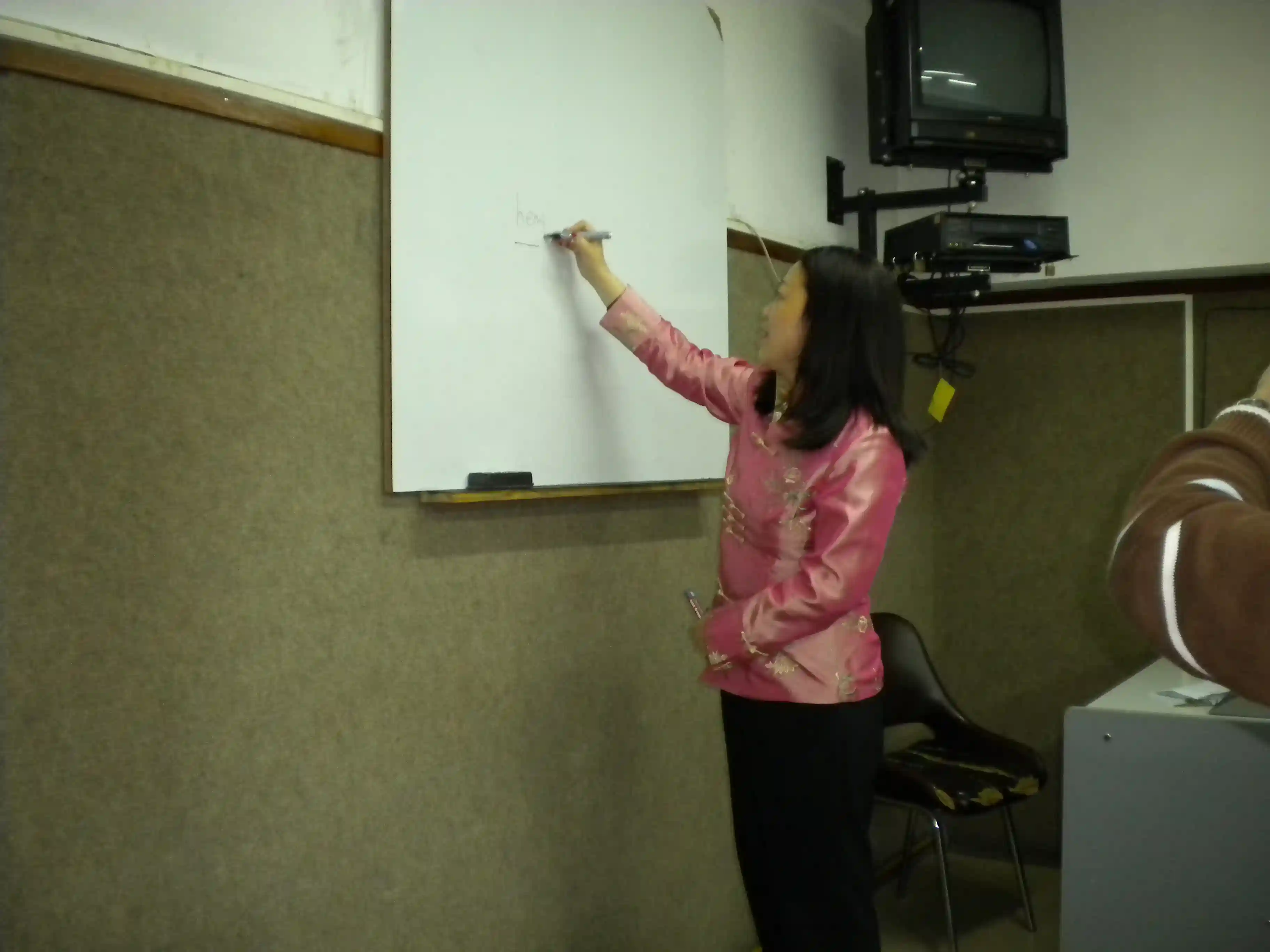
Maca Laoshi, Mandarin Chinese teacher
Updated October 25, 2026 · 7 min read

Start with pinyin and tones, because in Chinese the tone is part of the word. Then learn 100 to 300 very useful words inside short sentences, the most frequent characters, and listen to Chinese from day one. Leave complex grammar, traditional characters and handwriting everything for later. A good first goal is HSK 1.
The recommended order, in one table
This is a working order, not a law. It is meant for people studying alone who want to avoid jumping into character lists without knowing how anything sounds.
| Stage | What to learn | What it gives you |
|---|---|---|
| 1 | Pinyin and the 4 tones | You can read any word and say it understandably |
| 2 | Greetings, numbers and 100 to 300 basic words | Material for your first sentences |
| 3 | Complete short sentences | Tone, classifier and context all at once |
| 4 | The most frequent characters | You begin to read without relying only on pinyin |
| 5 | Listening to Chinese, from day one | Your ear gets used to tones and rhythm |
The stages overlap: from the second week you can mix them. For a day-by-day calendar there is the 30-day plan, and for how long it takes, how long it takes to learn Chinese.
1. Pinyin and tones come first
Pinyin writes the sounds of Chinese with Latin letters; China adopted it officially in 1958. Learning it first gives you a big advantage: you can look words up in a dictionary, type on your phone and check your own pronunciation.
Tones are what surprise people most. Standard Chinese has four main tones and a neutral tone, and tone separates words: 买 mǎi is to buy and 卖 mài is to sell. English speakers have a small head start with sounds: English already aspirates p, t and k at the start of stressed syllables, and that is exactly what separates pinyin p, t, k from b, d, g. Spend your first days on:
- reading the pinyin chart aloud, row by row;
- practicing the sounds that cause the most trouble;
- learning the 4 tones and, as soon as you can, tone pairs.
It does not have to be perfect before you move on. What matters is that you do not get used to saying words with no tone.
2. Your first 100 to 300 words
The new HSK syllabus sets 300 words for level 1, a practical reference for a first block. Pick the words you will use most: pronouns, numbers, family, food, places and the most common verbs. Learn each word with its tone and, for nouns, with its classifier. Techniques are in how to memorize Chinese vocabulary, and basic greetings in how to say hello in Chinese.
As a rule of thumb (not from a study), 5 to 10 new words a day with daily review is a pace many people can keep up.
3. Short sentences, not loose words
A single word hides information. A short sentence teaches you tone in context, the classifier and word order. An example with what you already know:
| Sentence | Pinyin | Meaning |
|---|---|---|
| 你好 | nǐ hǎo | hello |
| 谢谢 | xièxie | thank you |
| 我学中文 | wǒ xué Zhōngwén | I study Chinese |
| 我不是学生 | wǒ bú shì xuésheng | I am not a student |
The dictionary gives 你好 as nǐ hǎo, but it is said ní hǎo: with two third tones in a row, the first sounds like a second tone. And 不 (bù) becomes bú before a fourth tone, as in 不是.
Basic grammar is kind to beginners: verbs do not change with the person and carry no tense endings, and the basic order is subject, verb, object, as in English. What you will need early on are classifiers, because most countable nouns require one.
 Test your Chinese
Improve your Chinese with our app, Macalaoshi Flashcards: 1,300+ words and characters to practice like this.
See the app4. The most frequent characters
You do not have to study characters by difficulty or alphabetically: start with the ones that appear most often (see the most frequent characters). At first aim to recognize them; handwriting is a separate step. When you want to practice writing, learn the basic strokes and their order first.
5. Listen from day one
Even if you understand little, listen. Your ear needs months to separate tones and syllables, and the earlier it starts the better. Nothing fancy is needed: audio of short sentences, beginner dialogues, and songs or shows with pinyin subtitles. Also see podcasts for learning Chinese.
What can wait
- Complex grammar. Long structures, subtle particles and formal registers can wait until you have vocabulary.
- Traditional characters. If your goal is mainland China, learn simplified first and add traditional later. More in traditional vs. simplified Chinese.
- Handwriting everything. It is useful but not the first step. We explain it in whether you need to handwrite Chinese.
- Regional varieties. Start with Mandarin (what Mandarin is).
Typical mistakes when starting alone
- Skipping tones. The habit is very hard to fix later.
- Reading only pinyin forever. Pinyin helps, but if you never look at characters your reading does not grow.
- Building huge lists and never reviewing them. Fewer words, well reviewed, work better.
- Studying only in silence. Your mouth needs training too: say things out loud.
- Changing method every week. Pick a simple plan and stick to it for a month before judging it.
- Waiting to "know more" before speaking. Talking in short sentences early moves you forward faster.
Materials by stage
You do not need to buy anything special at first. These are the kinds of resources that fit each stage:
| Stage | Type of resource |
|---|---|
| Pinyin and tones | A pinyin chart with audio, this series of guides and sound-pair exercises |
| First words | An app or notebook with audio, and an HSK 1 vocabulary list (the HSK 1 list) |
| Sentences | Travel or daily-life phrases with audio (phrases for travel) |
| Characters | A frequency-ordered list and a dictionary that shows stroke order |
| Listening | Podcasts, songs and shows with subtitles (shows, songs) |
Always compare a resource with your level: if you understand almost nothing it is too high; if you understand everything it no longer teaches you.
How to tell you are making progress
A clear first goal is HSK 1. In the new syllabus it covers 300 words, and it gives you an objective yardstick without forcing you to sit the exam. Signs you are on track:
- You read a pinyin syllable and say it with the right tone almost every time.
- You recognize the words on the HSK 1 list without thinking hard.
- You understand very short sentences spoken slowly.
- You can introduce yourself, ask for something and say numbers.
To decide what to aim for next, see which HSK level you need.
How Macalaoshi does it
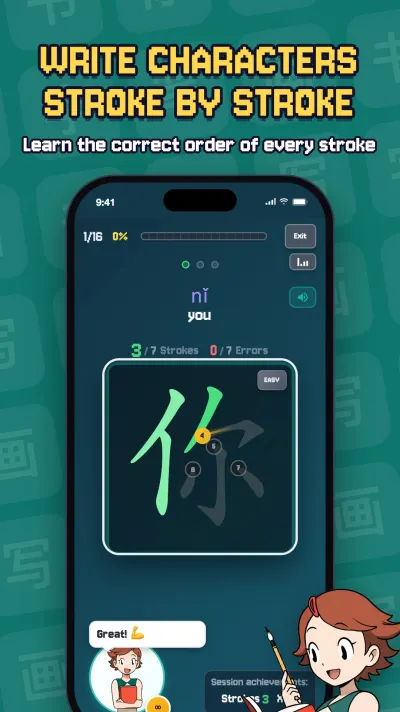
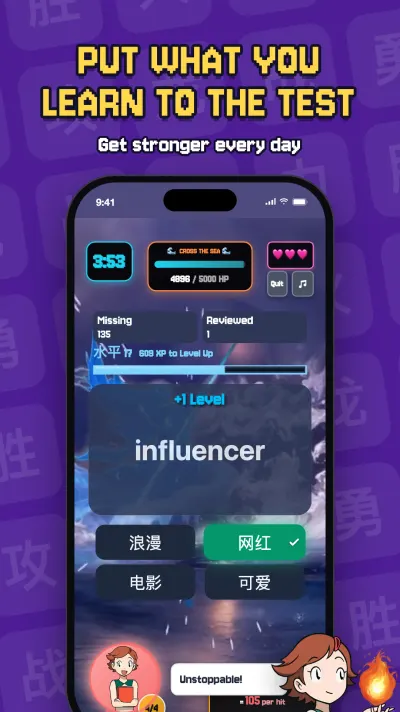
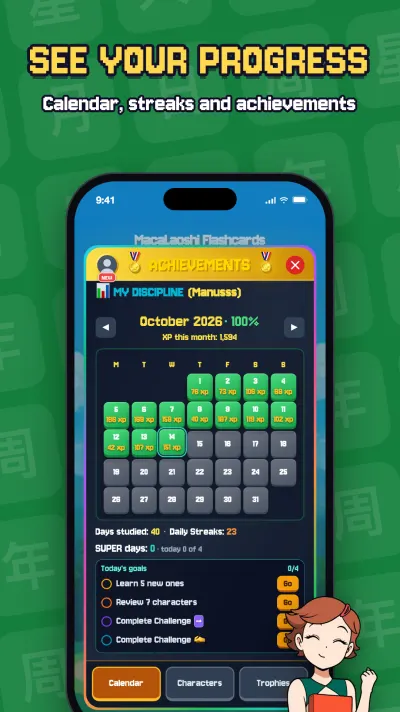
Macalaoshi puts this order inside a challenge: you collect characters and words from HSK 1 to 4 (more than 1300 in all), every character you get right goes up a level, and what you miss comes back for you to review. The bosses only fall to what you truly remember, and there is a stroke-by-stroke writing mode in the correct order and story mode with Lili. You can start for free and build your own notebooks.
HSK figures can change. If you are preparing for the exam, confirm the current syllabus on the official site.
Improve your Chinese with Macalaoshi Flashcards
Maca Laoshi's app for learning characters, with audio, pinyin and stroke-by-stroke writing.
- 1,300+words and characters
- HSK 1–4by level
- Freeto start



Learn with our songs
We made them for Macalaoshi. Singing along is a fun way to practice pronunciation and review vocabulary.

The Lighthouse of My Heart 我心里灯塔

Study With You 跟你一起学
Frequently asked questions
Where do I start if I teach myself Chinese?
With pinyin and tones: they are the doorway to the sound. Then learn the 100 to 300 most useful words in short sentences, the most frequent characters, and listen to Chinese from day one.
Do I need to learn characters from the beginning?
It helps to start recognizing them early, but you do not need to handwrite them all. Start with the most frequent ones and leave mass handwriting for later.
What can wait?
Complex grammar, traditional characters and handwriting everything. None of the three is needed for your first conversations.
How do I know I am making progress?
A reasonable first goal is HSK 1, which covers 300 words in the new syllabus. If you recognize those words and understand very simple sentences spoken slowly, you are on track.
How long should I study per day?
Research does not fix a number for beginners. As a rule of thumb, 20 minutes every day works better than two hours on Sunday. For a concrete schedule, see the 30-day plan.
Maca Laoshi, born in Beijing, has taught Mandarin Chinese for more than 22 years and has had over 1,500 students. Together with her son Manu Shi, who has more than 93,000 subscribers on YouTube, she created Macalaoshi, an app that challenges you to push yourself one character at a time. Few Chinese teachers can show both: their own app and a channel like that.
Sources
- Wikipedia: the contrast between p/t/k and b/d/g is aspiration, not voicing; Standard Chinese has four main tones plus a neutral tone.
- Wikipedia: Chinese grammar almost entirely lacks inflection, has no grammatical tense markers and basic SVO order; most countable nouns need a classifier.
- Wikipedia: pinyin was formally adopted in China on 11 February 1958 and is the dominant input method in mainland China.
- CLEC (China): new HSK syllabus (November 2025): 300 words at level 1 and a handwriting character list from level 2. We could not open the PDF as text; the figures match our other HSK guides.
- Chinese Testing International: official HSK page and sample exams.
- MDBG (CC-CEDICT): meaning and pinyin of 买, 卖, 你好, 谢谢, 学 and 不.
This guide in other languages: Español · Português · Français · Deutsch · Italiano · 日本語 · 한국어