Guides › The 100 most used characters
The 100 most used Chinese characters (with pinyin and meaning)
Maca Laoshi, Mandarin Chinese teacher
Updated October 20, 2026 · 8 min read
The 100 most frequent characters already cover 41.8% of the characters in a modern Chinese text, according to Jun Da’s frequency list (built on about 193 million characters). The top five are 的, 一, 是, 不 and 了. But beware: many are grammar words and, on their own, they are not enough to understand a text. They are best learned inside words and sentences.
The top 100, with pinyin and meaning
The table follows the order of Jun Da’s Modern Chinese Character Frequency List. When a character has several readings, the most common comes first and the other appears in brackets; the meaning shown goes with the main reading.
1 to 50
| No. | Character | Pinyin | Meaning |
|---|---|---|---|
| 1 | 的 | de (dì, dí) | possessive "'s", "of" |
| 2 | 一 | yī | one |
| 3 | 是 | shì | to be |
| 4 | 不 | bù | not |
| 5 | 了 | le (liǎo) | completed-action particle |
| 6 | 在 | zài | at, in, to be at |
| 7 | 人 | rén | person |
| 8 | 有 | yǒu | to have |
| 9 | 我 | wǒ | I, me |
| 10 | 他 | tā | he |
| 11 | 这 | zhè | this |
| 12 | 个 | gè | general measure word |
| 13 | 们 | men | plural for people |
| 14 | 中 | zhōng | middle, in |
| 15 | 来 | lái | to come |
| 16 | 上 | shàng | up, on |
| 17 | 大 | dà | big |
| 18 | 为 | wèi (wéi) | for |
| 19 | 和 | hé | and, with |
| 20 | 国 | guó | country |
| 21 | 地 | dì (de) | earth, place |
| 22 | 到 | dào | to arrive, to |
| 23 | 以 | yǐ | by means of |
| 24 | 说 | shuō | to say |
| 25 | 时 | shí | time |
| 26 | 要 | yào | to want, need |
| 27 | 就 | jiù | then, right away |
| 28 | 出 | chū | to go out |
| 29 | 会 | huì | can, will |
| 30 | 可 | kě | can, may |
| 31 | 也 | yě | also |
| 32 | 你 | nǐ | you |
| 33 | 对 | duì | correct; towards |
| 34 | 生 | shēng | to be born, life |
| 35 | 能 | néng | can, to be able |
| 36 | 而 | ér | and, yet |
| 37 | 子 | zǐ | child, son |
| 38 | 那 | nà | that |
| 39 | 得 | dé (de, děi) | to obtain |
| 40 | 于 | yú | in, at, from |
| 41 | 着 | zhe (zháo, zhuó) | continuous particle |
| 42 | 下 | xià | down, below |
| 43 | 自 | zì | self, from |
| 44 | 之 | zhī | literary "of" |
| 45 | 年 | nián | year |
| 46 | 过 | guò | to pass; experience particle |
| 47 | 发 | fā | to send out |
| 48 | 后 | hòu | after, behind |
| 49 | 作 | zuò | to do, make |
| 50 | 里 | lǐ | inside |
51 to 100
| No. | Character | Pinyin | Meaning |
|---|---|---|---|
| 51 | 用 | yòng | to use |
| 52 | 道 | dào | road, way |
| 53 | 行 | xíng (háng) | OK, to go |
| 54 | 所 | suǒ | place; particle |
| 55 | 然 | rán | so, thus |
| 56 | 家 | jiā | home, family |
| 57 | 种 | zhǒng | kind, type |
| 58 | 事 | shì | matter, thing |
| 59 | 成 | chéng | to become, succeed |
| 60 | 方 | fāng | side, direction |
| 61 | 多 | duō | many, much |
| 62 | 经 | jīng | to pass through |
| 63 | 么 | me | (in 什么, "what") |
| 64 | 去 | qù | to go |
| 65 | 法 | fǎ | law, method |
| 66 | 学 | xué | to study |
| 67 | 如 | rú | as, if |
| 68 | 都 | dōu | all, both |
| 69 | 同 | tóng | same, together |
| 70 | 现 | xiàn | present, to appear |
| 71 | 当 | dāng (dàng) | to be, when |
| 72 | 没 | méi | not have (negation of 有) |
| 73 | 动 | dòng | to move |
| 74 | 面 | miàn | face, surface; noodles |
| 75 | 起 | qǐ | to rise, begin |
| 76 | 看 | kàn | to look, see |
| 77 | 定 | dìng | to fix, decide |
| 78 | 天 | tiān | sky, day |
| 79 | 分 | fēn | to divide, minute |
| 80 | 还 | hái (huán) | still, also |
| 81 | 进 | jìn | to enter |
| 82 | 好 | hǎo (hào) | good |
| 83 | 小 | xiǎo | small |
| 84 | 部 | bù | part, department |
| 85 | 其 | qí | his/her/its (literary) |
| 86 | 些 | xiē | some, a few |
| 87 | 主 | zhǔ | main, master |
| 88 | 样 | yàng | manner, shape |
| 89 | 理 | lǐ | reason, principle |
| 90 | 心 | xīn | heart, mind |
| 91 | 她 | tā | she |
| 92 | 本 | běn | root; measure word for books |
| 93 | 前 | qián | front, before |
| 94 | 开 | kāi | to open |
| 95 | 但 | dàn | but |
| 96 | 因 | yīn | cause, because |
| 97 | 只 | zhǐ (zhī) | only |
| 98 | 从 | cóng | from |
| 99 | 想 | xiǎng | to think, want |
| 100 | 实 | shí | real, true |
Double readings worth knowing: 了 is le as a particle (吃了, “I already ate”) and liǎo in words like 了解 liǎojiě (“to understand”). 的 is de almost always, but dì in 目的 mùdì (“goal”). 地 is dì in 地方 dìfang (“place”) and de after an adjective, as in 慢慢地 mànmàn de (“slowly”). 行 is xíng (“OK”) and háng in 银行 yínháng (“bank”).
 Test your Chinese
Improve your Chinese with our app, Macalaoshi Flashcards: 1,300+ words and characters to practice like this.
See the appHow much of a text they cover
According to the same list, this is how much the first characters account for out of all the characters in the corpus:
| The first… | Cumulative share |
|---|---|
| 5 | 9.3% |
| 10 | 13.9% |
| 20 | 19.7% |
| 50 | 30.5% |
| 100 | 41.8% |
So just five characters are already almost 10%. But this is character coverage, not comprehension: the missing ones are often the ones that carry the meaning (names, topics, technical words). To see how the curve continues up to 3,000 characters, read how many characters you need to know.
Why you should not memorize them in isolation
Look at the list: 的, 了, 是, 在, 不, 也, 就, 和, 都... Many are grammar words. They are so frequent precisely because they do not name anything concrete: they mark possession, time, negation or the link between ideas. Memorizing them with a loose translation (“的 = of”) does not help, because their use depends on the sentence.
Another reason: a character is not always a word. 国 is “country”, but “China” is 中国 (two characters) and “Chinese person” is 中国人. A character without context does not tell you how it sounds inside the word or which tone it takes there (for that, see tones).
How to study them better: in words and sentences
With just these characters you can already read whole sentences. Look:
| Sentence | Pinyin | Meaning |
|---|---|---|
| 我是中国人。 | Wǒ shì Zhōngguó rén. | I am Chinese. |
| 他也想去我家。 | Tā yě xiǎng qù wǒ jiā. | He also wants to go to my home. |
| 你说得对。 | Nǐ shuō de duì. | You’re right. |
- Learn each character inside a word or short sentence, not only on its own: that way you remember the sound and the use.
- Write the strokes in order. Frequent characters are easy to practice: stroke order saves you from bad habits.
- Go back to what you miss. What you do not remember is what needs another pass: see how to memorize characters.
Where to go next
After these 100, the natural step is the words of HSK 1 and, later, the 1,000 most frequent characters, which already cover 89.1% of the characters in a modern text (more details here).
Improve your Chinese with Macalaoshi Flashcards
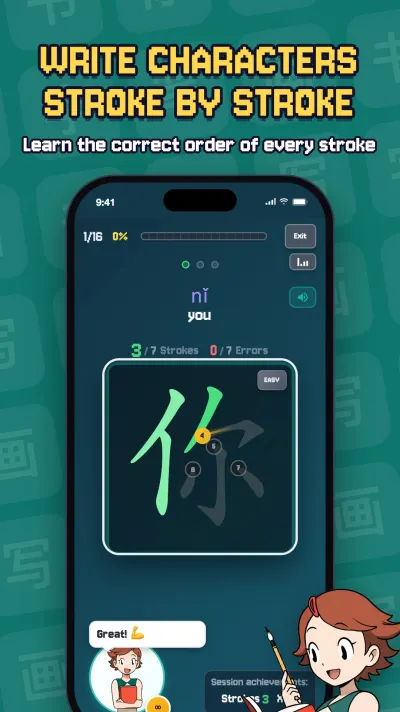
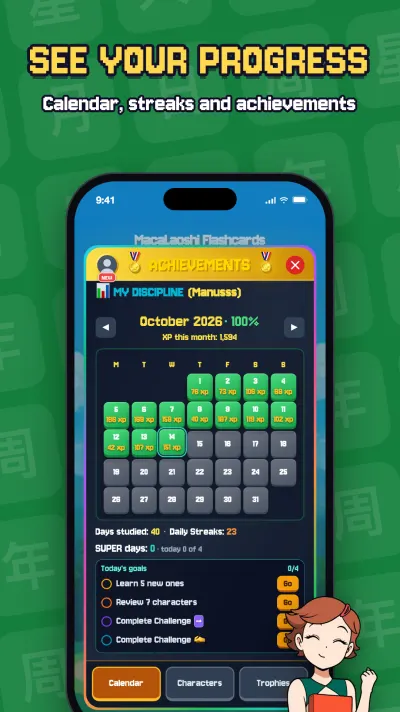
Maca Laoshi's app for learning characters, with audio, pinyin and stroke-by-stroke writing.
- 1,300+words and characters
- HSK 1–4by level
- Freeto start




Learn with our songs
We made them for Macalaoshi. Singing along is a fun way to practice pronunciation and review vocabulary.

The Lighthouse of My Heart 我心里灯塔

Study With You 跟你一起学
Frequently asked questions
What are the most used Chinese characters?
According to Jun Da’s frequency list, the first ten are 的, 一, 是, 不, 了, 在, 人, 有, 我 and 他. Those ten alone add up to 13.9% of the characters in a text.
How much of a text do the 100 most frequent characters cover?
They cover 41.8% of the characters in a modern Chinese text. Note that this does not mean understanding 41.8% of the text, because the missing characters are often the ones that carry the meaning.
How many basic Chinese characters do I need to know?
With 500 characters you cover about 75.8% of a text, with 1,000 about 89.1% and with 2,000 about 97.1%, according to the same list. HSK 1 asks for fewer; the details are in the guide on how many characters you need to know.
Why is 的 read de and sometimes dì?
Because some characters have more than one reading. 的 is de almost always (the possessive particle), but in 目的 (mùdì, “goal”) it is read dì. The same happens with 了 (le or liǎo) and 地 (dì or de).
Should I memorize the list of 100 characters?
Not as a loose list. Many are grammar words that only make sense inside a sentence. It is better to learn each character inside words and short sentences, write it with the strokes in order and review what you get wrong.
Maca Laoshi, born in Beijing, has taught Mandarin Chinese for more than 22 years and has had over 1,500 students. Together with her son Manu Shi, who has more than 93,000 subscribers on YouTube, she created Macalaoshi, an app that challenges you to push yourself one character at a time. Few Chinese teachers can show both: their own app and a channel like that.
This guide in other languages: Español · Português · Français · Deutsch · Italiano · 日本語 · 한국어