Guides › Writing Chinese by hand
Do you need to learn to write Chinese by hand? What research and the HSK say
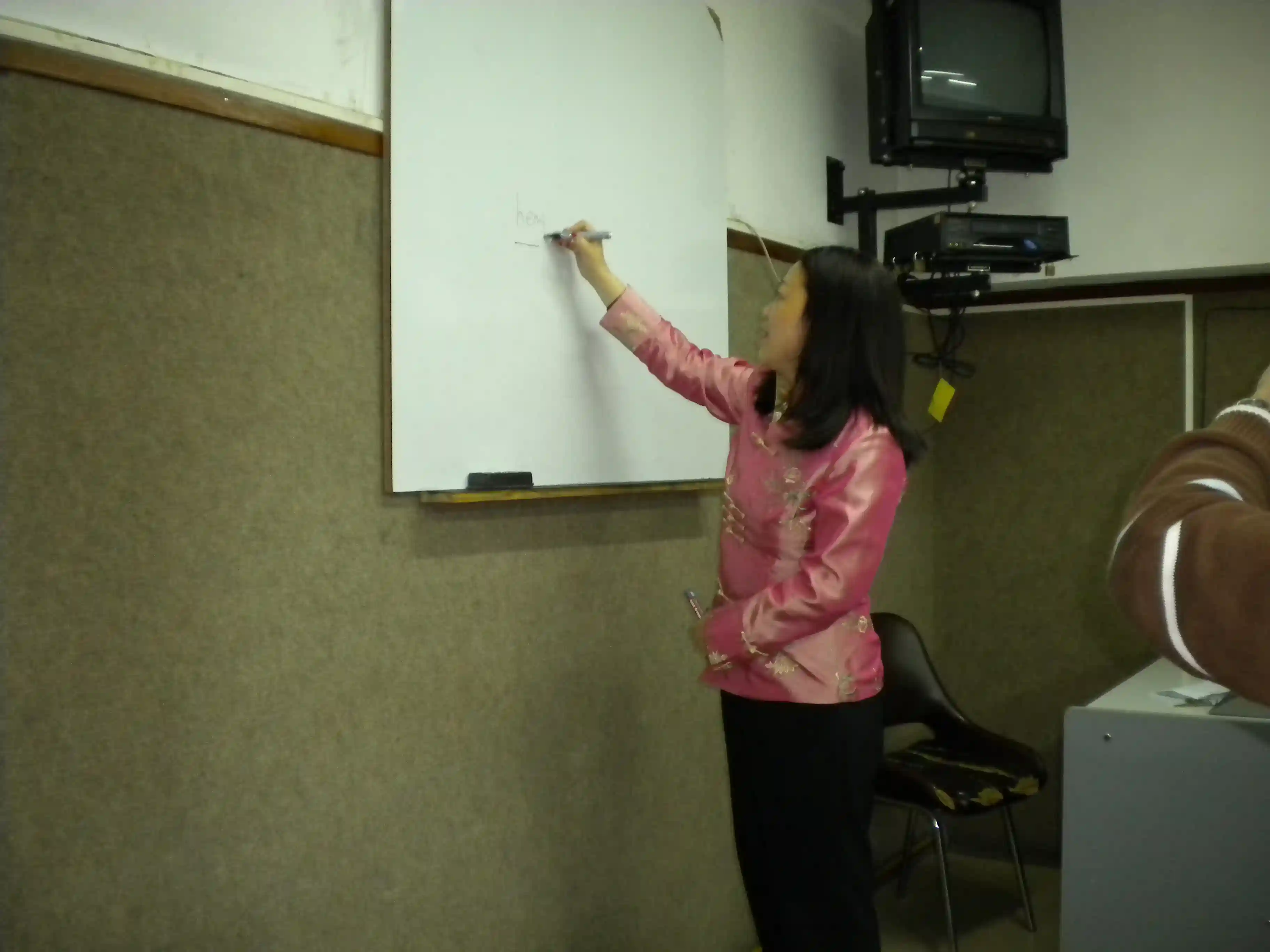
Maca Laoshi, Mandarin Chinese teacher
Updated October 20, 2026 · 7 min read
You do not need to handwrite every character, but handwriting some of them helps. Research suggests that writing strengthens recognition of a character and its meaning, while typing pinyin mostly trains the sound. A sensible rule: recognize many characters and handwrite the most frequent ones. And if you plan to sit the new HSK, handwriting appears from level 2.
Two honest positions
This is a real debate among teachers and learners of Chinese, and both sides have serious arguments.
| For handwriting | Against, or more nuanced | |
|---|---|---|
| Core idea | Writing makes you look closely at strokes and components, which helps you remember characters and tell similar ones apart. | Almost everything is typed today, and the practice time can go to reading and typing instead. |
| Who says so | Hacking Chinese argues that anyone who wants to read and write characters should learn to write them by hand, mainly because it helps you understand how characters work. | Frederick Poole (Michigan State University, 2024) calls it "a skill that is now largely obsolete" and wonders how much further he would have got spending that time on reading and digital writing. |
| Nuance | Hacking Chinese also criticizes courses that demand handwriting of everything: how far to go is up to the learner, whether 100, 1,000 or 5,000 characters. | Typing Chinese requires knowing pronunciation and telling homophones apart, so it is a skill you train too. |
What the research says
A well-known study is Guan, Liu, Chan, Ye and Perfetti (2011, Journal of Educational Psychology), with adult learners of Chinese. They found that handwriting improved word recognition and the link between a character and its meaning, but not the link between character and sound; pinyin typing strengthened that one. The authors recommend combining handwriting with pinyin typing.
We did not find a study showing that handwriting is essential for speaking or for fluent reading. The results are skill by skill: writing helps the shape of the character, typing helps the sound. That is why the best answer is "it depends on your goal."
What HSK 3.0 requires
The new HSK 3.0, whose first official exam is on 13 December 2026, tests handwriting from level 2. In the official level 2 sample exam, you must handwrite the missing character in a sentence given in pinyin. The syllabus includes a list of characters to write by hand (100 characters for levels 1 and 2 together) and a longer list for recognition only.
 Test your Chinese
Improve your Chinese with our app, Macalaoshi Flashcards: 1,300+ words and characters to practice like this.
See the appWhen handwriting is worth it, and when you can skip it
It is worth it if you will take HSK 3.0 (writing questions start at level 2), if you confuse look-alike characters, if characters will not stick when you only read them, or if you want to understand how components fit together. A few minutes a day on paper or a touchscreen goes a long way.
You can skip much of it if your goal is to follow shows, read messages, travel or chat and type on your phone. Recognition matters most there: recognizing a character in context is far easier than reproducing it from memory, and pinyin input does the rest. Even so, knowing the stroke order of common components saves time when you look characters up by drawing them in a dictionary.
Common mistakes when practicing writing
- Copying without thinking. Filling a page with the same character feels productive but does not force you to recall anything.
- Writing without knowing the meaning or sound. That is memorizing a drawing; always attach the pinyin and the meaning.
- Trying to write everything from day one. It is the fastest road to burnout. Start with a few characters and widen gradually.
- Ignoring stroke order. The correct order gives cleaner shapes and is what dictionaries and phone handwriting recognition rely on.
Practical recommendation
- Recognize many, write the frequent ones. Learn to recognize the characters that appear most often (see the most frequent Chinese characters) and handwrite at least those of your HSK level. For the kanji link with Japanese, see the kanji guide.
- Learn the basic strokes. With a few stroke-order rules, writing stops being memorizing drawings. See how Chinese strokes work.
- Write from memory, not by copying. Look at the meaning or pinyin, try to write the character, and only then compare. As a rule of thumb (not from a study), write each new character a few times over several days instead of a hundred times in a row.
- Pair it with typing. Practice typing with pinyin too, since that is what you will use day to day.
- Revisit what you miss. More ideas in how to memorize Chinese characters.
How Macalaoshi does it
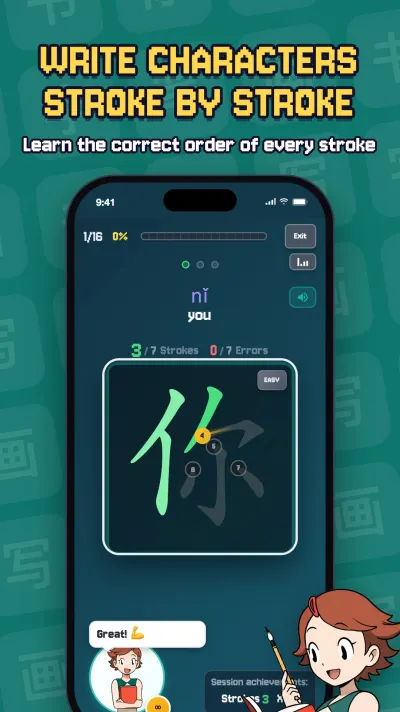
In Macalaoshi, writing mode asks you to draw each character stroke by stroke, in the correct order, as part of the challenge against the Empress: characters are her weakness. You do not need thousands of characters to start; move forward with the most useful ones and let what you miss come back for review.
HSK lists and requirements can change. If you are preparing for an exam, confirm the current syllabus on the official site.
Improve your Chinese with Macalaoshi Flashcards
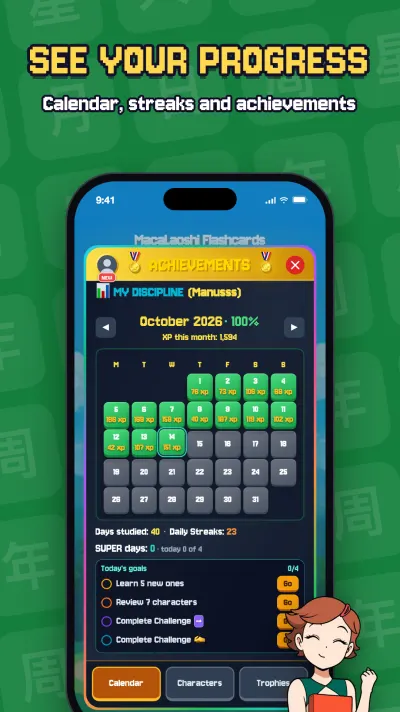
Maca Laoshi's app for learning characters, with audio, pinyin and stroke-by-stroke writing.
- 1,300+words and characters
- HSK 1–4by level
- Freeto start




Learn with our songs
We made them for Macalaoshi. Singing along is a fun way to practice pronunciation and review vocabulary.

The Lighthouse of My Heart 我心里灯塔

Study With You 跟你一起学
Frequently asked questions
Do I need to handwrite Chinese characters?
Not all of them. Many advanced learners rarely write by hand, but writing helps you remember a character and tell look-alikes apart. A sensible approach is to recognize many and write the most frequent.
Can you learn Chinese without learning to write characters?
Yes. For speaking, reading and typing with pinyin you do not need handwriting. But if you take the new HSK, there are handwriting questions from level 2.
What does research say about handwriting Chinese?
A study with adult learners (Guan et al., 2011) found that handwriting improves word recognition and the link between character and meaning, while typing pinyin strengthens the link with sound. The authors recommend combining both.
Does the HSK require handwriting?
HSK 3.0 tests handwriting from level 2. Its syllabus includes a list of 100 characters to write for levels 1 and 2 together.
How many times should I write a new character?
Research does not set a number. As a rule of thumb, a few times spread over several days, always trying to recall it before copying.
Maca Laoshi, born in Beijing, has taught Mandarin Chinese for more than 22 years and has had over 1,500 students. Together with her son Manu Shi, who has more than 93,000 subscribers on YouTube, she created Macalaoshi, an app that challenges you to push yourself one character at a time. Few Chinese teachers can show both: their own app and a channel like that.
Sources
- Hacking Chinese: is it necessary to learn to write characters by hand? A middle position: writing helps you understand characters, but not to the level many courses demand.
- Frederick Poole, Michigan State University (26 August 2024): argues the time spent on handwriting is better spent on typing, reading and digital composition.
- Guan, Liu, Chan, Ye and Perfetti (2011), Journal of Educational Psychology 103(3): handwriting strengthens word recognition and character-meaning links; typing pinyin strengthens character-sound links.
- CLEC (China): syllabus of the new HSK (November 2025), with the list of characters to write by hand.
- Chinese Testing International: official HSK 3.0 sample exams (September 2026).
This guide in other languages: Español · Português · Français · Deutsch · Italiano · 日本語 · 한국어