Guides › Pinyin pronunciation
Chinese pronunciation: the pinyin sounds English speakers find hardest
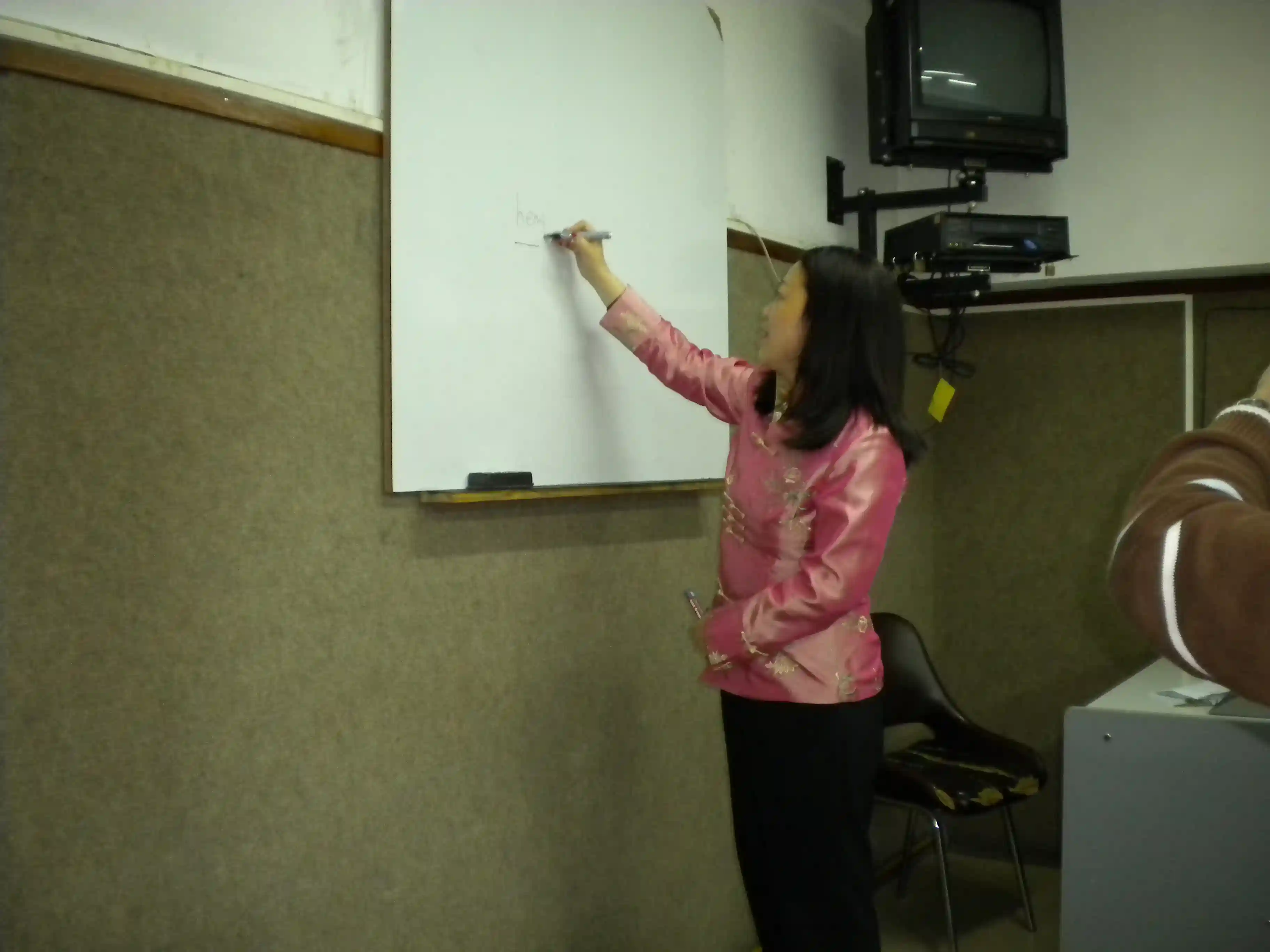
Maca Laoshi, Mandarin Chinese teacher
Updated October 20, 2026 · 9 min read

Pinyin uses the Latin alphabet, but many letters don't sound the way they do in English. The hardest parts: b, d and g differ from p, t and k by a puff of air, not by voice; x, q and c sound nothing like their English versions; and zh, ch, sh and r take the tip of the tongue back. Chinese also has vowels most English speakers don't use, like ü and the e of 饿 è, and an “i” that doesn't sound like “ee” after z, c, s, zh, ch, sh and r. With the tables in this guide you can read almost any syllable correctly; the tones are practiced separately.
Pinyin isn't read like English
Pinyin, approved in China in 1958, chose its letters for the sounds of Chinese, not English. Letters you think you know get new sounds: x isn't the x of “taxi”, q needs no u and isn't the “kw” of “queen”, and c is never a k or an s. Read each letter as a new symbol and always check with the audio.
b, p, d, t, g, k: it's all about the air
You already make this difference in English without noticing. At the start of a word, p, t and k come with a puff of air (pin, top, kill); after an s, they don't (spin, stop, skill). Mandarin uses exactly that puff to tell words apart: p, t and k have a strong puff, called aspiration; b, d and g have none, like the p, t and k that come after an s. In Chinese, the difference isn't the voice but the air.
| Pinyin | How it sounds | Example | Watch out for… |
|---|---|---|---|
| b | Like the p in “spin”: no puff of air | 爸 bà, dad | Add a puff and it turns into p |
| p | Like the p in “pin”, with a strong puff | 怕 pà, to be afraid | Without the puff, pà sounds like bà |
| d | Like the t in “stop” | 大 dà, big | Add a puff and it turns into t |
| t | Like the t in “top”, with a strong puff | 他 tā, he | Without the puff, it gets confused with d |
| g | Like the k in “skill” | 狗 gǒu, dog | Always hard, never like the g in “gem”: 哥哥 gēge |
| k | Like the k in “kill”, with a strong puff | 口 kǒu, mouth | gǒu and kǒu differ only in the air |
Try it with your hand in front of your mouth: with p, t and k you should feel the air; with b, d and g, almost nothing. And don't be surprised if you hear a softer b in the second 爸 of 爸爸 bàba: in neutral-tone syllables, b, d and g are sometimes voiced.
z, c, s: c sounds like “ts”
z is the “ts” sound of the zz in “pizza”, without a puff of air: 在 zài (to be at). c is the same “ts” with a strong puff, like the ts in “cats”: 菜 cài (dish). Careful: c is never a k or an s, and z isn't the buzzing z of “zoo”. s is the s in “say”: 三 sān (three).
zh, ch, sh, r: the tip of the tongue goes back
For these four, the tip of the tongue rises toward the area just behind your upper gums, a little further back than for s. You don't need to curl it.
| Pinyin | How it sounds | Example | Watch out for… |
|---|---|---|---|
| zh | Like the j in “jack”, or a ch with no puff, with the tongue tip back | 中国 Zhōngguó, China | It isn't z + h, and it isn't z |
| ch | Like the ch in “church”, tongue tip back, with a strong puff | 吃 chī, to eat | It isn't q: 吃 chī isn't 七 qī (seven) |
| sh | Like the sh in “shirt”, with the tongue tip back | 书 shū, book | It isn't s: 是 shì isn't 四 sì |
| r | Between the r in “reduce” and the s in “measure” | 人 rén, person | Don't round your lips as for an English r |
Some speakers make the Chinese r softer, close to an English r, but with the tongue tip back and no lip rounding. And if you hear z, c, s instead of zh, ch, sh, that's normal: many speakers from outside Beijing do it.
 Test your Chinese
Improve your Chinese with our app, Macalaoshi Flashcards: 1,300+ words and characters to practice like this.
See the appj, q, x… and h
j, q and x are made by raising the front of the tongue toward the roof of your mouth. They only ever come before i or ü, even when the ü is written u: ju, qu, xu.
| Pinyin | How it sounds | Example | Watch out for… |
|---|---|---|---|
| j | Like an English ch with no puff of air | 家 jiā, home, family | It isn't zh: here the front of the tongue does the work, not the tip |
| q | Like j, with a strong puff | 去 qù, to go | Never k or “kw”, as in “queen” |
| x | Close to English sh, with the front of the tongue raised toward the palate | 谢谢 xièxie, thank you | Never “ks” as in “taxi” or “z” as in “xylophone” |
| h | Between the h in “hat” and the ch in Scottish “loch” | 好 hǎo, good | Often raspier than an English h |
The Chinese h ranges from an English h to the ch of “loch”: if yours sounds like a soft sigh, give it a little more friction at the back of the mouth.
The tricky vowels
Chinese has a few vowels most English speakers don't use, and an i that isn't always “ee”:
| Pinyin | How it sounds | Example | Watch out for… |
|---|---|---|---|
| ü | “ee” with your lips rounded as for “oo”: the German ü or the French u | 绿 lǜ, green | 绿 lǜ (green) isn't 路 lù (road) |
| e | Close to the “uh” in “duh”, but further back and less open, with lips unrounded | 饿 è, hungry | In ie, üe and ei it's a normal e: 谢 xiè |
| i after z, c, s, zh, ch, sh, r | Not “ee”: the consonant keeps sounding, with voice | 字 zì, character | shì isn't “she”, and 四 sì (four) doesn't rhyme with 西 xī (west) |
| er | A relaxed vowel with the tongue tip back, close to the “ar” in “bar” said with the r | 二 èr, two | It's also a word ending: 花儿 huār, flower |
After j, q, x and y, ü is written without the dots, but it's still ü: 去 qù (to go), 学 xué (to study), 鱼 yú (fish). The dots are only written after n and l, because nu and lu also exist: 女 nǚ (woman) and 努 nǔ (to strive).
Finals that trick you
-n and -ng
-n is the n in “ban”, with the tip of the tongue up. -ng is the ng in “sing”: the back of the tongue touches the roof of the mouth and there's no separate g sound. They change the word: 饭 fàn (meal) and 放 fàng (to put); 新 xīn (new) and 星 xīng (star). And the a in an and ang is an open “ah”, close to the a in “father”.
ou rhymes with “so”; ao, with “cow”
ou sounds like the o in “so” (as said in North America), not like the ou in “out”: 都 dōu (all), 口 kǒu (mouth). The one that sounds like “cow” is ao: 好 hǎo (good).
ian sounds like “yen”
In ian, the a closes and sounds almost like an e, close to the English word “yen”: 天 tiān (sky, day), 钱 qián (money), 见 jiàn (to see). The same happens in yuan, juan, quan and xuan: 远 yuǎn (far). In uan (guān, huān), though, the a stays an a.
iu, ui, un hide a vowel
They're short for iou, uei and uen: 六 liù (six), 对 duì (correct), 困 kùn (sleepy). That's why duì rhymes with “way”, and kùn is closer to “kwun” (as in “won”) than to “koon”. The hidden vowel is clearest with the 3rd and 4th tones; with the 1st and 2nd, some speakers barely say it, as in 牛 niú (cow) or 春 chūn (spring).
How to practice
- Work with pairs that differ in only one sound: bà and pà, gǒu and kǒu, zài and cài, sì and shì, lù and lǜ, fàn and fàng.
- Record yourself and compare with the audio of a native speaker.
- Go through the pinyin chart row by row and compare the rows that look alike, like z, zh and j.
- Add the tones afterward, with the 4 tones and tone pairs.
Improve your Chinese with Macalaoshi Flashcards
Maca Laoshi's app for learning characters, with audio, pinyin and stroke-by-stroke writing.
- 1,300+words and characters
- HSK 1–4by level
- Freeto start






Learn with our songs
We made them for Macalaoshi. Singing along is a fun way to practice pronunciation and review vocabulary.

The Lighthouse of My Heart 我心里灯塔

Study With You 跟你一起学
Frequently asked questions
How do you pronounce x in pinyin?
Close to the English sh, with the front of the tongue raised toward the roof of the mouth. Never like the x in “taxi” or “xylophone”: 谢谢 xièxie (thank you) starts with this sound.
What's the difference between b and p in Chinese?
The air, not the voice. Chinese b is like the p in “spin”, with no puff of air; Chinese p is like the p in “pin”, with a strong puff. The same goes for d and t, g and k, z and c, zh and ch, j and q.
How do you pronounce the Chinese r?
It isn't quite the English r. The tip of the tongue goes back, as for sh, and you add voice: 人 rén (person). It falls between the r in “reduce” and the s in “measure”, and your lips don't round as they do for an English r.
How do you pronounce ü?
Say “ee” and, without moving your tongue, round your lips as if to say “oo”. It's the German ü or the French u. After j, q, x and y it's written without the dots (去 qù, 鱼 yú), but it sounds the same.
Why doesn't the i in 是 shì sound like “ee”?
Because after z, c, s, zh, ch, sh and r, the i isn't a vowel: the consonant keeps sounding, with voice. So shì isn't “she”, and 四 sì (four) and 西 xī (west) sound very different.
Maca Laoshi, born in Beijing, has taught Mandarin Chinese for more than 22 years and has had over 1,500 students. Together with her son Manu Shi, who has more than 93,000 subscribers on YouTube, she created Macalaoshi, an app that challenges you to push yourself one character at a time. Few Chinese teachers can show both: their own app and a channel like that.
Sources
- Scheme for the Chinese Phonetic Alphabet (汉语拼音方案, 1958): ü without dots and the short forms iu, ui, un.
- Lee and Zee (2003): the sounds of Beijing Mandarin in the International Phonetic Alphabet.
- San Duanmu (2005): the Chinese r (no lip rounding, unlike English) and the “i” of zi and zhi.
- Standard Chinese phonology: aspiration, retroflex consonants and vowels, compared with English sounds.
- Pinyin: how each initial and final sounds, with English examples.
- Aspirated consonant: the p of “pin” has a puff of air; the p of “spin” doesn't.
- English phonology: p, t and k are aspirated at the start of a stressed syllable and unaspirated after s.
- The letter X in English: “ks” as in “ox” and “z” at the start of a word, as in “xylophone”.
- The letter Q in English: qu usually sounds “kw”.
- Hard and soft G: in English, g can sound like the j of “gem”.
- Close front rounded vowel: the ü sound, found only in a few English accents.
- MDBG dictionary: pinyin and meaning of the examples.
This guide in other languages: Español · Português · Français · Deutsch · Italiano · 日本語 · 한국어