Guides › Chinese greetings
Everyday Chinese Greetings and Expressions, with Pinyin
Maca Laoshi, Mandarin Chinese teacher
Updated October 25, 2026 · 7 min read

The basic greeting is 你好 (nǐ hǎo), and to show respect, 您好 (nín hǎo). To say thanks, use 谢谢 (xièxie), and reply 不客气 (bú kèqi). This guide gathers in tables the greetings and everyday expressions people use most, with pinyin and when each fits. If you want phrases for a trip, see Chinese phrases for travel.
Saying hello
Three ways to start, from the most general to the most polite.
| Chinese | Pinyin | Meaning | When to use it |
|---|---|---|---|
| 你好 | nǐ hǎo | hello | Works for anyone at any time. |
| 您好 | nín hǎo | hello (polite) | For elders, customers or anyone you want to show respect to: 您 is the polite "you". |
| 大家好 | dàjiā hǎo | hello everyone | For greeting a group. |
Pinyin is given as in the dictionary. In speech, 你好 sounds like ní hǎo: when two third tones come together, the first is said as a second tone (more in the third tone).
Good morning, good night
| Chinese | Pinyin | Meaning | When to use it |
|---|---|---|---|
| 早上好 | zǎoshang hǎo | good morning | In the morning. |
| 早 | zǎo | morning! (short) | Informal, between acquaintances. |
| 早安 | zǎo'ān | good morning | A variant of 早上好. |
| 晚上好 | wǎnshang hǎo | good evening (greeting) | When you meet someone in the evening. |
| 晚安 | wǎn'ān | good night | When going to bed or saying goodbye at night. |
How are you? and "long time no see"
| Chinese | Pinyin | Meaning | When to use it |
|---|---|---|---|
| 你好吗? | nǐ hǎo ma | how are you? | Correct, but very "textbook" (see the note). |
| 最近怎么样? | zuìjìn zěnmeyàng | how have you been lately? | With friends and acquaintances you have not seen for a while. |
| 好久不见 | hǎojiǔ bú jiàn | long time no see | When you meet again. |
| 吃了吗? | chī le ma | have you eaten? | A greeting between people who know each other (see the note). |
What people really say. 你好吗 is the question most books teach, but several teaching sources point out that native speakers rarely use it and that it sounds textbook-like; among friends you hear 最近怎么样 more. Usage varies by region. 吃了吗 is not an invitation to eat: it is a greeting among neighbors, friends and coworkers, and today it is used mostly by older people. You answer with what is true, for example 吃了,你呢? (chī le, nǐ ne?, "yes, and you?"). Asking a stranger sounds odd. In 好久不见, 不 is said bú before jiàn, and 好久 sounds like háo jiǔ.
Introducing yourself and meeting people
| Chinese | Pinyin | Meaning | When to use it |
|---|---|---|---|
| 很高兴认识你 | hěn gāoxìng rènshi nǐ | nice to meet you | The first time you meet someone. |
| 幸会 | xìnghuì | pleased to meet you | More formal. |
| 久仰 | jiǔyǎng | it is an honor to finally meet you | Very formal; an honorific formula. |
| 请多关照 | qǐng duō guānzhào | please look after me | Conventional phrase when meeting. |
| 请多指教 | qǐng duō zhǐjiào | please guide me | Modest phrase when introducing yourself. |
请多关照 and 请多指教 are not translated word by word: they are courtesy formulas said when introducing yourself, playing a role similar to "pleased to meet you, I count on you". In a Japanese-Chinese dictionary they appear as equivalents of よろしくお願いします.
 Test your Chinese
Improve your Chinese with our app, Macalaoshi Flashcards: 1,300+ words and characters to practice like this.
See the appSaying thanks and replying
| Chinese | Pinyin | Meaning | When to use it |
|---|---|---|---|
| 谢谢 | xièxie | thanks, thank you | Fits almost any situation. |
| 多谢 | duōxiè | many thanks | A bit more emphatic. |
| 感谢 | gǎnxiè | to thank, to be grateful | A verb: combine it with the person you thank. |
| 不客气 | bú kèqi | you're welcome | The usual reply to 谢谢. |
| 不用谢 | bú yòng xiè | you're welcome, no need to thank | Reply to 谢谢. |
| 别客气 | bié kèqi | don't mention it, no formalities | To cut the ceremony. |
| 哪里哪里 | nǎlǐ nǎlǐ | you flatter me | Modest reply to a compliment. |
Before a fourth tone, 不 is said bú: 不客气 sounds like bú kèqi and 不用谢 like bú yòng xiè.
Apologizing and asking to pass
| Chinese | Pinyin | Meaning | When to use it |
|---|---|---|---|
| 对不起 | duìbuqǐ | I'm sorry | A serious apology. |
| 不好意思 | bù hǎoyìsi | excuse me, sorry about that | A light apology: bothering someone, asking a favor, a small mistake. |
| 没关系 | méi guānxi | it doesn't matter | Reply to an apology. |
| 没事 | méishì | it's nothing, never mind | Informal reply. |
| 劳驾 | láojià | excuse me (please) | To ask for room or a favor politely. |
| 借过 | jièguò | excuse me, let me through | To get past people. |
In short: 对不起 is the serious apology; 不好意思 is the light, everyday one; and you reply with 没关系 or 没事.
Saying goodbye
| Chinese | Pinyin | Meaning | When to use it |
|---|---|---|---|
| 再见 | zàijiàn | goodbye, see you again | The standard farewell. |
| 拜拜 | báibái | bye | Informal; from "bye-bye". |
| 明天见 | míngtiān jiàn | see you tomorrow | With someone you will see the next day. |
| 回头见 | huítóu jiàn | see you later | Informal. |
| 慢走 | màn zǒu | take care, safe trip | Said by the person staying to the one leaving. |
| 保重 | bǎozhòng | take care of yourself | For a warm goodbye. |
Congratulating, toasting and cheering on
| Chinese | Pinyin | Meaning | When to use it |
|---|---|---|---|
| 生日快乐 | shēngrì kuàilè | happy birthday | Birthdays. |
| 新年快乐 | xīnnián kuàilè | happy New Year | New Year. |
| 恭喜 | gōngxǐ | congratulations | To congratulate someone on an achievement. |
| 恭喜发财 | gōngxǐ fācái | may you prosper (New Year greeting) | Said at Chinese New Year. |
| 干杯 | gānbēi | cheers! | Literally "dry cup". |
| 加油 | jiāyóu | come on!, go for it! | To cheer someone on; literally "add oil". Often heard at sports events. |
| 我爱你 | wǒ ài nǐ | I love you | A declaration of love. |
加油 is a cheer and is heard a lot at sports events. In 干杯 the characters mean "dry cup": it is said when making a toast.
How to sound natural
- Start with 你好 and 谢谢. With those two words and a smile you handle most first contacts.
- Use 您 with people you want to respect. It is the polite form of "you" and does not change the rest of the sentence.
- Do not rely on literal translation. Phrases like 吃了吗 or 加油 have a social meaning different from their word-by-word translation.
- Mind the tones. A greeting with wrong tones can still be understood, but it shows; review the tones and the pinyin chart.
How Macalaoshi does it
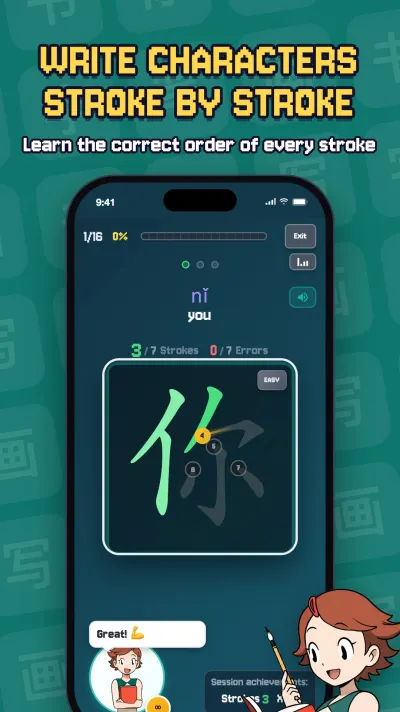
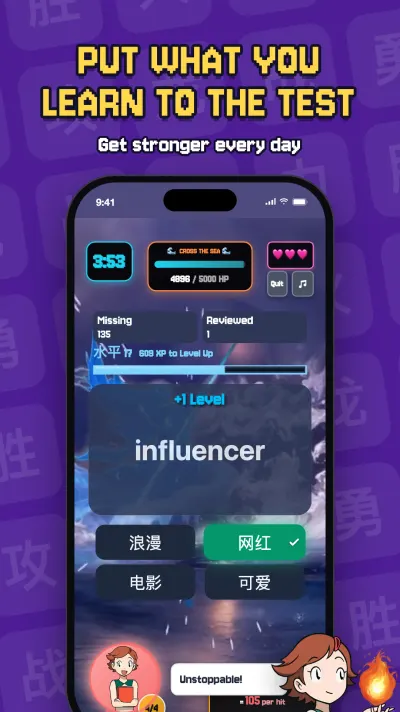
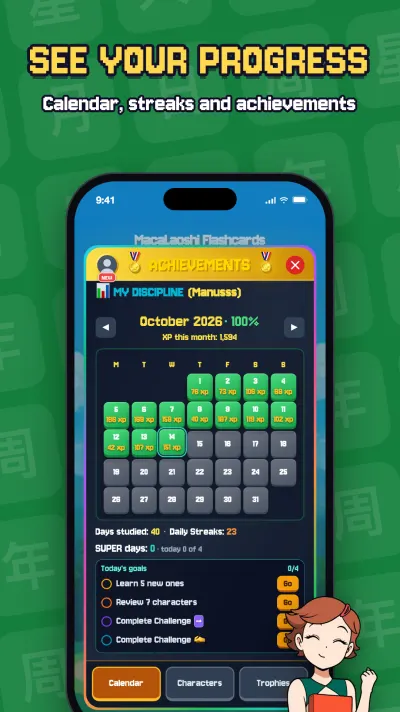
In Macalaoshi you collect characters from HSK 1 to 4 (more than 1300 words and characters in all), and every character you get right goes up a level; what you miss comes back for you to review. The most basic greetings (你好, 谢谢, 再见) are on the HSK 1 list, and you can practice writing each character stroke by stroke, in the correct order, while you move through the story with Lili against the Empress.
The pinyin in the tables follows the dictionary. Real pronunciation can vary by region and by speaker.
Improve your Chinese with Macalaoshi Flashcards
Maca Laoshi's app for learning characters, with audio, pinyin and stroke-by-stroke writing.
- 1,300+words and characters
- HSK 1–4by level
- Freeto start


Learn with our songs
We made them for Macalaoshi. Singing along is a fun way to practice pronunciation and review vocabulary.

The Lighthouse of My Heart 我心里灯塔

Study With You 跟你一起学
Frequently asked questions
How do you say "hello" in Chinese?
你好 (nǐ hǎo) works for anyone at any time. To show respect, say 您好 (nín hǎo), where 您 is the polite form of "you".
How do you reply to 谢谢 (thank you)?
The usual replies are 不客气 (bú kèqi) or 不用谢 (bú yòng xiè), both meaning "you're welcome". To answer a compliment modestly, say 哪里哪里 (nǎlǐ nǎlǐ).
Do people really say 你好吗 (how are you)?
It is a correct phrase and many textbooks teach it, but several teaching sources point out that native speakers rarely use it and prefer 你好 or 最近怎么样. Usage varies by region.
What does 加油 (jiāyóu) mean?
Literally "add oil" (or fuel). It is used to cheer someone on, for example at sports events: "come on!", "go for it!".
How do I introduce myself in Chinese?
You can say 你好,我是… (nǐ hǎo, wǒ shì…, "hello, I am…") and close with 很高兴认识你 (hěn gāoxìng rènshi nǐ), "nice to meet you". A more formal courtesy phrase is 请多关照 (qǐng duō guānzhào).
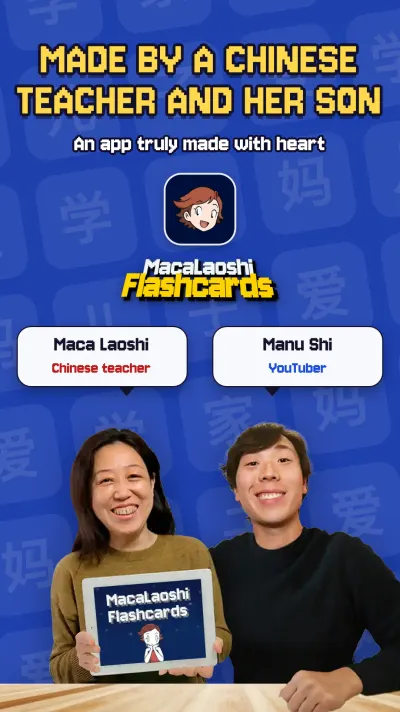
Maca Laoshi, born in Beijing, has taught Mandarin Chinese for more than 22 years and has had over 1,500 students. Together with her son Manu Shi, who has more than 93,000 subscribers on YouTube, she created Macalaoshi, an app that challenges you to push yourself one character at a time. Few Chinese teachers can show both: their own app and a channel like that.
Sources
- MDBG dictionary (based on CC-CEDICT): meaning and pinyin of every expression in the tables (for example 请多关照: "conventional greeting on first meeting"; 慢走: "to a departing guest"; 干杯: "lit. dry cup").
- Wiktionary: 加油 is used as an interjection to cheer on, mainly at sporting events; literally "add oil".
- Language Log: 吃了吗 is a greeting among neighbors, friends and coworkers; today it is used mostly by older people, and asking a stranger is odd.
- Sinosplice: 你好吗 as a "training wheels" greeting for learners; natives often use other phrases.
- New Concept Mandarin: how native speakers greet each other (最近怎么样, 吃了吗) and why 你好吗 sounds textbook-like.
- Japanese-Chinese dictionary: 请多关照 and 请多指教 as equivalents of よろしくお願いします.
This guide in other languages: Español · Português · Français · Deutsch · Italiano · 日本語 · 한국어