Guides › The third tone
The Mandarin third tone: half-third tone and tone changes
Maca Laoshi, Mandarin Chinese teacher
Updated October 20, 2026 · 8 min read

The third tone is, above all, a low tone. In full (dipping and rising again, 2 → 1 → 4), you mostly hear it when the syllable is on its own or at the end, and even there the rise is optional. Inside a sentence, before a 1st, 2nd or 4th tone and almost all neutral tones, it's said as a “half-third tone”: low and without rising, as in 老师 lǎoshī. Before another third tone, it changes to a 2nd: 你好 is said ní hǎo. If you think of it as a low tone, you'll stop confusing it with the second.
A low tone, not a rising one
In most textbooks, the third tone appears as 214: it starts low, dips a little lower and rises. That's the classic description, but many linguists describe it, above all, as a low tone. San Duanmu, of the University of Michigan, sums up the four Mandarin tones like this: high, rising, low and falling. The final rise is optional and shows up at the end of a sentence or before a pause.
A thesis at Lund University reviewed fifteen textbooks: only one presented it as a low tone. Its conclusion: teaching it that way fits real speech better and makes the rules simpler. It also cites a finding: even at the end of a sentence, educated Beijing speakers usually say it low and only add the rise for emphasis.
| Form | When | Scale | Example |
|---|---|---|---|
| Half-third tone | Before 1st, 2nd, 4th and almost all neutral tones | 2 → 1 | 老师 lǎoshī |
| Full | On its own or at the end, especially if stressed | 2 → 1 → 4 | 好 hǎo, good |
| As a 2nd tone | Before another 3rd | 3 → 5 | 你好 ní hǎo |
Creaky voice
Because it goes so low, the third tone often comes out with a slightly creaky voice. Duanmu points out that its voice quality is different from that of the other three tones, and a 2017 acoustic study showed that creaky voice goes with low pitch: the lower you say the 3rd, the creakier it gets. You don't need to imitate it; if it happens, that's normal.
The half-third tone, in words
This is the form you'll use most. The third tone stays low, and your voice rises again as the next syllable begins:
| Combination | Word | Pinyin | Meaning |
|---|---|---|---|
| 3 + 1 | 手机 | shǒujī | cell phone |
| 3 + 2 | 女儿 | nǚ'ér | daughter |
| 3 + 4 | 好看 | hǎokàn | good-looking, nice |
| 3 + neutral | 我们 | wǒmen | we, us |
Two third tones: the first one rises
As we explain in the 4 Mandarin tones, 你好 nǐ hǎo is said ní hǎo. It happens with any pair of third tones, inside a word or across two words:
- 可以 kěyǐ (can, may) is said kéyǐ.
- 水果 shuǐguǒ (fruit) is said shuíguǒ.
- 老虎 lǎohǔ (tiger) is said láohǔ.
To the ear it sounds like a second tone, although measurements find small differences. Note: the official list of the new HSK marks the changes of 不 and 一 (búyào, yíxià), but not this one (it writes nǐ hǎo, kěyǐ): you have to make the change yourself.
 Test your Chinese
Improve your Chinese with our app, Macalaoshi Flashcards: 1,300+ words and characters to practice like this.
See the appThree or more: it depends on how they group
When three third tones come together, it matters which ones belong together in meaning. The last one generally stays a third tone, and for the other two, Chinese putonghua manuals give two cases:
- Two + one: the first two become 2nd tones. 展览馆 (exhibition hall) is 展览 “exhibition” + 馆 “hall”: it's written zhǎnlǎnguǎn and said zhánlánguǎn.
- One + two: the final pair makes its change, and the first one, if you stress it, stays low. 纸老虎 (paper tiger) is 纸 “paper” + 老虎, and it's said zhǐ láohǔ. Without stress, the first one can rise too, as in 买手表 (mǎi shǒubiǎo, to buy a watch), which can sound like mái shóubiǎo.
- A very common phrase: 我很好 (wǒ hěn hǎo, I'm very well) is usually said wó hén hǎo. If you want to stress the “I”, it becomes wǒ hén hǎo.
In longer chains, the sentence breaks into chunks by meaning and rhythm, and the change happens inside each chunk. It varies from speaker to speaker, and when the structure isn't clear, the Chinese manuals themselves say not to force a rule.
Before the neutral tone
Before a neutral tone, the third tone is almost always said low: 姐姐 jiějie (older sister), 奶奶 nǎinai (grandma), 尾巴 wěiba (tail). Your voice rises on the neutral tone, which sits high after a third tone.
But there are exceptions. In 姐姐 and in 小姐 (miss, young lady), the second syllable is the same, 姐, and yet they behave differently: in 姐姐 the first one stays low, while 小姐 is said xiáojie (dictionaries write it xiǎojie or xiǎojiě). Linguists explain it through word stress, but there's no simple rule to know which words with a neutral tone make the third tone rise. The practical answer: learn them by ear, one by one.
Common mistakes
- Always making it rise. Many learners use the full 214 in the middle of a sentence. With the rise, the syllable lasts quite a bit longer than the others. Inside a sentence, take it low and move on.
- Confusing it with the 2nd. With the final rise, they sound alike. Studies with English-speaking learners, from beginners to people with more than two years of Chinese, keep finding that the 2nd and 3rd are the most confused pair.
- Copying the slow version. When someone corrects you, they usually say the word slowly, and then the third tone comes out in full, with the rise. At normal speed it's low again: ask them to repeat it at a natural pace.
How to practice it
- Find your low note. Say “ah” on the lowest note that feels comfortable, without straining. That's where the third tone lives.
- Say the words in the table above without letting the third tone rise, and then the rows that start with 3 in Mandarin tone pairs.
- Contrast it with the 2nd: 鱼 yú (fish) goes up; 雨 yǔ (rain) goes down.
- Practice the changes out loud: 你好, 可以, 水果, and then 展览馆 and 我很好.
- Record yourself at normal speed and check that the third tones in the middle don't rise.
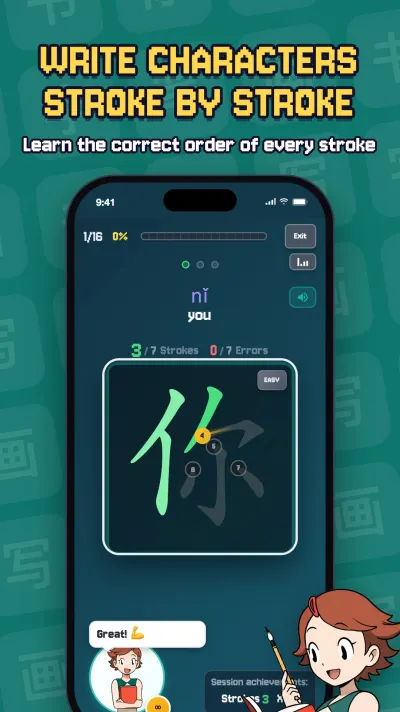
Improve your Chinese with Macalaoshi Flashcards
Maca Laoshi's app for learning characters, with audio, pinyin and stroke-by-stroke writing.
- 1,300+words and characters
- HSK 1–4by level
- Freeto start





Learn with our songs
We made them for Macalaoshi. Singing along is a fun way to practice pronunciation and review vocabulary.

The Lighthouse of My Heart 我心里灯塔

Study With You 跟你一起学
Frequently asked questions
How do you pronounce the third tone in Mandarin?
As a low tone. In full, it dips and rises again (214), but you mostly hear that when the syllable is on its own or at the end. Inside a sentence, it's said low, without rising.
What is the half-third tone?
It's the third tone without the rise at the end: just the low part (21). It's used before 1st, 2nd and 4th tones and almost all neutral tones, which means most of the time.
What happens when two third tones come together?
The first one is pronounced as a second tone: 你好 is said ní hǎo, and 可以, kéyǐ. This is called third-tone sandhi. In pinyin, it's still written with the third tone.
How do you pronounce three third tones in a row?
It depends on how they group. In 展览馆 (two + one), the first two become second tones: zhánlánguǎn. In 纸老虎 (one + two), if you stress the first one, it stays low: zhǐ láohǔ.
Why do I confuse the second and third tones?
Because if you learn the 3rd as a tone that dips and rises, it sounds like the 2nd. Think of it as a low tone: the 2nd goes up; the 3rd stays down. Studies with English-speaking learners find these two are the most confused pair.
Maca Laoshi, born in Beijing, has taught Mandarin Chinese for more than 22 years and has had over 1,500 students. Together with her son Manu Shi, who has more than 93,000 subscribers on YouTube, she created Macalaoshi, an app that challenges you to push yourself one character at a time. Few Chinese teachers can show both: their own app and a channel like that.
Sources
- San Duanmu (2005): the 3rd is a low tone, with an optional final rise; the 3+3 → 2+3 rule.
- Standard Chinese phonology: low tone, value 214, half-third tone, creaky voice and neutral tone.
- Olle Linge (2011), Lund University: the 3rd tone in fifteen textbooks and why to teach it as a low tone.
- Jianjing Kuang (2017), JASA: creaky voice goes with low pitch.
- Putonghua training material (2024, in Chinese): half-third tone, 3+3 and groups of three third tones.
- Zhang Yixin (2021), PhD thesis, University of Cambridge: the changed 3rd tone and the neutral tones that do or don't trigger the change.
- Xiaonan Susan Shen (1991): 小姐 and 姐姐 behave differently with the tone change.
- Wiktionary: pronunciation of 小姐, xiáojiě.
- Dig Mandarin: 我很好 is said wó hén hǎo.
- Zou, Caspers and Chen (2022), Frontiers in Psychology: review of studies in which English-speaking learners confuse the 2nd and 3rd tones most.
- Official syllabus of the new HSK (2025): it marks the changes of 不 and 一, not the 3+3 change.
This guide in other languages: Español · Português · Français · Deutsch · Italiano · 日本語 · 한국어