Guides › Pinyin chart
Complete pinyin chart: every syllable in Mandarin Chinese
Maca Laoshi, Mandarin Chinese teacher
Updated October 20, 2026 · 8 min read
Mandarin Chinese has about 400 syllables if you don't count tones, and about 1,300 if you do. Each syllable is made of an initial (a consonant, which can be missing), a final (the vowel, sometimes with -n or -ng) and a tone. The official pinyin scheme defines 21 initials and 35 finals, but not all of them combine with each other. Below you'll find the complete chart: 407 syllables without tones, sorted by initial.
How many syllables does Chinese have?
Very few. The linguist San Duanmu counts about 400 syllables without tone and about 1,300 with tone; English, by contrast, has around 10,000 different one-syllable words. With the consonants and vowels of Chinese you could build about 2,000 combinations, but the language uses only about 400.
On top of that, not every syllable exists with all four tones. In Duanmu's count, out of 402 syllables, 178 have all four tones, 130 have three, 59 have two and 35 have just one. With so few syllables there are lots of homophones; it helps that the average Chinese word has about two syllables, and context does the rest.
The 21 initials
The initial is the consonant at the start. The 汉语拼音方案 lists them in this order, grouped by the part of the mouth where they're made, and gives an example character for each one:
| Where they're made | Initials | Characters in the scheme |
|---|---|---|
| With the lips | b p m f | 玻 bō, 坡 pō, 摸 mō, 佛 fó |
| Tip of the tongue up | d t n l | 得 dé, 特 tè, 讷 nè, 勒 lè |
| Back of the tongue | g k h | 哥 gē, 科 kē, 喝 hē |
| Tongue against the palate | j q x | 基 jī, 欺 qī, 希 xī |
| Tip of the tongue back | zh ch sh r | 知 zhī, 蚩 chī, 诗 shī, 日 rì |
| Tongue near the teeth | z c s | 资 zī, 雌 cí, 思 sī |
Y and w aren't on the list: they aren't initials, but the way to write syllables that start with i, u or ü when there's no consonant in front (yi, wu, yu). How each initial sounds, compared with English, is in the pinyin pronunciation guide.
The 35 finals
The final is everything that comes after the initial. The 汉语拼音方案 sorts them into four columns: the basic ones and the ones that start with i, with u or with ü.
| Basic | With i | With u | With ü |
|---|---|---|---|
| — | i | u | ü |
| a | ia | ua | — |
| o | — | uo | — |
| e | ie | — | üe |
| ai | — | uai | — |
| ei | — | uei (ui) | — |
| ao | iao | — | — |
| ou | iou (iu) | — | — |
| an | ian | uan | üan |
| en | in | uen (un) | ün |
| ang | iang | uang | — |
| eng | ing | ueng | — |
| ong | iong | — | — |
On top of these 35 come three special cases: the i of zhi, chi, shi, ri, zi, ci and si, which doesn't sound like an i; er, as in 二 èr (two); and ê, which only appears in a few interjections. The finals iou, uei and uen are written iu, ui and un when there's an initial in front: 牛 niú, 归 guī, 论 lùn.
 Test your Chinese
Improve your Chinese with our app, Macalaoshi Flashcards: 1,300+ words and characters to practice like this.
See the appThe complete syllable chart
Each row is an initial, with every syllable that exists with it, without tones. The last row has the syllables with no initial, which are written with y or w when they start with i, u or ü.
| Initial | Syllables |
|---|---|
| b | ba bo bai bei bao ban ben bang beng bi bie biao bian bin bing bu |
| p | pa po pai pei pao pou pan pen pang peng pi pie piao pian pin ping pu |
| m | ma mo me mai mei mao mou man men mang meng mi mie miao miu mian min ming mu |
| f | fa fo fei fou fan fen fang feng fu |
| d | da de dai dei dao dou dan den dang deng dong di die diao diu dian ding du duo dui duan dun |
| t | ta te tai tao tou tan tang teng tong ti tie tiao tian ting tu tuo tui tuan tun |
| n | na ne nai nei nao nou nan nen nang neng nong ni nie niao niu nian nin niang ning nu nuo nuan nun nü nüe |
| l | la lo le lai lei lao lou lan lang leng long li lia lie liao liu lian lin liang ling lu luo luan lun lü lüe |
| g | ga ge gai gei gao gou gan gen gang geng gong gu gua guo guai gui guan gun guang |
| k | ka ke kai kao kou kan ken kang keng kong ku kua kuo kuai kui kuan kun kuang |
| h | ha he hai hei hao hou han hen hang heng hong hu hua huo huai hui huan hun huang |
| j | ji jia jie jiao jiu jian jin jiang jing jiong ju jue juan jun |
| q | qi qia qie qiao qiu qian qin qiang qing qiong qu que quan qun |
| x | xi xia xie xiao xiu xian xin xiang xing xiong xu xue xuan xun |
| zh | zhi zha zhe zhai zhao zhou zhan zhen zhang zheng zhong zhu zhua zhuo zhuai zhui zhuan zhun zhuang |
| ch | chi cha che chai chao chou chan chen chang cheng chong chu chua chuo chuai chui chuan chun chuang |
| sh | shi sha she shai shei shao shou shan shen shang sheng shu shua shuo shuai shui shuan shun shuang |
| r | ri re rao rou ran ren rang reng rong ru ruo rui ruan run |
| z | zi za ze zai zei zao zou zan zen zang zeng zong zu zuo zui zuan zun |
| c | ci ca ce cai cao cou can cen cang ceng cong cu cuo cui cuan cun |
| s | si sa se sai sao sou san sen sang seng song su suo sui suan sun |
| No initial | a o e ai ei ao ou an en ang eng er yi ya yo ye yao you yan yin yang ying yong wu wa wo wai wei wan wen wang weng yu yue yuan yun |
We built the list from Wikipedia's “Pinyin table” and checked it against the CC-CEDICT dictionary and the list on Chinese Wikipedia: all 407 syllables appear in all three. We included lia (from 俩 liǎ, “two, both”), which Wikipedia marks as nonstandard but which is very common in speech. Left out: consonant-only interjections (m, n, ng, hm, hng), ê, regional or slang syllables (like biang or duang) and the ones ending in -r, like 花儿 huār. Some syllables in the chart are extremely rare, like eng, nun or chua: they appear in only one or two uncommon characters.
Spelling rules worth knowing
- Y and w at the start. If the syllable has no initial, i is written yi or y; u, wu or w; and ü, yu: 衣 yī, 烟 yān, 乌 wū, 弯 wān, 迂 yū, 冤 yuān.
- ü without dots. After j, q, x and y it's written u, but pronounced ü: ju, qu, xu, yu. After n and l the dots stay, because nu and lu also exist: 女 nǚ, 吕 lǚ. On a keyboard, that ü is typed with v: nv, lv.
- Short forms. iou, uei and uen are written iu, ui and un after an initial: liù, guì, lùn. With no initial, they're written in full: you, wei, wen.
- The apostrophe. If a syllable starting with a, o or e follows another one and the boundary could be unclear, they're separated with an apostrophe: 西安 Xī'ān (two syllables) isn't xian (one).
- The tone mark goes on the main vowel: if there's an a or an e, on that; in ou, on the o; otherwise, on the last vowel (liù, guì). On an i, the mark replaces the dot: nǐ. The neutral tone isn't marked. We explain it in the 4 Mandarin tones.
How to use the chart
- Read it out loud row by row and compare yourself with audio: each row repeats the same consonant with different finals, which trains your mouth.
- Compare the rows that get mixed up most: z, zh and j; c, ch and q; s, sh and x.
- Use it to spell correctly. If a syllable isn't there, it's probably misspelled: there's no “xü” (it's written xu) and no “fong” (it's feng).
- Don't memorize it. Syllables stick inside words you hear and repeat with their tone. For that, practice with tone pairs.
Improve your Chinese with Macalaoshi Flashcards
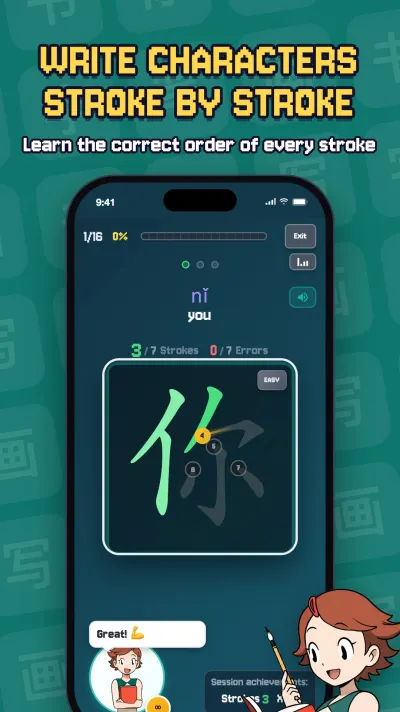
Maca Laoshi's app for learning characters, with audio, pinyin and stroke-by-stroke writing.
- 1,300+words and characters
- HSK 1–4by level
- Freeto start





Learn with our songs
We made them for Macalaoshi. Singing along is a fun way to practice pronunciation and review vocabulary.

The Lighthouse of My Heart 我心里灯塔

Study With You 跟你一起学
Frequently asked questions
How many syllables are there in Mandarin Chinese?
About 400 if you don't count tones, and about 1,300 if you do. Not every syllable exists with all four tones.
How many initials and finals does pinyin have?
The official scheme, the 汉语拼音方案, lists 21 initials and 35 finals in its tables, plus three special cases: the i of zhi or zi, er and ê. Y and w aren't initials: they're used to write syllables that start with i, u or ü.
Why is it written ju and not jü?
Because u never comes after j, q and x, so the dots aren't needed. It's written ju, qu, xu and yu, but pronounced ü. After n and l, the dots are written: nü, lü.
How do you type ü on a keyboard?
With the v key. The Chinese keyboard standard uses V for the ü that keeps its dots: lü is typed lv and nü is typed nv.
Do I need to memorize the pinyin chart?
No. It's a map for reading and writing correctly. Syllables stick better inside words you hear and repeat with their tone.
Maca Laoshi, born in Beijing, has taught Mandarin Chinese for more than 22 years and has had over 1,500 students. Together with her son Manu Shi, who has more than 93,000 subscribers on YouTube, she created Macalaoshi, an app that challenges you to push yourself one character at a time. Few Chinese teachers can show both: their own app and a channel like that.
Sources
- Scheme for the Chinese Phonetic Alphabet (汉语拼音方案, 1958): tables of initials and finals, and spelling rules (y, w, ü, iu, ui, un, apostrophe).
- Official pinyin orthography rules (GB/T 16159-2012): where the tone mark goes.
- Standard GF 3006-2001: ü is typed with the V key.
- San Duanmu (2005): about 400 syllables without tone and about 1,300 with tone, and how many tones each syllable has.
- Pinyin table (Wikipedia): the complete list of pinyin syllables, the basis for the chart in this guide.
- List of pinyin syllables (Chinese Wikipedia), used for comparison.
- CC-CEDICT dictionary (MDBG): syllables found in the dictionary and pinyin of the examples.
- Standard Chinese phonology: about 35 finals and an average word length of two syllables.
This guide in other languages: Español · Português · Français · Deutsch · Italiano · 日本語 · 한국어