Guides › Is Chinese hard to learn?
Is Chinese hard to learn for English speakers?
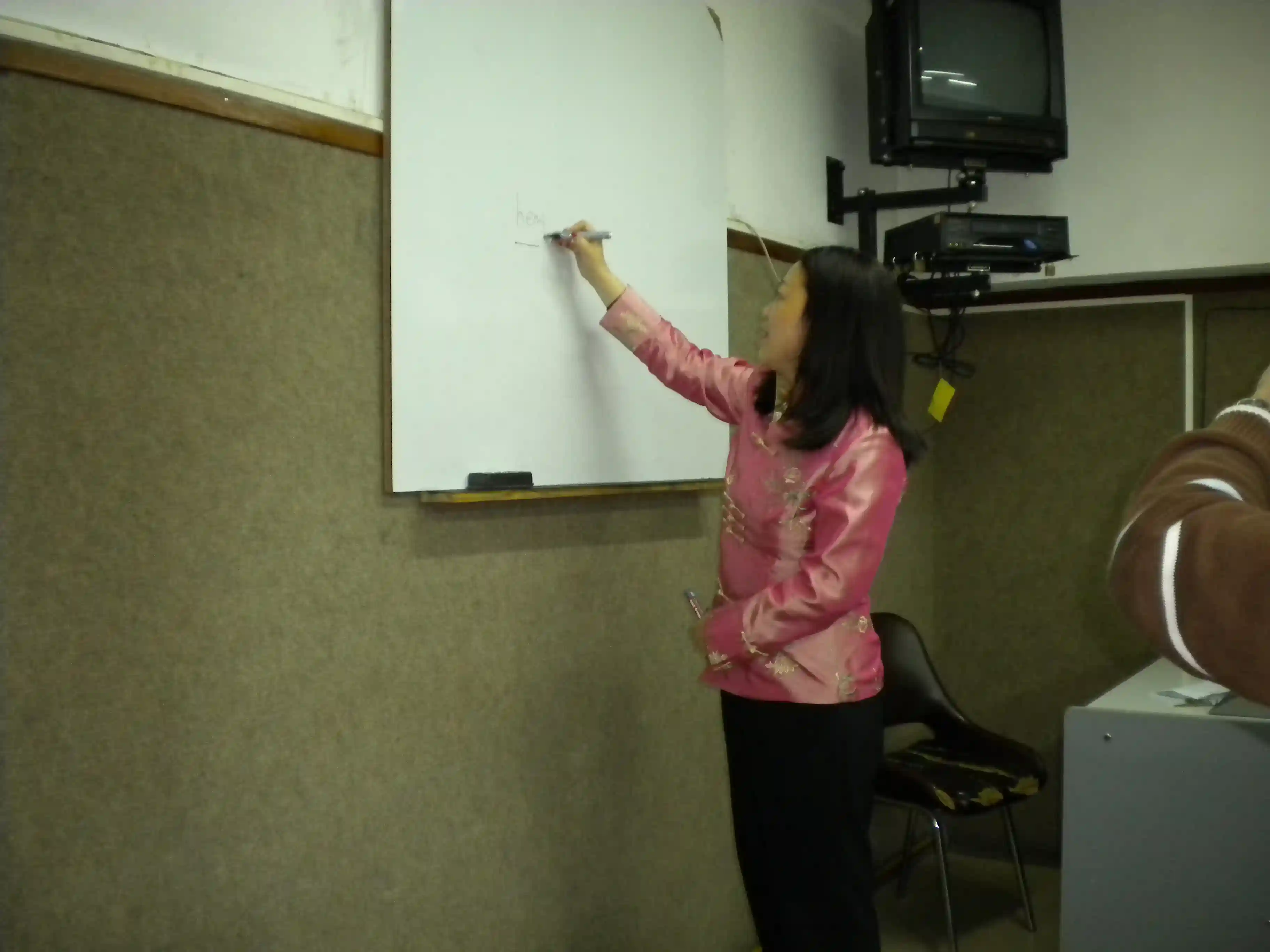
Maca Laoshi, Mandarin Chinese teacher
Updated October 14, 2026 · 7 min read
Learning Chinese takes longer than learning Spanish, French or Italian, but it's not impossible, and some parts are easier than they look. The hard parts are the characters and the tones. The easy part is the grammar: verbs don't conjugate, there are no articles and plurals barely exist. With 15 minutes a day, in a few weeks you can say hello, introduce yourself and read your first characters.
What really is hard
1. The characters
Chinese has no alphabet: every word is written with characters, and each character has to be learned. This is the part that takes the most time. There are two pieces of good news: you don't need thousands to get started (2,500 cover almost all of a typical text, as we explain in how many Chinese characters you need), and most of them are built from pieces that repeat, as we show in how to memorize Chinese characters.
2. The tones
Mandarin has four tones plus a neutral tone. In English, intonation changes the sense of a sentence (a question or a statement); in Chinese, the tone changes the word itself:
| Character | Pinyin | Tone | Meaning |
|---|---|---|---|
| 妈 | mā | 1st, high and level | mom |
| 麻 | má | 2nd, rising | hemp |
| 马 | mǎ | 3rd, low (and sometimes rising) | horse |
| 骂 | mà | 4th, sharply falling | to scold |
At first it's hard to hear the difference. You learn it by listening a lot and repeating whole words and sentences, not isolated syllables.
3. Sounds that don't exist in English
Some sounds are new: zh, ch, sh and r are said with the tip of the tongue curled back; j, q and x, with the tip of the tongue resting behind the lower teeth; and ü doesn't exist in English (it's like the German ü or the French u). The pinyin h is also rougher than the English h, closer to the “ch” in Scottish “loch”. On top of that, b and p (and d and t, g and k) are not a voiced and voiceless pair: the only difference is a puff of air. 爸 (bà, dad) is said without a puff and 怕 (pà, to be afraid) with one.
4. Almost no familiar words
In Spanish or French you recognize lots of words from day one. In Chinese, almost none, apart from a few loanwords like 咖啡 (kāfēi, coffee), 沙发 (shāfā, sofa) or 巧克力 (qiǎokèlì, chocolate). You learn all the vocabulary from scratch.
What's easier than it looks
1. Verbs don't conjugate
Forget “I am, you are, he is”: in Chinese the verb never changes.
| Chinese | Pinyin | English |
|---|---|---|
| 我是 | wǒ shì | I am |
| 你是 | nǐ shì | you are |
| 他们是 | tāmen shì | they are |
To talk about the past or the future, you add a word like 昨天 (zuótiān, yesterday) or 明天 (míngtiān, tomorrow), or the particle 了 to show that something is done. There are no irregular verbs.
2. No articles and no gender
朋友 (péngyou) means “friend”, with no “a” or “the” in front. And unlike French or Spanish, nouns have no gender, so adjectives never change to agree with them. Even “he” and “she” sound the same when spoken: 他 and 她 are both pronounced tā.
3. Plurals barely exist
一本书 (yì běn shū) is “a book” and 三本书 (sān běn shū) is “three books”: the word 书 doesn't change. What's new is the word in the middle, 本, a measure word that goes between the number and the thing. For people you use 们: 我们 (wǒmen, we).
4. Word order is like English
Subject, verb, object, just as in English: 我喝咖啡 (wǒ hē kāfēi) is “I drink coffee”.
5. English speakers have one head start (and one trap)
The puff of air that separates pinyin p from b is something you already make: say “pin” and then “spin” with your hand in front of your mouth, and you'll feel air only on the first. Pinyin p, t and k sound like the English ones in “pin”, “top” and “kit”; b, d and g are close to the p, t and k in “spin”, “stop” and “skit”. The trap is pinyin spelling: q is close to the “ch” in “cheese”, x is close to “sh”, c sounds like the “ts” in “cats”, and the vowels a, i and u are closer to Spanish or Italian vowels than to English ones.
Is it harder than Japanese or Korean?
It depends on what you find hardest. Japanese uses three writing systems (hiragana, katakana and kanji), many kanji have several readings and verbs change with different levels of politeness, but it has no tones like Mandarin's. Korean has an alphabet, hangul, that you can learn to read in a few days, but its grammar has more endings and levels of politeness. Chinese has a single writing system and simple grammar, but adds the tones.
The US Foreign Service Institute, which trains American diplomats, puts Mandarin, Japanese and Korean in the same group: the hardest languages for English speakers, at about 88 weeks (2,200 class hours) to reach a professional level. By comparison, it gives Spanish 30 weeks.
That figure is for speaking and reading at a professional level, with intensive classes every day. To travel, introduce yourself and have simple conversations, you need much less.
How to make it easier
- First weeks: pinyin and tones. Good pronunciation from the start saves you from fixing bad habits later.
- Learn characters by their parts. Pieces that repeat make each new character easier.
- A little every day. 15 minutes a day gets you further than two hours on the weekend.
- Listen a lot. Videos, songs and shows with subtitles train your ear for the tones.
- Track your progress. Seeing how many characters you've already mastered is what keeps you going.

Practice with Macalaoshi
To keep Chinese from feeling like an uphill climb, we made an app that turns your daily study into a game:
- Collect 1,300+ characters from HSK 1 to HSK 4, with pinyin, meaning and audio.
- Every character levels up when you get it right, so you see what you've mastered and what to review.
- Writing mode: learn to write them stroke by stroke, in the correct stroke order.
- Challenges and bosses you can only beat with your vocabulary, so reviewing feels like a game.
- A short plan for every day. It's free to start.


Frequently asked questions
Is Chinese harder than Spanish for English speakers?
Yes. Spanish uses the same alphabet and shares many words with English; Chinese has characters, tones and almost no familiar words. The US Foreign Service Institute estimates about 88 weeks of training for Mandarin and 30 for Spanish. In exchange, Chinese grammar is simpler: no conjugations and no irregular verbs.
Which is harder in Chinese, speaking or reading?
For most people, reading and writing take longer because of the characters. Speaking about basic topics comes sooner, as long as you practice the tones from the start.
Can adults learn the tones?
Yes. It's hard at first because in English pitch doesn't change what a word means, but with daily listening and repetition you can learn them. The key is to practice them in words and sentences, not just in isolated syllables.
Are Mandarin and Cantonese the same?
No. They share much of their writing, but they're pronounced very differently, and speakers of one can't understand the other in speech. Mandarin is China's official common language and the most widely used in Taiwan; Cantonese is spoken mainly in Guangdong province, Hong Kong and Macau.
Can I learn Chinese on my own?
To get started, yes: with an app, videos and some consistency you can learn pinyin, tones, vocabulary and your first characters. To hold fluent conversations, at some point you need to practice with people.
Maca Laoshi has taught Mandarin Chinese for more than 22 years and has had over 1,500 students. Together with her son Manu Shi, who has more than 90,000 subscribers on YouTube, she created Macalaoshi, the app for learning Chinese by playing.
Sources
This guide in other languages: Español · Português · Français · Deutsch · Italiano · 日本語 · 한국어