Guides › Tone pairs
Mandarin tone pairs: the 20 combinations to practice
Maca Laoshi, Mandarin Chinese teacher
Updated October 20, 2026 · 7 min read
The 20 tone combinations are the 16 pairs of two tones (from 1+1 to 4+4) plus each tone followed by a neutral tone. You practice them with two-syllable words because tones change shape depending on their neighbor, and because the hard part isn't saying one tone on its own but linking them. The pair learners mix up most is the 2nd and the 3rd. A routine that works: one row of the table a day, recording yourself and comparing, and minimal pairs like 买 mǎi (to buy) and 卖 mài (to sell).
Why practice in pairs
If you already know the four tones (if not, start with the 4 Mandarin tones), you can probably say mā, má, mǎ and mà without trouble. The trouble starts when you speak, and there's a reason:
- A tone on its own is stable; in context, it changes. The linguist Yi Xu measured the voice in sequences of two tones and found that each tone varies depending on its neighbors.
- The tone before matters most. The start of a tone adjusts to the end of the previous one. For example, after a 4th tone, which ends low, the next tone starts lower.
You can't train that with isolated syllables: you train it with words. And since every sentence is a chain of these pairs, the 20 combinations are the foundation for everything else.
The 20 combinations, with a word for each
All these words are level 1 of the new HSK, so they double as vocabulary:
| Combination | Word | Pinyin | Meaning |
|---|---|---|---|
| 1 + 1 | 今天 | jīntiān | today |
| 1 + 2 | 中国 | Zhōngguó | China |
| 1 + 3 | 中午 | zhōngwǔ | noon |
| 1 + 4 | 工作 | gōngzuò | work, to work |
| 1 + neutral | 妈妈 | māma | mom |
| 2 + 1 | 明天 | míngtiān | tomorrow |
| 2 + 2 | 学习 | xuéxí | to study |
| 2 + 3 | 苹果 | píngguǒ | apple |
| 2 + 4 | 学校 | xuéxiào | school |
| 2 + neutral | 朋友 | péngyou | friend |
| 3 + 1 | 老师 | lǎoshī | teacher |
| 3 + 2 | 起床 | qǐchuáng | to get up |
| 3 + 3 | 你好 | nǐ hǎo | hello (said ní hǎo) |
| 3 + 4 | 米饭 | mǐfàn | cooked rice |
| 3 + neutral | 喜欢 | xǐhuan | to like |
| 4 + 1 | 面包 | miànbāo | bread |
| 4 + 2 | 问题 | wèntí | question, problem |
| 4 + 3 | 汉语 | Hànyǔ | Chinese (language) |
| 4 + 4 | 再见 | zàijiàn | goodbye |
| 4 + neutral | 谢谢 | xièxie | thank you |
Three things to notice in the table
- 3 + 3 sounds like 2 + 3. Two third tones in a row aren't said as written: the first one becomes a second tone. 你好 is written nǐ hǎo and said ní hǎo, with the same pattern as 苹果.
- Before a 1st, 2nd, 4th or neutral tone, the 3rd doesn't rise. In 老师, 起床, 米饭 or 喜欢, the third tone is said low, without the rise at the end. We explain it in detail in the Mandarin third tone.
- The neutral tone has no pitch of its own. It depends on the tone before it. On a scale from 1 (low) to 5 (high): after a 1st tone it sits at 2; after a 2nd, at 3; after a 3rd, at 4 (the highest), and after a 4th, at 1 (the lowest). That's why 喜欢 and 谢谢 end at very different heights.
 Test your Chinese
Improve your Chinese with our app, Macalaoshi Flashcards: 1,300+ words and characters to practice like this.
See the appThe hardest pair: the 2nd and the 3rd
If you mix these two up, it's not that you have a bad ear: studies find this confusion in learners of almost every language, and English speakers are among the most studied.
- English speakers. In a 1969 study, beginning Australian learners often misidentified the 2nd tone and tended to confuse it with the 3rd. In a 1999 study with American learners, the 2nd was the hardest tone to identify and 2–3 the most confused pair, both before and after training. And in a 2012 study, English speakers with more than two and a half years of Chinese identified the 1st and 4th tones about 90% of the time, but the 2nd and 3rd only about 70%.
- Other languages. In a 2022 study with Dutch learners, the 2nd–3rd contrast caused the most errors, in beginners and advanced learners alike. In 2023, a study with 25 Spanish speakers from Ecuador, Colombia and Bolivia, with about two months of Chinese, found the 3rd was the tone they recognized worst, and that errors went up when the 2nd and 3rd were next to each other.
- Watch the first syllable. That 2023 paper notes that in two-syllable words, earlier studies with Spanish, Hungarian, Swedish and Indonesian learners found more errors on the tone of the first syllable than on the second.
The key to telling them apart: the 2nd rises; the 3rd is a low tone. If you think of the 3rd as a tone that dips and rises, it sounds too much like the 2nd. Practice with minimal pairs, words that differ only in tone: 油 yóu (oil) and 有 yǒu (to have), or the 2 + 3 row (苹果) against the 3 + 2 row (起床).
The good news: it gets better with practice. In that 1999 study, eight American learners trained for eight sessions over two weeks and improved their tone identification by 21% on average, and they still kept that gain six months later.
A short routine for every day
- One row a day. On Monday, the five words that start with a 1st tone; on Tuesday, the ones that start with a 2nd, and so on. Listen to each one and repeat it five times.
- Then, by columns. Group the ones that end the same way: 1 + 3, 2 + 3, 3 + 3 and 4 + 3. That way you train each tone after all the others.
- Record yourself and compare with the audio of a native speaker. Listen to yourself again the next day: with fresh ears, mistakes are easier to hear.
- Minimal pairs. 买 mǎi (to buy) and 卖 mài (to sell); 汤 tāng (soup) and 糖 táng (sugar, candy); 油 yóu and 有 yǒu. Ask someone to say one at random and point to which one it was; then switch roles.
- Cover the pinyin. When a row goes well, look only at the characters and say the word. If you're not sure, listen to it again.
- Move on to short sentences with words from the table: 我喜欢学习汉语 (wǒ xǐhuan xuéxí Hànyǔ, I like studying Chinese).
If a word won't come out right, take it apart: each syllable on its own, then both together slowly, and finally at normal speed, which is the one that counts.
If you want to review how each syllable sounds, without the tones, see the pinyin pronunciation guide.
Improve your Chinese with Macalaoshi Flashcards
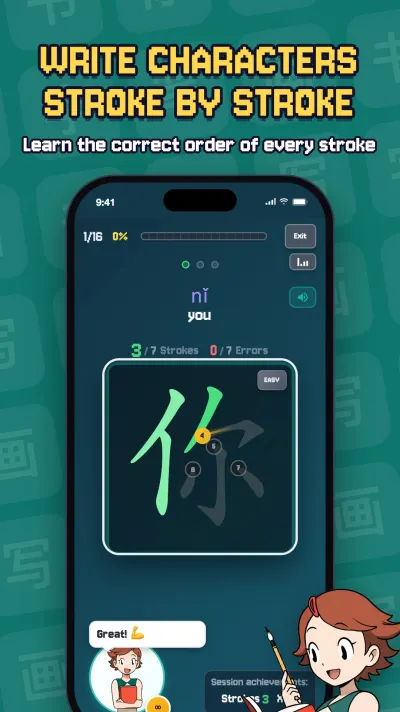
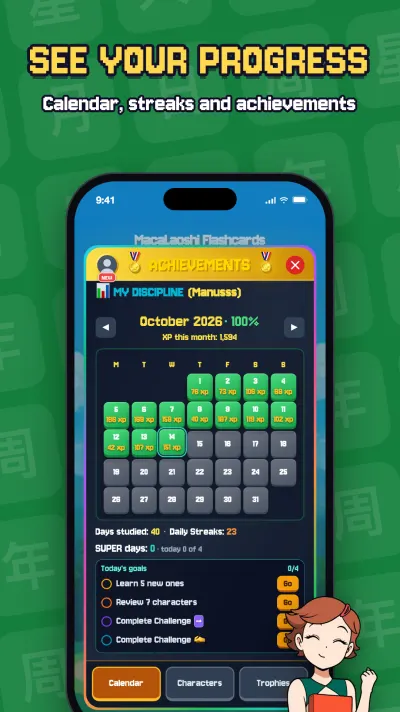
Maca Laoshi's app for learning characters, with audio, pinyin and stroke-by-stroke writing.
- 1,300+words and characters
- HSK 1–4by level
- Freeto start




Learn with our songs
We made them for Macalaoshi. Singing along is a fun way to practice pronunciation and review vocabulary.

The Lighthouse of My Heart 我心里灯塔

Study With You 跟你一起学
Frequently asked questions
How many tone combinations are there in Mandarin?
In two-syllable words, there are 20 to practice: the 16 pairs of the four tones (from 1+1 to 4+4) and the 4 where a tone is followed by a neutral tone, like 妈妈 māma or 谢谢 xièxie.
Why should I practice Mandarin tones in pairs?
Because inside a word, each tone changes depending on the one next to it: the start of a tone adjusts to the end of the one before. Repeating isolated syllables doesn't prepare you for that.
How do I tell the 2nd tone from the 3rd?
The 2nd rises; the 3rd is low and, inside a word, almost never rises. Practice minimal pairs like 油 yóu (oil) and 有 yǒu (to have), and make sure the 3rd stays low.
How do you pronounce two third tones in a row?
The first one is said as a second tone: 你好 is written nǐ hǎo and said ní hǎo. In pinyin, it's still written with the third tone.
Which tone pair is hardest for English speakers?
Any pair that mixes the 2nd and 3rd tones. Studies with English-speaking learners, from beginners to people with more than two years of study, find it's the most confused contrast, and studies with Dutch and Spanish speakers find the same.
Maca Laoshi, born in Beijing, has taught Mandarin Chinese for more than 22 years and has had over 1,500 students. Together with her son Manu Shi, who has more than 93,000 subscribers on YouTube, she created Macalaoshi, an app that challenges you to push yourself one character at a time. Few Chinese teachers can show both: their own app and a channel like that.
Sources
- Yi Xu (1997), Journal of Phonetics: in context, each tone changes depending on the tones around it; the start of a tone adjusts to the end of the one before.
- Zou, Caspers and Chen (2022), Frontiers in Psychology: the 2nd–3rd tone contrast causes the most errors, in beginners and advanced learners; review of earlier studies with English-speaking learners.
- Wang, Spence, Jongman and Sereno (1999), Journal of the Acoustical Society of America: training American listeners to perceive Mandarin tones.
- Hao, Gong and Zhang (2023), Interspeech: 25 Spanish speakers recognize the 3rd tone worst, especially next to the 2nd.
- Olle Linge (2011), Lund University: why the 3rd tone, taught as a rising tone, gets confused with the 2nd.
- Standard Chinese phonology: the 3rd tone without its rise inside a phrase, the 3+3 change and the pitch of the neutral tone.
- Official syllabus of the new HSK (November 2025): the 20 words in the table are level 1.
- MDBG dictionary (CC-CEDICT): pinyin and meaning of each word.
This guide in other languages: Español · Português · Français · Deutsch · Italiano · 日本語 · 한국어