Guides › Chinese, Japanese or Korean?
Chinese, Japanese or Korean: which one should you learn for your goal?

Maca Laoshi, Mandarin Chinese teacher
Updated October 20, 2026 · 9 min read
Choose by purpose. Chinese if you want work, business or the largest number of speakers; Japanese if anime, games or living in Japan drive you; Korean if K-dramas and music do, and you want an easy alphabet from day one. All three sit in the FSI's hardest category (about 2,200 class hours), so what matters most is whether your goal keeps you studying.
What they share (and what they don't)
For an English speaker, all three languages are distant. The US Department of State places them in Category IV, its hardest, alongside Arabic, and estimates 88 weeks (about 2,200 class hours) to reach a working level. That figure is an average for English speakers, so treat it as an order of magnitude. To see what makes Chinese hard in particular, read is Chinese really hard? Here we compare what each language is good for.
Number of speakers
| Language | Native speakers (Ethnologue, 2026) | Where it is spoken |
|---|---|---|
| Mandarin | about 988 million | China, Taiwan, Singapore and communities worldwide |
| Japanese | about 124 million | Almost only Japan |
| Korean | about 82 million | South Korea, North Korea and the diaspora |
Chinese has about eight times as many native speakers as Japanese. But "more speakers" does not mean "more useful for you": if you will never deal with China, the headcount matters little.
Work and business
Mandarin is the common language of business with mainland China, Taiwan and Singapore, and trade with that region is huge. Companies that import, export, manufacture or run tourism with China value Mandarin speakers; a level that lets you negotiate or work with documents usually means HSK 5 or above (see what HSK level you need). Japanese is valued in industry, automotive, technology, games and translation; Korean in entertainment, cosmetics and consumer electronics. These are general trends, not job promises.
Travel and daily life
In all three countries you can get by with English in big cities, but reading helps a lot. In Japan, understanding signs in kanji and kana makes life easier; in Korea, hangul can be learned in an afternoon and you can read signs and menus right away; in China, recognising a few hundred characters also helps, although payment apps and local maps ask for more preparation.
Anime, K-dramas and series
Anime and video games come in Japanese; K-dramas and K-pop in Korean; Chinese series (电视剧) and web novels have grown a lot in recent years. If you already have a hobby, that is your best engine: studying a language with no emotional pull is what people drop most. If Chinese series appeal to you, see how to train your ear with Chinese series.
 Test your Chinese
Improve your Chinese with our app, Macalaoshi Flashcards: 1,300+ words and characters to practice like this.
See the appWriting, tones and grammar
| Chinese (Mandarin) | Japanese | Korean | |
|---|---|---|---|
| Writing | Characters (汉字); pinyin helps you read them | Three systems: kanji, hiragana and katakana (2,136 general-use kanji) | Hangul: 14 basic consonants and 10 vowels; hanja rarely used day to day |
| Tones | 4 tones plus neutral (see tones) | Pitch accent, less decisive | No lexical tones |
| Grammar | No conjugation or verb tenses; subject-verb-object order, like English | Verb last, particles, several politeness levels | Verb last, particles, honorifics |
| First obstacle | Tones and memorising characters | Reading kanji with several readings | Verb endings and formality levels |
One advantage of Chinese: its grammar is very regular and nothing is conjugated. The price is in the writing. To see how learners cope without an alphabet, read does Chinese have an alphabet?
If your goal is X, choose Y
| If your goal is... | Choose | Why |
|---|---|---|
| Business, importing or working with China | Chinese | Market size and number of speakers |
| Living or studying in Japan | Japanese | English is not enough for daily life |
| Anime, manga and games in the original | Japanese | That is where the original material is |
| K-dramas and K-pop | Korean | Original material and an easy alphabet |
| Fast early results | Korean | You can read in the first week |
| Simple grammar, no conjugation | Chinese | No verb tenses to conjugate |
| Studying or living in Taiwan or Hong Kong | Chinese (Mandarin or Cantonese) | Traditional writing |
| No idea: I want what motivates me most | The one you already consume | Consistency matters more than difficulty |
If you already read kanji, see also can you read Chinese if you know kanji?
What about learning two at once?
You can, but the most common advice is to start with one. Each language takes hundreds of hours, and splitting your time between two doubles the time to any goal. Chinese and Japanese share characters, but not always their pronunciation, form or meaning, and at the start that confuses more than it helps. If you still want two, a reasonable plan is to bring one to a solid basic level (Chinese, for example, up to HSK 3) and only then add the second on a separate study schedule.
If you choose Chinese, start with the HSK 1 vocabulary, or see how long it usually takes in how long does it take to learn Chinese?
Improve your Chinese with Macalaoshi Flashcards
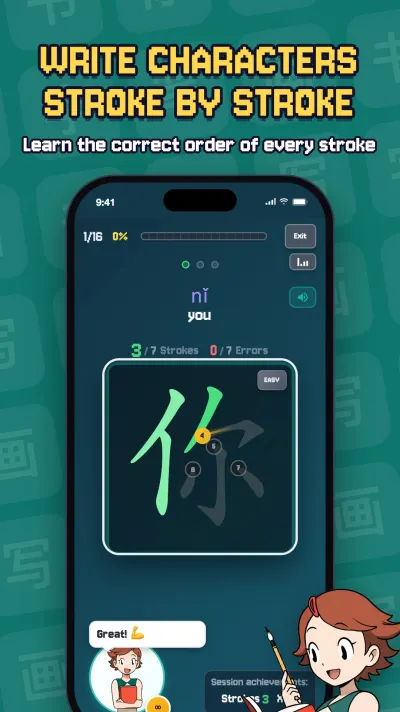
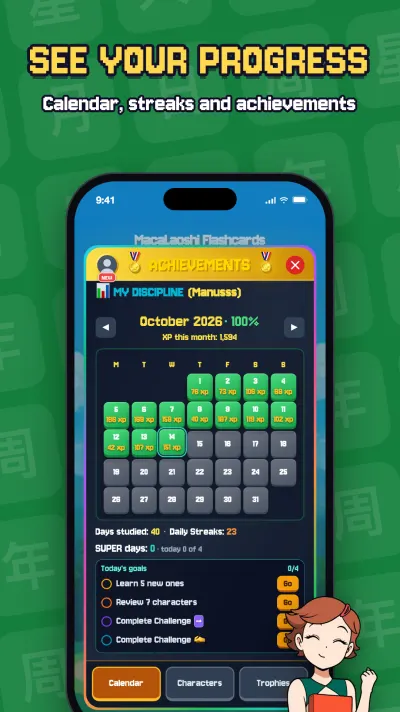
Maca Laoshi's app for learning characters, with audio, pinyin and stroke-by-stroke writing.
- 1,300+words and characters
- HSK 1–4by level
- Freeto start




Learn with our songs
We made them for Macalaoshi. Singing along is a fun way to practice pronunciation and review vocabulary.

The Lighthouse of My Heart 我心里灯塔

Study With You 跟你一起学
Frequently asked questions
Should I learn Chinese or Japanese?
It depends on your goal. Chinese has far more speakers and more weight in business and trade; Japanese fits you better if you love anime, games, literature or want to live in Japan. If you have no clear goal, pick the language whose culture you already enjoy.
Which is easier: Chinese, Japanese or Korean?
None is easy for an English speaker: the US Foreign Service Institute (FSI) puts all three in Category IV, its hardest group, at about 2,200 class hours. Korean is often gentler at first thanks to its alphabet, hangul; Chinese has simple grammar but tones and characters; Japanese adds three writing systems and more complex grammar.
Can you learn Chinese and Japanese at the same time?
You can, but most teachers advise starting with one. The two share characters but not their pronunciation, and mixing up kanji readings and forms is a classic source of confusion. Build a solid basic level in one before adding the other.
How many people speak Chinese, Japanese and Korean?
According to Ethnologue (2026), Mandarin has about 988 million native speakers, Japanese about 124 million and Korean about 82 million.
Which language gives the best career options?
By market size and trade volume, Chinese usually opens more doors; Japanese is valued in industry, technology and video games; Korean in entertainment, cosmetics and consumer electronics. These are general trends, not guarantees.
Which of the three has tones?
Chinese: Mandarin has four tones plus a neutral one. Korean has no lexical tones, and Japanese has a pitch accent that affects meaning less often.
Maca Laoshi, born in Beijing, has taught Mandarin Chinese for more than 22 years and has had over 1,500 students. Together with her son Manu Shi, who has more than 93,000 subscribers on YouTube, she created Macalaoshi, an app that challenges you to push yourself one character at a time. Few Chinese teachers can show both: their own app and a channel like that.
Sources
- US Department of State (FSI): Mandarin, Cantonese, Japanese and Korean are in Category IV, estimated at 88 weeks (2,200 class hours) for English speakers.
- Native speakers per Ethnologue (2026): Mandarin 988 million, Japanese 124 million, Korean 82 million.
- Japanese writing: kanji, hiragana and katakana; the official jōyō list has 2,136 kanji.
- Hangul: the Korean alphabet, with 14 basic consonants and 10 basic vowels, promulgated in 1446.
This guide in other languages: Español · Português · Français · Deutsch · Italiano · 日本語 · 한국어