Guides › Can you read Chinese if you know kanji?
Can you read Chinese if you know kanji? What carries over and what doesn't
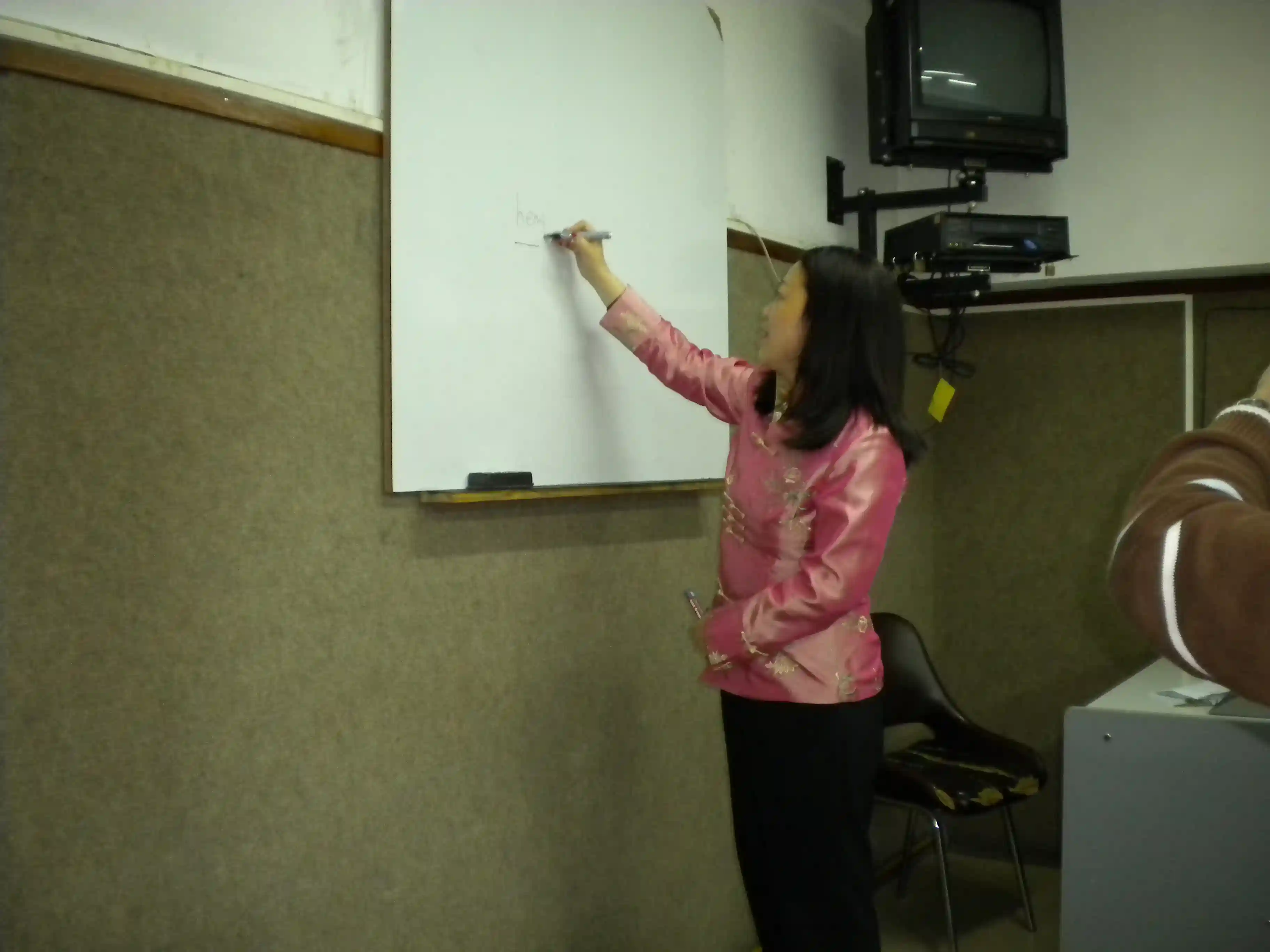
Maca Laoshi, Mandarin Chinese teacher
Updated October 20, 2026 · 9 min read
Partly. If you know kanji you can often guess the meaning of written Chinese, because the two systems share thousands of characters and many compounds. But kanji do not help with pronunciation, tones or grammar, many characters changed shape, and some words mean something different (手紙 is a letter in Japanese and toilet paper in Chinese). Think of it as a big head start in reading, not as being able to read Chinese.
What helps
Recognising characters and compounds. Words such as 学校 (xuéxiào, school), 电话 (diànhuà, telephone) or 经济 (jīngjì, economy) are written almost the same in both languages. Knowing the building blocks (radicals) and the logic of compounds also saves months. Because HSK 1 to HSK 4 are mostly made of common characters, a Japanese reader meets many old friends. For how many characters a learner needs, see how many Chinese characters do you need?
What does not help
- Pronunciation. Japanese readings (on'yomi and kun'yomi) come from different periods and do not map onto pinyin: 学 is gaku in Japanese and xué in Chinese.
- Tones. Mandarin has four tones plus a neutral one, and Japanese has none in this sense. See Chinese tones.
- Grammar. Chinese has no conjugation, no case particles like は and を and no kana. Word order is subject-verb-object, the reverse of Japanese verb-last order.
- Speaking. You still need to learn each word in pinyin to say it, and the Chinese word for something is often a different compound from the Japanese one.
Characters that changed shape
Japan simplified some characters after the war (shinjitai), and mainland China simplified many others on its own. The result: three versions of many characters. Japanese kanji sit closer to traditional, but not always.
| Japanese | Traditional | Simplified | Pinyin |
|---|---|---|---|
| 気 | 氣 | 气 | qì |
| 図 | 圖 | 图 | tú |
| 楽 | 樂 | 乐 | lè / yuè |
| 発 | 發 | 发 | fā |
| 歩 | 步 | 步 | bù |
| 学 | 學 | 学 | xué |
| 買 | 買 | 买 | mǎi |
| 電 | 電 | 电 | diàn |
There is also the opposite problem: some Japanese characters (kokuji) such as 峠 and 働 were made in Japan and do not exist in standard Chinese. For the full story of the two Chinese writing styles and which one Japanese kanji resemble, see simplified and traditional characters.
 Test your Chinese
Improve your Chinese with our app, Macalaoshi Flashcards: 1,300+ words and characters to practice like this.
See the appFalse friends: same characters, different meaning
| Word | In Japanese | In Chinese |
|---|---|---|
| 手紙 / 手纸 | letter (tegami) | toilet paper (shǒuzhǐ) |
| 愛人 / 爱人 | lover, mistress (aijin) | spouse in mainland China (àiren) |
| 汽車 / 汽车 | steam train (kisha) | car (qìchē) |
| 新聞 / 新闻 | newspaper (shinbun) | news (xīnwén) |
| 走 | to run (hashiru) | to walk, to go, to leave (zǒu) |
| 湯 / 汤 | hot water (yu) | soup (tāng) |
| 勉強 / 勉强 | study (benkyō) | forced, reluctant (miǎnqiǎng) |
| 丈夫 | sturdy, strong (jōbu) | husband (zhàngfu) |
These are the famous traps, and the main reason why guessing from kanji alone is risky. The reverse is also true: many of the most useful words are the same in both languages, so the hit rate is high but never 100 %.
A test: reading one Chinese sentence as a kanji reader
Take 我今天去学校。 (Wǒ jīntiān qù xuéxiào, "Today I go to school"). A kanji reader recognises 今天 and 学校 at once, and probably guesses "school" and "today" (in Japanese you would write 今日, so 今天 is already a surprise). But 我 ("I") is a character Japanese rarely uses that way, and 去 means "to go", while in Japanese it is mostly "to leave" or "past" (as in 去年, last year). You get the gist, but you did not read the sentence: no tones, no word order, no certainty about the verb. That is the real gain and the real limit of kanji knowledge.
How to use kanji to learn Chinese faster
- Start from what you know. Take the HSK 1 list and mark the characters you already read; use that time for pinyin and tones. The HSK 1 vocabulary has them with pinyin.
- Learn simplified forms in pairs. Learn 気 together with 气, 図 with 图, so your brain links the shapes instead of confusing them.
- Check every word. If a compound looks familiar, confirm the meaning in a dictionary before you trust it.
- Treat pronunciation as new. Never say a Chinese word with a Japanese reading in your head. Learn it in pinyin from day one.
With that approach you can move faster than most beginners. For how hard Chinese is overall, read is Chinese really hard?, and to decide between Chinese and other East Asian languages, see Chinese, Japanese or Korean: which to learn.
Improve your Chinese with Macalaoshi Flashcards
Maca Laoshi's app for learning characters, with audio, pinyin and stroke-by-stroke writing.
- 1,300+words and characters
- HSK 1–4by level
- Freeto start
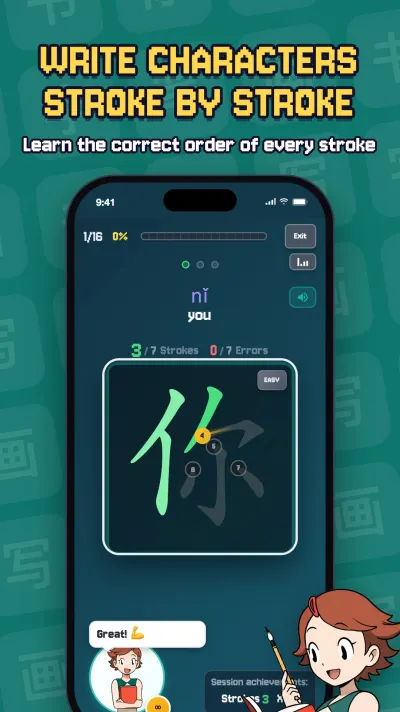

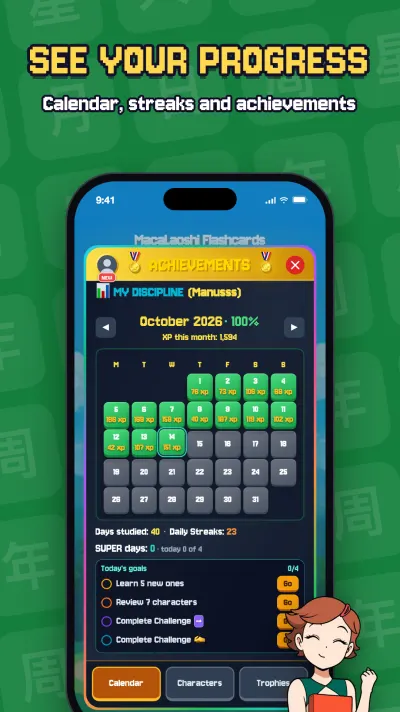


Learn with our songs
We made them for Macalaoshi. Singing along is a fun way to practice pronunciation and review vocabulary.

The Lighthouse of My Heart 我心里灯塔

Study With You 跟你一起学
Frequently asked questions
Can you read Chinese if you know Japanese kanji?
Partly. You can often guess the general meaning of written Chinese, because many characters and compounds are shared. But you cannot read it aloud, you will miss the grammar, and some words mean something different, so you can also be badly wrong.
Are kanji and Chinese characters the same?
They share the same origin but are not identical. Japan simplified some characters in its own way (気, 図, 楽), mainland China simplified many others (气, 图, 乐), and Japan created characters that do not exist in Chinese, called kokuji, such as 峠 and 働.
Does knowing kanji make learning Chinese faster?
It makes the characters and the vocabulary faster, since you already recognise thousands of shapes. It does not speed up pronunciation, tones or grammar, which are new for you.
What are the biggest false friends between Japanese and Chinese?
手紙 is a letter in Japanese but toilet paper in Chinese; 勉強 is studying in Japanese but 勉强 means forced or reluctant in Chinese; 汽車 is a steam train in Japanese but a car in Chinese; 新聞 is a newspaper in Japanese but news in Chinese; 愛人 means lover in Japanese but spouse in mainland Chinese.
Is Japanese kanji closer to traditional or simplified Chinese?
Closer to traditional. Japan simplified fewer characters and in a different way, so many kanji look like traditional characters (電, 買, 見) and some like simplified ones (学, 国, 体). Learning both writing styles is part of the work.
Do I have to learn pinyin if I already know kanji?
Yes. Pinyin is the way to learn pronunciation and tones; your kanji readings (on'yomi) will not match the Chinese sound, and guessing from them leads to mistakes.
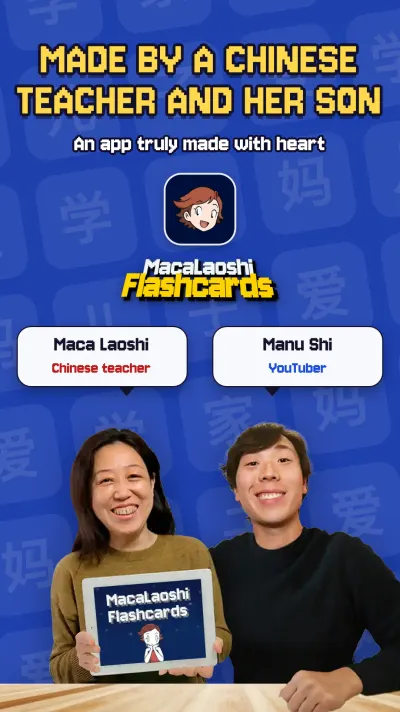
Maca Laoshi, born in Beijing, has taught Mandarin Chinese for more than 22 years and has had over 1,500 students. Together with her son Manu Shi, who has more than 93,000 subscribers on YouTube, she created Macalaoshi, an app that challenges you to push yourself one character at a time. Few Chinese teachers can show both: their own app and a channel like that.
Sources
- List of Chinese-Japanese false friends: 手紙 (letter / toilet paper), 勉強 (study / forced), 汽車 (train / car), 新聞 (newspaper / news), 愛人 (lover / spouse).
- Kokuji: characters created in Japan that have no Chinese origin, such as 峠 and 働.
- Shinjitai: the simplified forms Japan adopted after 1946 (気, 図, 楽, 発) and their differences from Chinese simplification.
- Simplified Chinese characters: forms used in mainland China (气, 图, 乐, 发).
- Kyōiku and jōyō kanji: official lists of 1,026 and 2,136 characters taught in Japan.