Guides › Are Chinese and Mandarin the same?
Are Chinese and Mandarin the same? Why people mix them up and how they differ
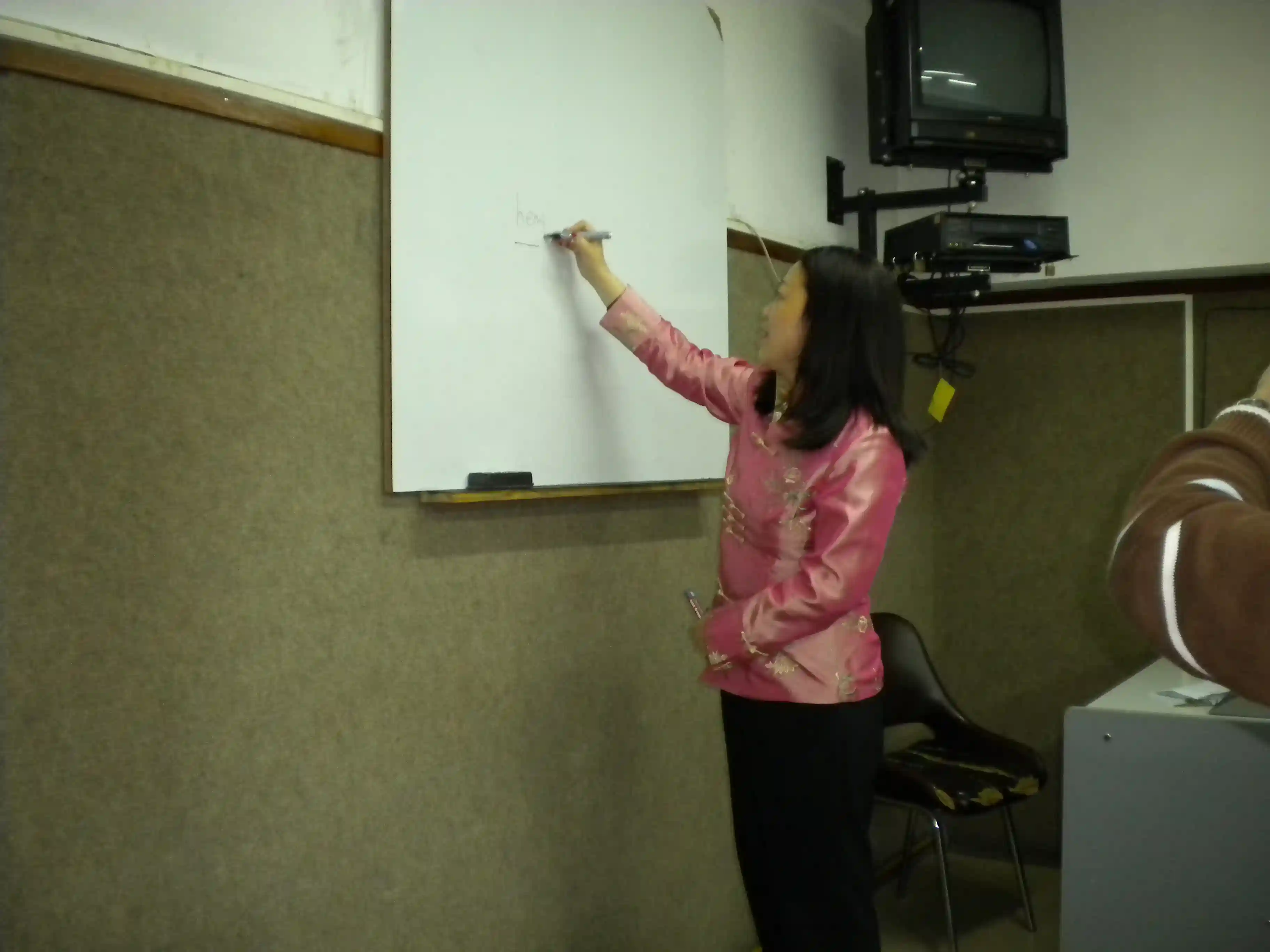
Maca Laoshi, Mandarin Chinese teacher
Updated October 20, 2026 · 8 min read
Not exactly. “Chinese” is a family of languages (Mandarin, Cantonese, Wu, Min, Hakka...) and Mandarin is the most spoken: about two out of three speakers of Chinese. Its standard form, called 普通话 (pǔtōnghuà) in mainland China, 国语 (traditional 國語, guóyǔ) in Taiwan and 华语 (huáyǔ) in Singapore, is what the world teaches as “Chinese”. Separately, simplified and traditional are not languages: they are two ways of writing.
Why “Chinese” and “Mandarin” get mixed up
In English, “Chinese” covers everything: the language, the people and the writing. In Chinese there are different words: 汉语 (Hànyǔ, “Han language”) names all the spoken varieties and 中文 (Zhōngwén) is used mainly for the written language. When someone says “I speak Chinese”, they usually mean Mandarin, but the sentence does not say so.
“Mandarin” is not a Chinese word. It comes from Portuguese mandarim, used in the 16th century for imperial officials, which dictionaries trace to Malay menteri (“minister”) and that to Sanskrit. European missionaries translated 官话 (guānhuà, “officials’ speech”) as “the Mandarin language”: it was the common tongue of the Ming and Qing dynasties. Over time the name moved to the modern standard.
Every place has its own name for it. Mainland China adopted 普通话 (“common speech”) in 1955. The official 1956 definition bases it on Beijing pronunciation, the northern dialects and the grammar of modern vernacular literature. Taiwan says 国语 (“national language”) and Singapore, Malaysia and other Southeast Asian countries say 华语. These are different names for a very similar standard.
The main varieties of Chinese
Linguists group spoken Chinese into several large groups. According to a survey by Xiong and Zhang (2012), cited by Wikipedia, this is how native speakers of Chinese divide up:
| Variety | Name in Chinese | Share of speakers | Where it is spoken |
|---|---|---|---|
| Mandarin | 官话 Guānhuà | 65.7% | Northern and southwestern China; the base of the standard |
| Min (includes Hokkien, or Taiwanese) | 闽语 Mǐnyǔ | 6.2% | Fujian and Taiwan |
| Wu (includes Shanghainese) | 吴语 Wúyǔ | 6.1% | Shanghai and Zhejiang |
| Yue (includes Cantonese) | 粤语 Yuèyǔ | 5.6% | Guangdong, Hong Kong and Macao |
| Jin | 晋语 Jìnyǔ | 5.2% | Shanxi |
| Gan | 赣语 Gànyǔ | 3.9% | Jiangxi |
| Hakka | 客家话 Kèjiāhuà | 3.5% | Southern China and Taiwan |
| Xiang | 湘语 Xiāngyǔ | 3.0% | Hunan |
In absolute numbers, Wikipedia gives about 85 million native speakers for Yue, about 83 million for Wu and about 44 million for Hakka. Do they understand each other? Generally not: the gaps between groups are compared to those between Romance languages, and a person from Guangzhou and one from Shanghai, each speaking their own language, would not understand each other. They communicate in standard Mandarin, which is promoted as the common language across the country. Even within Mandarin some varieties are hard: a 2009 study across 15 provinces found significant difficulty in understanding among speakers, with Beijing speakers understood best.
 Test your Chinese
Improve your Chinese with our app, Macalaoshi Flashcards: 1,300+ words and characters to practice like this.
See the appSpeaking and writing are different: simplified and traditional
One of the most common mix-ups is thinking “simplified Chinese” and “traditional Chinese” are two languages. They are not: they are two ways of writing the same characters. What changes from place to place is what is spoken and how it is written:
| Place | Usual spoken language | Official script |
|---|---|---|
| Mainland China | Mandarin (普通话) | Simplified |
| Taiwan | Mandarin (國語); also Hokkien and Hakka | Traditional |
| Hong Kong | Cantonese | Traditional |
| Macao | Cantonese | Traditional |
| Singapore | Mandarin (华语), alongside English, Malay and Tamil | Simplified (since 1969) |
That is why someone from Hong Kong and someone from Beijing can read the same text without it sounding the same: Cantonese and Mandarin sound very different even though they share many characters. For the differences between the two scripts, see simplified vs traditional.
Other typical differences
Even within standard Mandarin there are differences between mainland China and Taiwan, mostly in vocabulary and in the pronunciation aid: the mainland uses pinyin and Taiwan uses zhuyin. In Taiwan you hardly hear the final “r” sound that Beijing speech adds to some words. Some everyday words differ:
| Meaning | Mainland China | Taiwan |
|---|---|---|
| Taxi | 出租车 chūzūchē | 計程車 jìchéngchē |
| Software | 软件 ruǎnjiàn | 軟體 ruǎntǐ |
| Metro | 地铁 dìtiě | 捷運 jiéyùn |
| Bicycle | 自行车 zìxíngchē | 腳踏車 jiǎotàchē |
These are comparable to the differences between British and American English: you understand each other without trouble. What changes a lot is Cantonese, which also has more tones than Mandarin (Mandarin has four plus the neutral tone).
What should you learn, depending on your goal?
If in doubt, the most common choice is standard Mandarin with pinyin. But it depends on where and why you want it:
| Your goal | What to learn | Script |
|---|---|---|
| Living, studying or traveling in mainland China | Standard Mandarin (普通话) | Simplified |
| Living or studying in Taiwan | Mandarin (國語); Taiwanese is a bonus | Traditional |
| Living in Hong Kong or Guangzhou | Cantonese for the street; Mandarin to talk to everyone else | Traditional in Hong Kong |
| Business | Mandarin: the common language of the mainland, Taiwan and Singapore | Simplified for the mainland |
| Series, films and music | It depends on the origin: mainland ones are in Mandarin; classic Hong Kong ones in Cantonese | Subtitles in both |
To get started, see whether Chinese is really hard and why Chinese series help you practice listening.
Improve your Chinese with Macalaoshi Flashcards
Maca Laoshi's app for learning characters, with audio, pinyin and stroke-by-stroke writing.
- 1,300+words and characters
- HSK 1–4by level
- Freeto start






Learn with our songs
We made them for Macalaoshi. Singing along is a fun way to practice pronunciation and review vocabulary.

The Lighthouse of My Heart 我心里灯塔

Study With You 跟你一起学
Frequently asked questions
Are Chinese and Mandarin the same?
Not exactly. “Chinese” is a family of languages and Mandarin is the most spoken. Its standard form is what is taught as “Chinese”. Cantonese, Wu and Min are other Chinese languages.
What is the difference between Mandarin and Cantonese?
They are different Chinese varieties that are not mutually intelligible when spoken. Mandarin is the standard of mainland China, Taiwan and Singapore; Cantonese is spoken in Guangdong, Hong Kong and Macao, and has more tones.
What is the difference between simplified and traditional Chinese?
They are two ways of writing, not two languages. Simplified is used in mainland China and Singapore; traditional in Taiwan, Hong Kong and Macao.
What does 普通话 mean?
“Common speech”. It is the name of standard Mandarin in mainland China. In Taiwan it is called 国语 (guóyǔ, “national language”) and in Singapore and Malaysia, 华语 (huáyǔ).
Where does the word “Mandarin” come from?
From Portuguese mandarim, used in the 16th century for imperial officials. European missionaries translated 官话 (guānhuà, “officials’ speech”) as “the Mandarin language”.
Which Chinese should I learn?
For most people, standard Mandarin with pinyin. If you are going to live in Taiwan, traditional characters help; if you are going to Hong Kong, Cantonese.
Maca Laoshi, born in Beijing, has taught Mandarin Chinese for more than 22 years and has had over 1,500 students. Together with her son Manu Shi, who has more than 93,000 subscribers on YouTube, she created Macalaoshi, an app that challenges you to push yourself one character at a time. Few Chinese teachers can show both: their own app and a channel like that.
Sources
- Varieties of Chinese: share of speakers by group (Xiong and Zhang, 2012) and mutual intelligibility.
- Standard Chinese: the names 普通话, 国语 and 华语; the official 1956 definition.
- Mandarin (bureaucrat): origin of the word, from Portuguese mandarim, and the name of the language from 官话.
- Traditional Chinese characters: Taiwan, Hong Kong and Macao use traditional; Singapore adopted simplified in 1969.
- Taiwanese Mandarin: differences from mainland Mandarin, including zhuyin and the near absence of erhua.
- Mandarin HQ: vocabulary differences between mainland China and Taiwan (taxi, software, metro, bicycle).
- Yue and Cantonese: about 85 million native speakers; Wu: about 83 million; Hakka: about 44 million.
- Southern Min: includes Hokkien, spoken in Taiwan.
This guide in other languages: Español · Português · Français · Deutsch · Italiano · 日本語 · 한국어