Guides › Chinese calligraphy
Chinese calligraphy for beginners: tools and first strokes
Maca Laoshi, Mandarin Chinese teacher
Updated October 20, 2026 · 8 min read
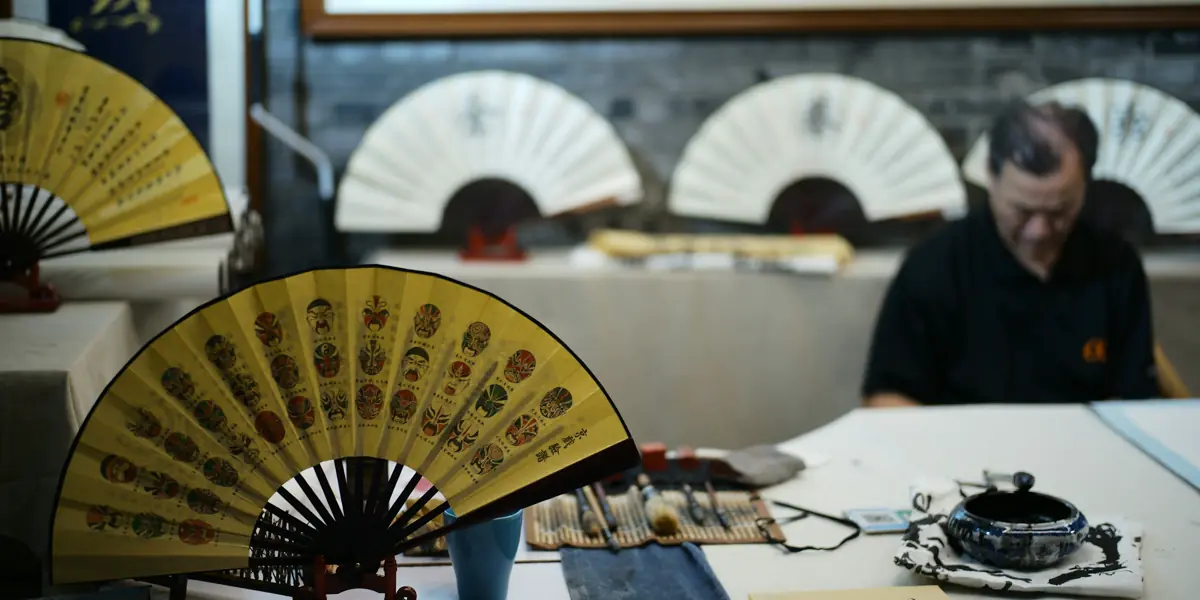
Chinese calligraphy, 书法 (shūfǎ), is the art of writing characters with brush and ink. To start you need the four “treasures of the study” (文房四宝): brush, ink, paper and inkstone, although at first you can use bottled liquid ink or a cloth you write on with water. You begin with regular script, 楷书 (kǎishū), and the eight basic strokes practiced with the character 永 (yǒng). You don't need it to learn Chinese, but it trains your hand and eye.
What Chinese calligraphy is and how it differs from writing to study
书法 (shūfǎ) literally means “method of writing”. It's writing characters as an art form: it matters not only what a text says but also how it looks. Writing by hand to study has a different goal: that you recognize and remember the character. If you're wondering whether it's necessary, read whether you need to learn to write Chinese by hand.
- Studying: you use a pen or pencil and aim for clarity and the correct stroke order. The rules are in Chinese stroke order.
- Calligraphy: you use a brush, and the thickness, pressure and rhythm of each stroke are part of what you practice.
Tools: the four treasures of the study
The traditional tools are called 文房四宝 (wénfáng sìbǎo), “the four treasures of the study”:
| Tool | Chinese | Pinyin |
|---|---|---|
| Brush | 笔 (毛笔) | bǐ (máobǐ) |
| Ink (stick) | 墨 | mò |
| Paper | 纸 | zhǐ |
| Inkstone | 砚 | yàn |
In the traditional way, you grind the ink stick with water on the stone. Today there are shortcuts for beginners.
Cheap ways to start
- Liquid ink (墨汁, mòzhī): it comes ready to use and saves you from grinding the stick. A traditional tutorial warns that it can make brush movements a little harder, and suggests mixing it with a bit of water on the stone. Grinding ink, it says, takes more time but builds skill in the hand and wrist.
- Water-writing cloth (水写布, shuǐxiěbù): you write with a brush dipped in water, no ink; the strokes look dark and fade as they dry, so you can reuse it. Some come with a 米 (mǐ) grid. It's a clean way to practice the shape of strokes, though it isn't the same as ink on paper.
- Practice paper: 毛边纸 (máobiānzhǐ) is a bamboo paper used for calligraphy, and one tutorial presents it as a cheaper substitute for xuan paper (宣纸) for practice. The same tutorial recommends not using newsprint.
The styles and why you start with regular script
Chinese calligraphy has five main styles:
| Style | Chinese | Pinyin |
|---|---|---|
| Seal | 篆书 | zhuànshū |
| Clerical | 隶书 | lìshū |
| Regular | 楷书 | kǎishū |
| Semi-cursive (running) | 行书 | xíngshū |
| Cursive | 草书 | cǎoshū |
Regular script is the most recent of the five: it matured around the 7th century. Nearly all calligraphers began their study by copying models in this style. One tutorial describes it as the style most new students adopt, easy to learn but hard to master because its strokes are very strict. Semi-cursive is easy to read if you can read regular script; cursive is faster to write and hard to read if you don't know it.
 Test your Chinese
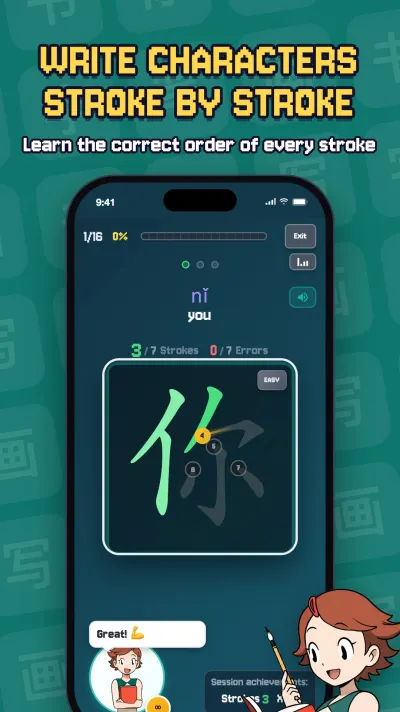
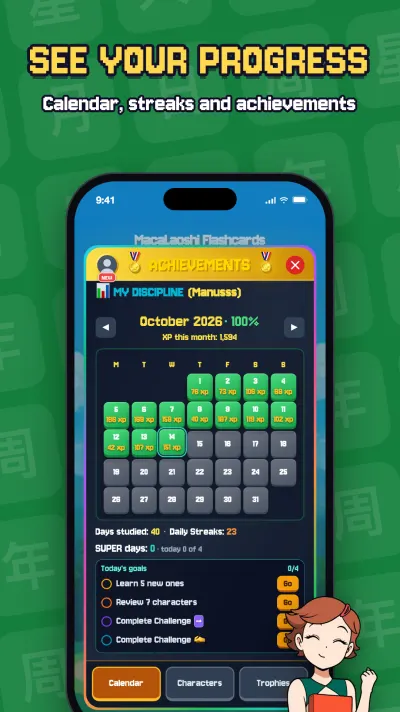
Improve your Chinese with our app, Macalaoshi Flashcards: 1,300+ words and characters to practice like this.
See the appThe eight basic strokes of 永
The character 永 (yǒng, “eternal”) brings the basic brush movements together in a single character. It's known as 永字八法 (yǒng zì bā fǎ), “the eight methods of the character 永”. Beginners practice it because it packs very different movements into just a few strokes.
Sources don't agree on the names of the eight strokes (there are Tang-era names, names from the Yuan era and modern ones). Here we use the Tang-era names, which are the ones the Hanyu dictionary gives, in the order they're written in 永:
| No. | Name | Pinyin | Meaning and movement |
|---|---|---|---|
| 1 | 侧 | cè | “sideways”: the dot |
| 2 | 勒 | lè | “bridle”: the horizontal stroke |
| 3 | 努 | nǔ | “to strive”: the vertical stroke |
| 4 | 趯 | tì | “to leap”: the hook |
| 5 | 策 | cè | “whip”: a stroke that rises diagonally |
| 6 | 掠 | lüè | “to skim”: a long stroke that goes down to the left |
| 7 | 啄 | zhuó | “to peck”: a short stroke that goes down |
| 8 | 磔 | zhé | “to spread”: a long stroke that goes down to the right |
In the modern list, which uses names like 点, 横, 竖, 钩, 提, 撇 and 捺, the equivalences differ, and some sources assign 掠 and 啄 differently. To see how the modern names are used, see Chinese stroke order.
How to hold the brush and practice
- Vertical brush: hold it upright, gripped between the thumb and middle finger, with the index finger touching the handle. One tutorial says keeping the brush as vertical as possible is the most important principle.
- Support for the beginner: the same tutorial advises resting your elbows on the table instead of writing with your arm in the air.
- Grid paper: the 田字格 (tiánzìgé) has a central cross and helps you place strokes. The 米字格 (mǐzìgé) adds two diagonals, useful for slanted strokes. According to one source, the 田字格 is the simplest to start with and the 米字格 is used to refine slanted strokes; another tutorial uses both on its practice paper.
- Tracing: sheets with characters in red (描红, miáohóng) are traced over with the brush and let you practice the shape before copying freehand.
- Copying models: model books are called 字帖 (zìtiè). Copying is 临摹 (línmó): 临 is placing the paper beside the model and imitating it, and 摹 is covering the model with paper and tracing it.
A good starting point: first copy the eight strokes of 永 very slowly, then simple characters you've already practiced, like those in the most common radicals.
Improve your Chinese with Macalaoshi Flashcards
Maca Laoshi's app for learning characters, with audio, pinyin and stroke-by-stroke writing.
- 1,300+words and characters
- HSK 1–4by level
- Freeto start



Learn with our songs
We made them for Macalaoshi. Singing along is a fun way to practice pronunciation and review vocabulary.
The Lighthouse of My Heart 我心里灯塔

Study With You 跟你一起学
Frequently asked questions
What is 书法?
书法 (shūfǎ) is calligraphy: writing Chinese characters as an art. The word literally means “method of writing”.
What do I need to start Chinese calligraphy?
The four treasures of the study, 文房四宝: brush (笔), ink (墨), paper (纸) and inkstone (砚). To start you can use bottled liquid ink (墨汁) or even a cloth you write on with water.
Which style should I start with?
Regular script, 楷书 (kǎishū). Nearly all calligraphers started by copying models in that style.
What are the eight strokes of 永?
It's a traditional method, 永字八法, that gathers eight basic strokes into a single character: 侧, 勒, 努, 趯, 策, 掠, 啄 and 磔.
Do I need to learn calligraphy to study Chinese?
No. To study, it's enough to write the characters clearly and with the correct stroke order. Calligraphy is an art you can add if you enjoy it.
Maca Laoshi, born in Beijing, has taught Mandarin Chinese for more than 22 years and has had over 1,500 students. Together with her son Manu Shi, who has more than 93,000 subscribers on YouTube, she created Macalaoshi, an app that challenges you to push yourself one character at a time. Few Chinese teachers can show both: their own app and a channel like that.
Sources
- Chinese calligraphy: shūfǎ as “method of writing”; the four treasures of the study; the five styles and their history; nearly all calligraphers started by copying models in regular script; the character 永 as practice; how to hold the brush; copying models and tracing.
- The Eight Principles of Yong: Tang-era names (侧, 勒, 努/弩, 趯, 策, 掠, 啄, 磔), Li Puguang's and modern names; sources differ.
- Hanyu Dictionary (汉典): 永字八法, the eight movements 侧, 勒, 努, 趯, 策, 掠, 啄 and 磔 as basic rules of regular-script strokes.
- 汉典: 临摹, copying a model; 临 is placing the paper beside the model and 摹 is covering the model with paper and tracing it.
- Chinese calligraphy tutorial (art-virtue.com, 2016): liquid ink versus grinding an ink stick, 毛边纸 paper with 九宫格 and 米字格 grids, regular script as the first style, how to hold the brush, tracing and copying models.
- Chinese Calligraphy (shufazitie.net): the 田字格 grid has two center lines; the 米字格 adds two diagonals.
- Chalk Academy: water-writing cloth for calligraphy, no ink, the strokes fade and it can be reused; some come with a 米 grid.
- CC-CEDICT (local copy): pinyin and meaning of 书法, 文房四宝, 毛笔, 墨汁, 砚, 楷书, 隶书, 篆书, 行书, 草书, 字帖, 临摹, 描红, 毛边纸 and the eight strokes.
This guide in other languages: Español · Português · Français · Deutsch · Italiano · 日本語 · 한국어