Guides › Stroke order
Chinese stroke order rules: the basics
Maca Laoshi, Mandarin Chinese teacher
Updated October 20, 2026 · 7 min read
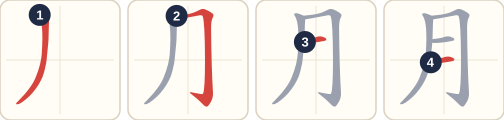
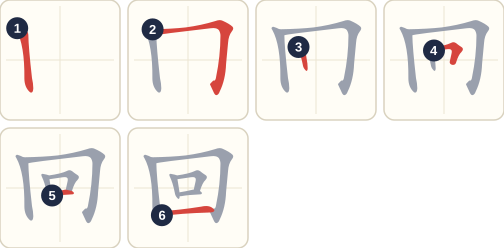
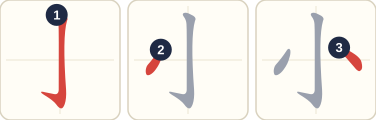
Stroke order follows a handful of rules: horizontal before vertical (十), left-falling before right-falling (人), top to bottom (三), left to right (川), outside before inside (月), close the frame last (回) and, in symmetrical characters, the center first (小). China has an official standard that sets the order for each of its 8,105 standard characters.
Why stroke order matters
Nobody will fail to understand you because you wrote one stroke before another. But the correct order teaches your hand a fixed path: the character comes out the same every time, you write faster, you remember its shape better, and your handwriting stays readable when you're in a hurry.
The 7 basic rules
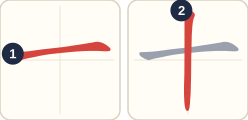
1. Horizontal before vertical
Example: 十 (shí, ten). The horizontal line, then the vertical one.
2. Left-falling before right-falling
Example: 人 (rén, person). The stroke going down to the left, then the one going down to the right.

3. Top to bottom
Example: 三 (sān, three). The three lines, from the top one to the bottom one.

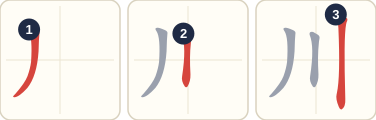
4. Left to right
Example: 川 (chuān, river). From the line on the left to the line on the right.
5. Outside before inside
Examples: 月 (yuè, moon) and 同 (tóng, same). The outline, then what goes inside.
6. Inside before closing the frame
Examples: 回 (huí, to return) and 国 (guó, country). The open frame, then the inside, and finally the bottom line that closes it.
7. In symmetrical characters, center first
Examples: 小 (xiǎo, small) and 水 (shuǐ, water). The middle stroke, then the two sides.
These rules work together. In 国 (country), for example, you write the open frame, then the inside from top to bottom, and finally the line that closes the frame.
 Test your Chinese
Improve your Chinese with our app, Macalaoshi Flashcards: 1,300+ words and characters to practice like this.
See the appThe basic strokes
China's official standard groups all strokes into five main forms. All the others are variants of these five:
| Stroke | Name | What it is | Also includes |
|---|---|---|---|
| 横 | héng | Horizontal, left to right | The short rising stroke 提 (tí) |
| 竖 | shù | Vertical, top to bottom | The vertical with a hook |
| 撇 | piě | Diagonal falling to the left | — |
| 点 | diǎn | Dot | The diagonal falling to the right, 捺 (nà) |
| 折 | zhé | Turning: changes direction | All strokes that turn, with or without a hook |
Said in this order, the five names make a sequence that's widely used in China to remember them: 横竖撇点折.
Are there 32 strokes?
Lots of people search for “the 32 Chinese strokes”. That number comes from study materials that count 6 simple strokes plus 26 compound ones, but it isn't official: depending on the author, lists range from 29 to 35, and no national standard sets the total. What a standard (GF 2001-2001) does define is the turning strokes: 25 forms in printed characters.
The official standards
- 1997: the stroke order standard for the 7,000 commonly used characters.
- 2020: standard GF 0023-2020, in force since March 2021, which gives the order for each of the 8,105 standard characters and keeps the 1997 rules.
Differences between China, Taiwan and Japan
The order is almost always the same, but there are some well-known cases:
| Character | Mainland China | Japan |
|---|---|---|
| 右 | Starts with the horizontal | Starts with the diagonal |
| 王 | Horizontal, horizontal, vertical, horizontal | Horizontal, vertical, horizontal, horizontal |
The order of 必 also differs between mainland China, Taiwan and Japan. If you study with materials from one country, follow that country's order.
How to practice
- Watch the animation first. Chinese dictionaries and apps show the stroke order for every character.
- Write it correctly three or four times, not fifty times wrong. Say its pronunciation out loud as you write it.
- Use grid paper (田字格, tiánzìgé), divided into four, to place each stroke and keep the proportions.
- Learn the most common components first. If you can write 口, 木 or 女, you can already write part of many other characters. We explain this in how to memorize Chinese characters.
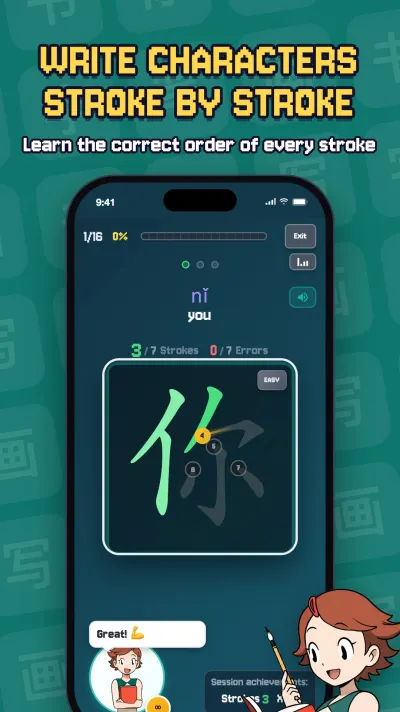
Improve your Chinese with Macalaoshi Flashcards
Maca Laoshi's app for learning characters, with audio, pinyin and stroke-by-stroke writing.
- 1,300+words and characters
- HSK 1–4by level
- Freeto start

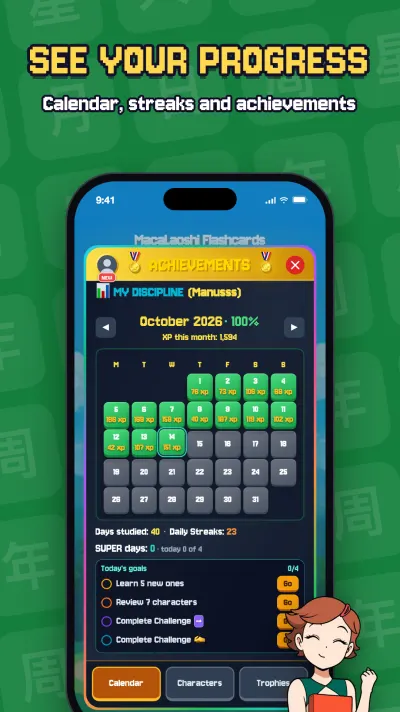



Learn with our songs
We made them for Macalaoshi. Singing along is a fun way to practice pronunciation and review vocabulary.
The Lighthouse of My Heart 我心里灯塔

Study With You 跟你一起学
Frequently asked questions
Do you have to follow stroke order?
Not to be understood. But with the correct order, your handwriting comes out more even and faster, you remember each character's shape better, and your writing stays legible even when you write quickly.
How many basic strokes are there in Chinese?
China's official standard groups strokes into five main forms: horizontal, vertical, left-falling diagonal, dot and turning. The figure of 32 strokes that circulates in study materials isn't official: depending on the author, lists range from 29 to 35.
Is stroke order the same in China, Taiwan and Japan?
Almost always, but there are exceptions. For example, in China 右 starts with the horizontal stroke, and in Japan with the diagonal.
How do I find the stroke order of a character I don't know?
Chinese dictionaries and apps show stroke order animations. Pleco, for example, has them free for 500 characters (28,000 in the paid version), and Macalaoshi uses them in its writing mode.
What is a 田字格?
It's a practice grid divided into four equal parts that helps you place each stroke and keep the character's proportions.
Maca Laoshi, born in Beijing, has taught Mandarin Chinese for more than 22 years and has had over 1,500 students. Together with her son Manu Shi, who has more than 93,000 subscribers on YouTube, she created Macalaoshi, an app that challenges you to push yourself one character at a time. Few Chinese teachers can show both: their own app and a channel like that.
Sources
- Ministry of Education of China: stroke order standard for general standard characters (GF 0023-2020), in force since 2021.
- Stroke order standard for commonly used characters in modern Chinese (1997).
- Standard for turning strokes (GF 2001-2001): 25 forms.
- Xu Lili (East China Normal University): no national standard sets the total number of strokes.
- Chen Chen and Feng Liping (2016): the basic stroke order rules in teaching.
- Nihon Bunkyo Shuppan (2018): stroke order in Japan (右 and 左).
- Pleco on the App Store: stroke order animations, 500 characters free and 28,000 in the paid version.
- Stroke-order diagrams generated from Make Me a Hanzi / hanzi-writer-data (Arphic Public License).
This guide in other languages: Español · Português · Français · Deutsch · Italiano · 日本語 · 한국어