Guides › Similar Chinese characters
Chinese characters that look alike (and how to tell them apart)
Maca Laoshi, Mandarin Chinese teacher
Updated October 20, 2026 · 7 min read
The most confused Chinese characters are pairs or trios that differ by a single stroke: 己 / 已 / 巳, 未 / 末, 土 / 士, 买 / 卖 or 午 / 牛. The most effective way to tell them apart is to look at the stroke that changes (its length, an extra dot, an opening) and to study them in pairs, inside words, not in isolation.
The 16 groups that get confused most
The table gathers groups of characters that look very similar. Each has pinyin, meaning and a concrete clue about the stroke that separates them. First look at the characters only, cover the rest and try to name them.
| Characters | Pinyin | Meaning | How to tell them apart |
|---|---|---|---|
| 己 / 已 / 巳 | jǐ / yǐ / sì | oneself / already / snake (sixth zodiac sign) | Look at the gap at the top left: 己 is open, 已 half closed and 巳 closed. |
| 未 / 末 | wèi / mò | not yet / end | In 末 the top horizontal stroke is the longest; in 未 the lower one is. |
| 土 / 士 | tǔ / shì | earth / scholar, soldier | In 土 the bottom bar is the long one; in 士 the top bar is. |
| 人 / 入 / 八 | rén / rù / bā | person / to enter / eight | In 入 the right stroke is the long one and starts higher; in 人 the left stroke is the long one and the right one starts from its middle; in 八 the two strokes don't touch. |
| 日 / 曰 | rì / yuē | sun, day / to say (literary) | 日 is taller than wide; 曰 is wider than tall. |
| 大 / 太 / 犬 | dà / tài / quǎn | big / too, very / dog (literary) | 太 is 大 with a dot below; 犬 is 大 with a dot at the top right. |
| 王 / 玉 / 主 | wáng / yù / zhǔ | king / jade / master, main | 玉 is 王 with a dot at the bottom right; 主 has the dot on top. |
| 天 / 夫 | tiān / fū | sky, day / husband | In 夫 the falling stroke sticks out above the top line; in 天 it doesn't, and the top line is shorter than the lower one. |
| 刀 / 力 | dāo / lì | knife / strength | In 力 the left stroke crosses the bar; in 刀 it starts below it. |
| 千 / 干 / 于 | qiān / gān / yú | thousand / dry; to do (gān/gàn) / at, in | 千 starts with a slanting stroke; 干 and 于 start with two bars, and 于 ends with a hook. |
| 买 / 卖 | mǎi / mài | to buy / to sell | 卖 has an extra 十 on top that 买 lacks. |
| 没 / 设 | méi / shè | not have / to set up | The left radical decides: 氵 (water) in 没, 讠 (speech) in 设. |
| 找 / 我 | zhǎo / wǒ | to look for / I, me | 找 has the hand radical 扌 on the left (searching with your hands); 我 starts with a slanting stroke. |
| 午 / 牛 | wǔ / niú | noon / ox, cow | In 牛 the vertical line pokes out at the top; in 午 it does not. |
| 贝 / 见 | bèi / jiàn | shell / to see | 贝 ends with a falling stroke and a dot; 见 ends with 儿, a “leg” that curves to the right. |
| 清 / 请 / 情 / 晴 | qīng / qǐng / qíng / qíng | clear / to ask, please / feeling / sunny | Same 青 on the right; the radical is the clue: 氵 water → 清; 讠 speech → 请; 忄 heart → 情; 日 sun → 晴. |
 Test your Chinese
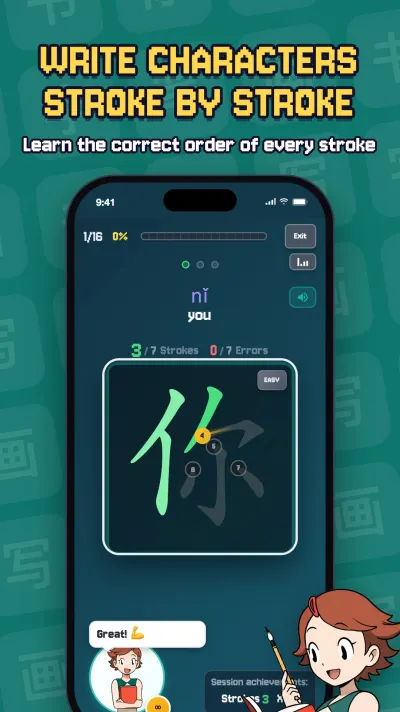
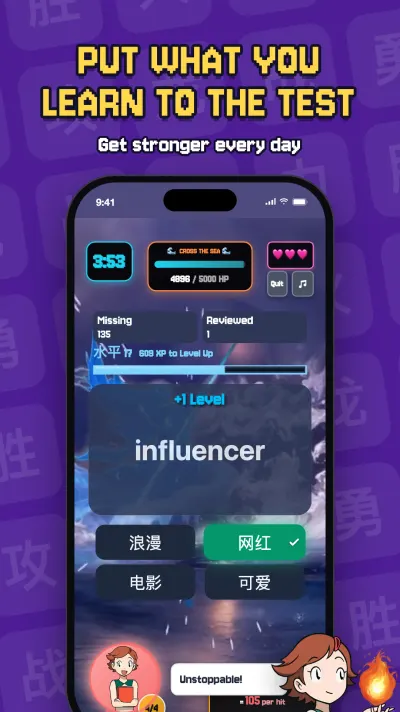
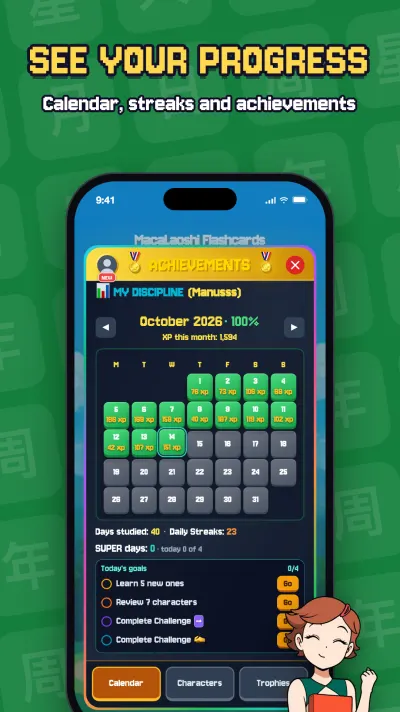
Improve your Chinese with our app, Macalaoshi Flashcards: 1,300+ words and characters to practice like this.
See the appWhy it happens: components
Most characters are built from smaller pieces (radicals and components), and many pieces are nearly identical. That is why 清, 请, 情 and 晴 share the same right-hand part, 青, which supplies the sound (qīng/qíng), while the left radical supplies the idea: water, speech, heart or sun. Once you understand the piece, you stop seeing a drawing and start seeing a combination with logic.
Techniques to stop mixing them up
- Look at the stroke that changes. Before memorizing, point at the difference: a longer bar, a dot, an opening.
- Study in pairs. Learn 买 and 卖 on the same day, side by side, and compare them; the brain then stores the difference, not just the shape.
- Learn with words and sentences. 买东西 (to buy things), 卖东西 (to sell things) or 我找你 (I'm looking for you) teach the use, which is what removes the ambiguity.
- Write by hand. Stroke order forces you to notice every line; see the stroke order guide.
- Review what you miss. Confusions are fixed by repeating the exact pairs that give you trouble. More techniques in how to memorize characters.
Practice them in Macalaoshi
In Macalaoshi the characters are a challenge: "You came to save this world from the Empress," and "the Empress's weakness is Chinese characters." Telling look-alikes apart is part of that challenge: each character levels up when you get it right, and what you miss comes back for review. To decide which characters to prioritize, see the most frequent characters, and to understand how they work, how to read characters you don't know.
The stroke tips describe the usual printed form of each character; handwriting and typefaces vary. The meanings are the main ones and do not exhaust the dictionary.
Improve your Chinese with Macalaoshi Flashcards
Maca Laoshi's app for learning characters, with audio, pinyin and stroke-by-stroke writing.
- 1,300+words and characters
- HSK 1–4by level
- Freeto start


Learn with our songs
We made them for Macalaoshi. Singing along is a fun way to practice pronunciation and review vocabulary.
The Lighthouse of My Heart 我心里灯塔

Study With You 跟你一起学
Frequently asked questions
Which Chinese characters are confused most often?
Among the most common are 己/已/巳, 未/末, 土/士, 买/卖, 找/我, 午/牛 and 贝/见. They differ by a stroke, an opening or a dot.
How do I tell 己, 已 and 巳 apart?
Look at the gap at the top left: 己 (jǐ, "oneself") is open, 已 (yǐ, "already") is half-closed and 巳 (sì, a zodiac sign) is closed.
How do I tell 买 and 卖 apart?
买 (mǎi) means "to buy" and 卖 (mài) means "to sell". 卖 has an extra 十 on top. The tone also changes: 买 is third tone and 卖 is fourth.
Why are there so many look-alike characters?
Because they are built from a limited set of components and strokes, and many differ in only one. Learning the components helps you see them as pieces with logic.
What is the best way to avoid confusing them?
Look at the stroke that changes, study them in pairs and inside words, write them by hand and review the ones you miss.
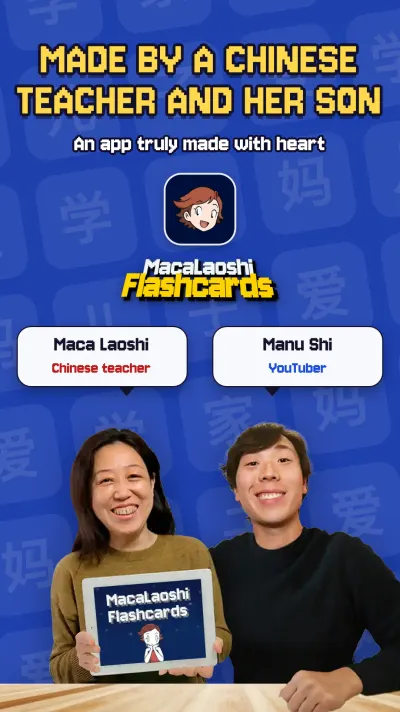
Maca Laoshi, born in Beijing, has taught Mandarin Chinese for more than 22 years and has had over 1,500 students. Together with her son Manu Shi, who has more than 93,000 subscribers on YouTube, she created Macalaoshi, an app that challenges you to push yourself one character at a time. Few Chinese teachers can show both: their own app and a channel like that.
Sources
This guide in other languages: Español · Português · Français · Deutsch · Italiano · 日本語 · 한국어