Guides › Does Chinese have tenses?
Does Chinese have tenses? Basic grammar without the fear
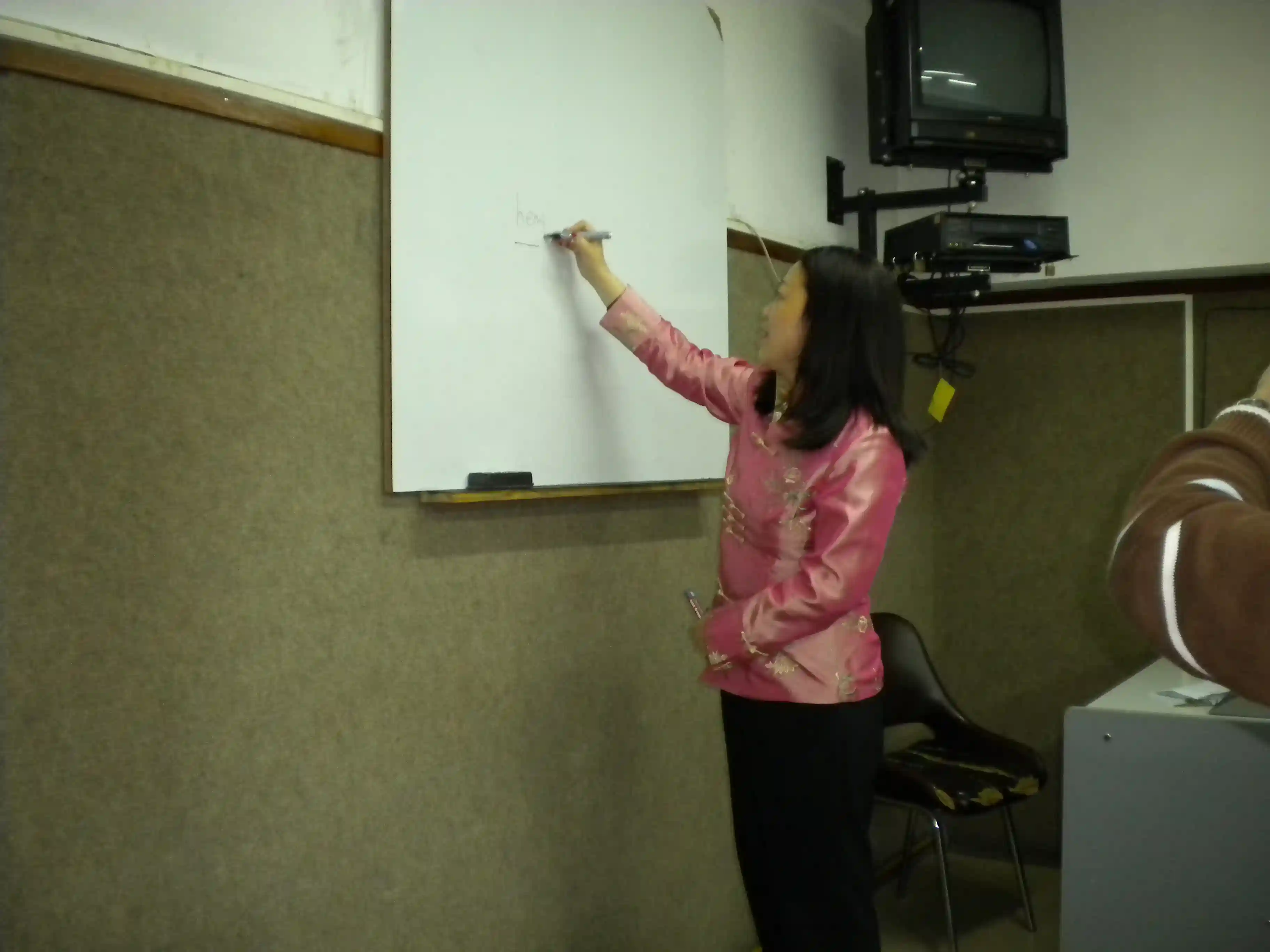
Maca Laoshi, Mandarin Chinese teacher
Updated October 20, 2026 · 8 min read
No. Chinese does not conjugate verbs: the verb stays the same for I, you or they, yesterday or tomorrow. Time is shown with words like 昨天 (yesterday) and 明天 (tomorrow), and what grammar adds is not tense but aspect, through particles such as 了, 过, 在 and 着. There is no grammatical gender, no articles, and plurals are rarely marked.
Does Chinese have tenses?
According to the Chinese Grammar Wiki (AllSet Learning), Chinese does not use a formal tense system. Instead it has an aspect system, where particles show how an action relates to time. The key difference:
- Tense (when something happens) is shown with words: 我昨天去商店。 (Wǒ zuótiān qù shāngdiàn: "I went to the shop yesterday") and 我明天去商店。 ("I will go to the shop tomorrow"). The verb 去 does not change.
- Aspect (how the action is viewed: completed, experienced, ongoing) is shown with particles.
| Particle | Aspect | Example |
|---|---|---|
| 了 | Completed action | 我买了一本书。 I bought a book. |
| 过 | Experience ("have ever") | 我去过中国。 I have been to China. |
| 在 / 正在 | Ongoing action | 他在吃饭。 He is eating. |
| 着 | Continuing state | 门开着。 The door is open. |
One detail that surprises English speakers: 了 does not mean "past". It marks that an action is complete, not when it happened, which is why it also appears with the future: 明天我吃了饭就去。 ("Tomorrow, once I have eaten, I will go."). For the full picture, see the Chinese Grammar Wiki page on expressing completion with 了.
The short answers, one by one
| Question | Answer in Chinese | Example |
|---|---|---|
| Are verbs conjugated? | No. One form for every person. | 我是, 你是, 他是 |
| Are there plurals? | Rarely marked. 们 is added only to pronouns and people; 些 means "some". | 我们, 学生们, 一些书 |
| Is there gender? | Not grammatically. 他, 她, 它 are written differently but sound the same: tā. | 他是老师。 她是老师。 |
| Are there articles? | No. Context or a demonstrative (这, 那) does the job. | 我有书。 I have books. |
| What is the word order? | Subject, verb, object. Time and place go before the verb. | 我今天在家学习中文。 |
| What are classifiers? | Words placed between a number and a noun. | 一个人, 一本书, 一只猫 |
| How do you ask yes/no questions? | Add 吗 at the end. | 你是学生吗? |
Plurals, gender and articles
书 can mean "book" or "books". With a number nothing more is added: 三本书 is "three books". The suffix 们 appears only with people (老师们, "the teachers") and never next to a number. As for gender, when speaking you only need to remember that 他, 她 and 它 are pronounced the same.
Word order and classifiers
The basic order resembles English (subject, verb, object), but there is an important rule: time and place expressions go before the verb. So you say, literally, "I today at home study Chinese". Classifiers are the most unfamiliar part for English speakers: you cannot say "three books" without the classifier 本. For numbers, see how to count in Chinese.
Negation and questions
Negation uses 不 (我不去, "I am not going") and 没 for what did not happen (我没去, "I did not go"). Yes/no questions are formed by adding 吗, with no change in word order.
 Test your Chinese
Improve your Chinese with our app, Macalaoshi Flashcards: 1,300+ words and characters to practice like this.
See the appCommon mistakes for beginners
- Putting 了 everywhere. It is not needed on every past verb: if there is already a time word like 昨天, the sentence works without it. 了 marks completion or a change of situation.
- Placing place or time at the end. In English you say "I study Chinese at home"; in Chinese, the place goes before the verb: 我在家学习中文.
- Using "to be" before an adjective. "I am busy" is 我很忙, without 是.
- Forgetting the classifier. With a number or "this" you need one: 这本书, "this book".
- Looking for a rule that is not there. If a sentence sounds odd, it is almost always word order or an extra word, not a missing ending.
Comparison with English
| Feature | English | Chinese |
|---|---|---|
| Tenses | Past, present, future, with verb forms | None; time words and aspect particles |
| Conjugation by person | Limited (I eat, he eats) | No |
| Plural | Almost always (book, books) | Rarely; 们 only with people |
| Gender | Pronouns only (he, she, it) | Not grammatical; he/she/it sound the same |
| Articles | a, an, the | None |
| Word order | Subject-verb-object | Subject-verb-object, time and place before the verb |
| Classifiers | Only with some nouns (a piece of, a cup of) | Yes, required with numbers |
| Yes/no questions | Word order change and "do" | Particle 吗 |
So, is it easy?
Chinese grammar is short, but that does not mean everything is easy: tones and characters are the hard part. To see how much each part costs, read is Chinese really hard to learn and the guide to Mandarin tones. To organize your study, the 30-day plan spreads the work week by week.
In Macalaoshi you practice it as a challenge: "You came to save this world from the Empress", and "the Empress's weakness is Chinese characters". The more words and characters you know, the more sentences you can build with this short grammar.
This guide summarizes the basic rules and does not replace a full grammar. For specific cases, consult the Chinese Grammar Wiki.
Improve your Chinese with Macalaoshi Flashcards
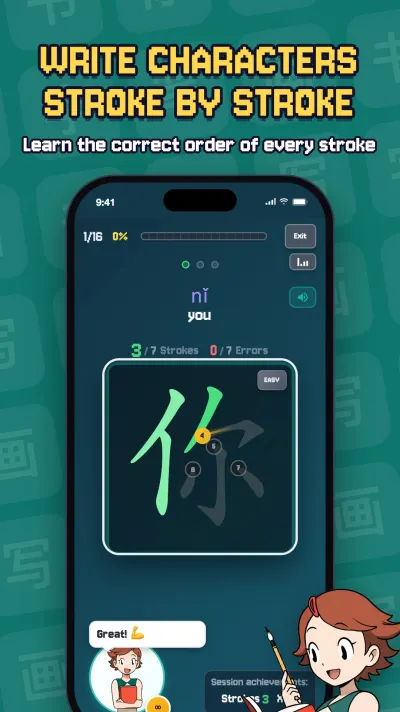
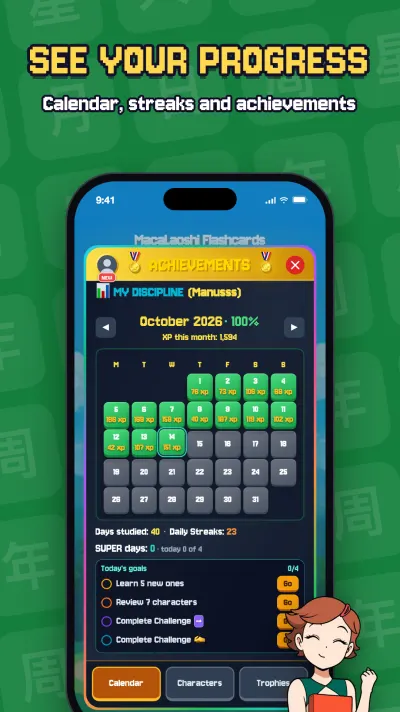
Maca Laoshi's app for learning characters, with audio, pinyin and stroke-by-stroke writing.
- 1,300+words and characters
- HSK 1–4by level
- Freeto start




Learn with our songs
We made them for Macalaoshi. Singing along is a fun way to practice pronunciation and review vocabulary.
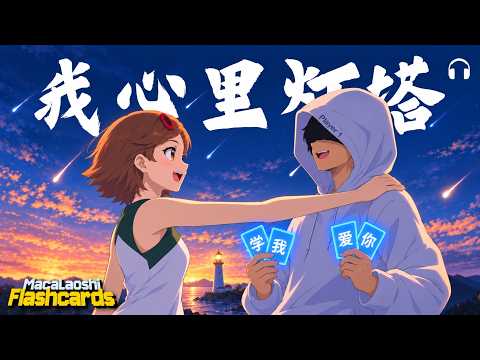
The Lighthouse of My Heart 我心里灯塔

Study With You 跟你一起学
Frequently asked questions
Does Chinese have tenses?
No. The verb does not change form. Time is shown with words such as yesterday or tomorrow, and grammar adds aspect particles (了, 过, 在, 着) that say whether an action is complete, experienced or ongoing.
How do you say the past tense in Chinese?
With a time word (昨天, "yesterday") and, if you want to mark that the action was completed, the particle 了 after the verb: 我买了一本书, "I bought a book". For a lived experience, use 过: 我去过中国.
Does Chinese have plurals?
Rarely marked. 书 can be "book" or "books". The particle 们 is added to pronouns and people (我们, 学生们), and 些 means "some".
Does Chinese have gender and articles?
No grammatical gender and no articles. 他, 她 and 它 ("he", "she", "it") are written differently but pronounced the same: tā.
What is the word order in Chinese?
Subject, verb, object, as in English. Time and place expressions go before the verb: 我今天在家学习中文.
What is a classifier?
A word placed between a number and a noun, like 个 in 一个人 or 本 in 一本书. It is required when counting.
Maca Laoshi, born in Beijing, has taught Mandarin Chinese for more than 22 years and has had over 1,500 students. Together with her son Manu Shi, who has more than 93,000 subscribers on YouTube, she created Macalaoshi, an app that challenges you to push yourself one character at a time. Few Chinese teachers can show both: their own app and a channel like that.
Sources
- Chinese Grammar Wiki (AllSet Learning): aspect; Chinese has no formal tense system and uses aspect particles (了, 过, 着).
- Chinese Grammar Wiki: expressing completion with 了; it marks that an action is complete, not when it happened.
- Chinese Grammar Wiki: referring to the past.
- Chinese Grammar Wiki: aspectual particles.
This guide in other languages: Español · Português · Français · Deutsch · Italiano · 日本語 · 한국어