Guides › Books to learn Chinese on your own
The best books to learn Chinese on your own: what to pick for your stage and goal
Maca Laoshi, Mandarin Chinese teacher
Updated October 25, 2026 · 8 min read

There is no single best book: it depends on your stage and goal. A sensible set is one course with audio, one grammar to look things up in, and one character book, plus daily practice of words and characters in an app. For a complete beginner, Colloquial Chinese (course with free audio) or Integrated Chinese (university-style course) are the usual starting points; for grammar, Basic Chinese and Chinese: An Essential Grammar. We list only books whose publisher or bookseller page we could check.
Before you buy: three things to check
- Audio: without audio you will not learn the tones. Check whether the book comes with CDs, downloadable MP3s or nothing, and for which edition: audio changes between editions.
- Simplified characters and pinyin: most courses for studying Mandarin of mainland China use simplified characters with pinyin. If you care about Taiwan, read the guide on traditional and simplified characters.
- Year and syllabus: HSK preparation books change with every reform. A grammar or a character book ages far less.
We do not give prices, because they change by edition and store. To plan your first steps before buying anything, see where to start.
Comparison table
| Stage | Book | Author(s) | Publisher and year | Verified notes |
|---|---|---|---|---|
| Start from zero | Colloquial Chinese: The Complete Course for Beginners (3rd ed.) | Kan Qian | Routledge, 2021 | Free MP3 audio; no prior knowledge required |
| Start from zero | Chinese For Dummies (3rd ed.) | Wendy Abraham | John Wiley & Sons, 2018 | Free conversational audio online; mini-dictionary |
| Full course | Integrated Chinese (4th ed., Volume 1) | Yuehua Liu, Tao-chung Yao and others | Cheng & Tsui, 2017 | University-style text; simplified-character edition |
| Grammar | Basic Chinese: A Grammar and Workbook (2nd ed.) | Yip Po-Ching and Don Rimmington | Routledge, 2009 | For beginners; the page does not mention audio |
| Grammar | Chinese: An Essential Grammar (3rd ed.) | Yip Po-Ching and Don Rimmington | Routledge, 2021 | Reference grammar, not a course; any level |
| Characters | Remembering Simplified Hanzi 1 | James W. Heisig and Timothy W. Richardson | University of Hawaii Press, 2008 | 1,500 characters: meaning and writing (not pronunciation) |
| HSK (previous) | HSK Standard Course 1 | Jiang Liping | Beijing Language and Culture University Press, 2014 | Written for the previous HSK, not 3.0 |
| Reading | Mandarin Companion, level 1 series | Various authors; edited by John Pasden | Mind Spark Press | Level 1 uses only 300 unique characters |
The details come from publisher and bookseller pages checked in October 2026. Editions, audio and availability change, so confirm them on the seller's page before buying.
 Test your Chinese
Improve your Chinese with our app, Macalaoshi Flashcards: 1,300+ words and characters to practice like this.
See the appStage by stage: what each book is for
1. Start from zero
Colloquial Chinese (Kan Qian, Routledge, 3rd edition, 2021) is a beginner course whose publisher page says no prior knowledge is required and offers the audio as a free MP3 download. That makes it a good fit if you want a single book with sound. Chinese For Dummies (Wendy Abraham, Wiley, 3rd edition, 2018) is a lighter, practical introduction with free audio tracks online, useful if your goal is travel or everyday phrases rather than a systematic course. For a calendar of what to do first, see the 30-day plan.
2. A full course
Integrated Chinese (Liu, Yao and others, Cheng & Tsui, 4th edition, 2017) is a textbook used in university courses. It is more structured and more demanding than the beginner titles above, and works best with a teacher or a clear study plan. If you study alone, check first that you can get the audio and workbook that go with your edition.
3. Grammar: reference or workbook
Basic Chinese: A Grammar and Workbook (Yip and Rimmington, Routledge, 2nd edition, 2009) pairs grammar explanations with exercises, so you can check what you learned. Chinese: An Essential Grammar (same authors, 3rd edition, 2021) is a reference grammar: you look things up in it rather than read it start to finish, and the publisher says it suits learners of any level. If you are not sure whether you need a grammar yet, start with our basic grammar guide.
4. Characters
Remembering Simplified Hanzi 1 (Heisig and Richardson, University of Hawaii Press, 2008) teaches the meaning and the writing of 1,500 characters with a memory method. It deliberately does not teach pronunciation, so it works alongside a course, not instead of one. It can be demanding if you do it alone; if you want to see how writing fits in, read whether you need to handwrite characters.
5. HSK and reading
HSK Standard Course 1 (Jiang Liping, BLCU Press, 2014) is a course written for the previous HSK. The new HSK 3.0 has its first official exam on 13 December 2026, so if you sit it, check the current syllabus on the HSK 1 guide and the official site before buying. For reading, the Mandarin Companion series adapts stories into graded Chinese; its level 1 uses only 300 unique characters, which makes it a first step into reading a whole story once you know the basics.
How to choose for your situation
- Complete beginner who likes structure: Colloquial Chinese or Integrated Chinese, plus a pinyin chart and tone practice.
- Traveller or casual learner: Chinese For Dummies and a few weeks of daily phrase practice.
- You want to understand the grammar: a grammar workbook alongside any course.
- You want to read and write characters: a character book plus daily writing practice.
- You are preparing for the HSK: pick materials that match the syllabus you will actually sit.
Books and an app: an honest combination
- The book explains how the language works: pinyin, grammar, examples. It only helps if you finish it.
- The app puts daily practice on words and characters. Five to ten minutes every day add up to more than one long session a month.
- A simple loop: read a lesson, practice the new words in the app, and come back to them the next day. More ideas in how to memorise vocabulary.
Neither is enough for everything. Try a week and adjust the mix to what you find hardest.
How Macalaoshi does it
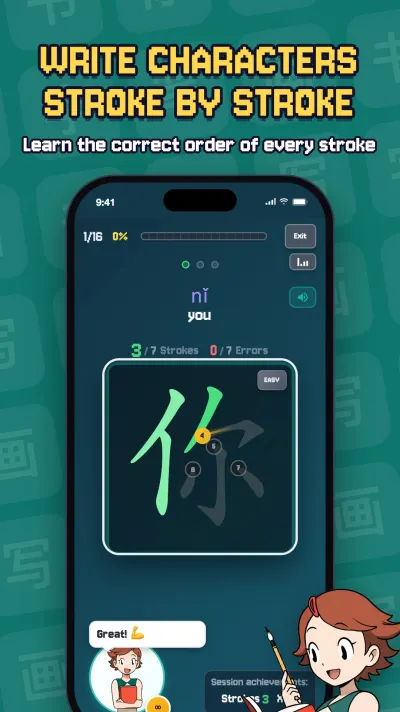
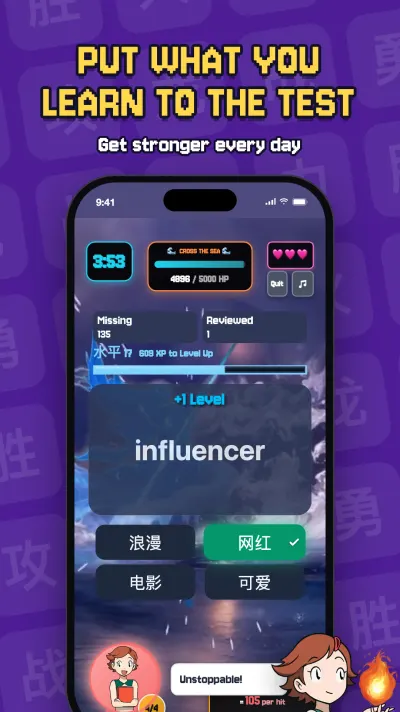
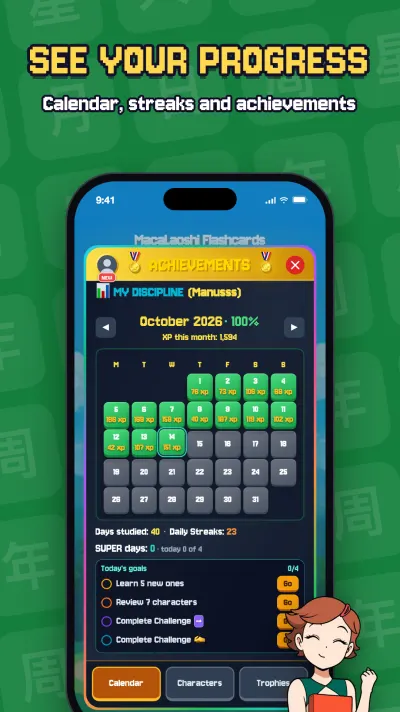
Macalaoshi does not replace a book: it puts in the daily practice. It is a challenge to save the world from the Empress with the power of characters, with more than 1300 words and characters from HSK 1 to 4. Each character you get right levels up and what you miss comes back so you can review it; in writing mode you trace each character stroke by stroke in the correct order. It is a good companion to the words you meet in your book. If you are deciding between apps, see the app comparison.
This guide includes only books whose listings we could check. Editions, audio and availability change: confirm the details on the publisher's or bookseller's page before buying.
Improve your Chinese with Macalaoshi Flashcards
Maca Laoshi's app for learning characters, with audio, pinyin and stroke-by-stroke writing.
- 1,300+words and characters
- HSK 1–4by level
- Freeto start


Learn with our songs
We made them for Macalaoshi. Singing along is a fun way to practice pronunciation and review vocabulary.

The Lighthouse of My Heart 我心里灯塔

Study With You 跟你一起学
Frequently asked questions
What is the best book to teach yourself Chinese?
It depends on your stage and goal. For a complete beginner who wants a single course with audio, Colloquial Chinese is a reasonable choice; for a university-style course, Integrated Chinese; for grammar, Basic Chinese or Chinese: An Essential Grammar. Each is described below, with who it suits.
Can I learn Chinese from books alone?
Books help you understand grammar, but pronunciation and tones need audio, and words and characters need daily repetition. Combining a book with audio and daily practice works better than a book alone.
Do these books teach simplified or traditional characters?
The ones listed here use simplified characters with pinyin. If you want Taiwan's traditional characters, check the edition before buying.
Which book is best for the HSK?
Books written before 2025 target the previous HSK. The new HSK 3.0 has its first official exam on 13 December 2026, so check which syllabus a book follows before buying.
Are graded readers worth it for beginners?
They can be, once you know a few hundred characters. Mandarin Companion's level 1 uses only 300 unique characters, which makes it a first step into reading real stories.
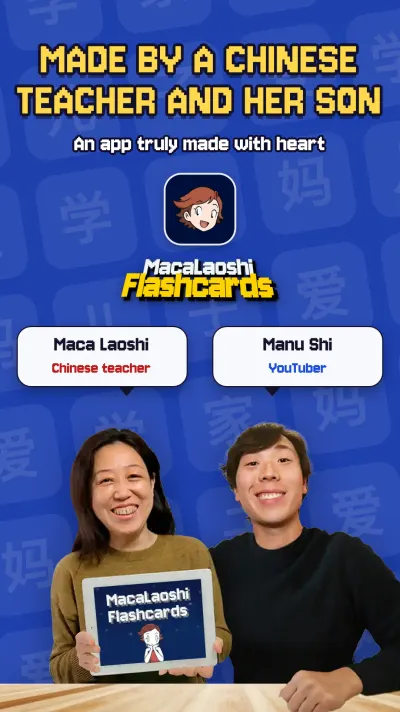
Maca Laoshi, born in Beijing, has taught Mandarin Chinese for more than 22 years and has had over 1,500 students. Together with her son Manu Shi, who has more than 93,000 subscribers on YouTube, she created Macalaoshi, an app that challenges you to push yourself one character at a time. Few Chinese teachers can show both: their own app and a channel like that.
Sources
- Routledge: Colloquial Chinese: The Complete Course for Beginners, 3rd edition, Kan Qian, 2021; free MP3 audio to download; no prior knowledge required.
- Cheng & Tsui: Integrated Chinese, Fourth Edition, Volume 1, simplified characters, 2017; principal authors Yuehua Liu and Tao-chung Yao.
- Dummies.com: Chinese For Dummies, 3rd edition, Wendy Abraham, John Wiley & Sons, 19 September 2018; free conversational audio tracks online; includes a mini-dictionary.
- Routledge: Basic Chinese: A Grammar and Workbook, 2nd edition, 2009, Yip Po-Ching and Don Rimmington; designed for students new to the language; the page does not mention audio.
- Routledge: Chinese: An Essential Grammar, 3rd edition, Yip Po-Ching and Don Rimmington, 2021; a reference grammar rather than a textbook, for learners of any level; characters and pinyin with every example.
- University of Cambridge Language Centre and bookseller listings: Remembering Simplified Hanzi 1 (Heisig and Richardson, University of Hawaii Press, 2008 or 2009 depending on the listing); covers 1,500 characters, their meaning and writing.
- Hacking Chinese: review of Mandarin Companion (Mind Spark Press, edited by John Pasden); level 1 uses 300 unique characters.
- Open Library: HSK Standard Course 1, Jiang Liping, Beijing Language and Culture University Press, 2014 (a course for the previous HSK).
- Chinese Testing International: the official HSK page and sample exams (September 2026).