Guides › Family in Chinese
Family Members in Chinese: What Each Relative Is Called, with Pinyin and HSK Level
Maca Laoshi ·
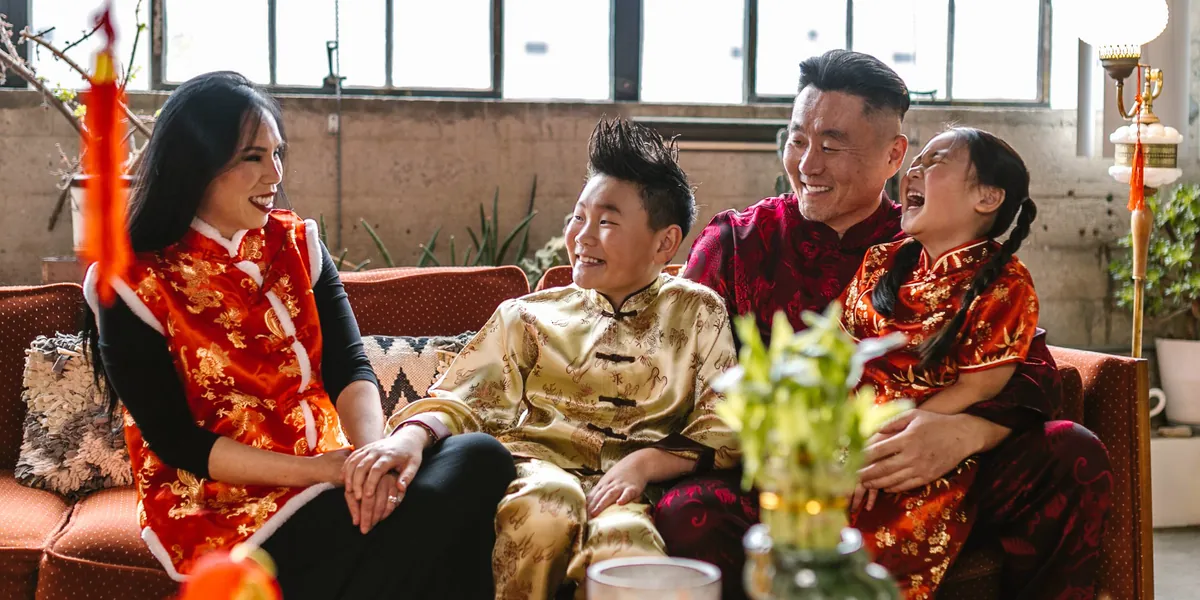
In Chinese almost every relative has their own word, which depends on whether they are on your father’s or your mother’s side and whether they are older or younger than you. The basics: 爸爸 (bàba, dad), 妈妈 (māma, mom), 哥哥 and 姐姐 (older brother and sister), 弟弟 and 妹妹 (younger brother and sister). Grandparents on your father’s side are 爷爷 and 奶奶; on your mother’s side, 外公 and 外婆. This guide gathers about 80 terms with pinyin and HSK level, plus phrases like 你家有几口人? (how many people are in your family?). For everyday phrases to start with, see Chinese greetings.
 Test your Chinese
Improve your Chinese with our app, Macalaoshi Flashcards: 1,300+ words and characters to practice like this.
See the appThe logic: father’s or mother’s side, older or younger
Before memorizing the list, it helps to understand four ideas that keep coming back:
- Father’s or mother’s side. Relatives on the paternal and maternal sides have different words: a father’s brother and a mother’s brother are not called the same. A father’s brothers are 伯 and 叔, and his sisters 姑; a mother’s brothers are 舅 and her sisters 姨.
- Older or younger. Siblings are told apart by age: 哥 and 姐 are older; 弟 and 妹 are younger. The same goes for a father’s brothers: 伯 for the older one and 叔 for the younger.
- 堂 and 表. 堂 is for cousins on your father’s side who share your surname (the children of your father’s brothers); 表 is for other cousins, through female relatives. According to Wikipedia, 表 also applies to the children of a father’s sisters.
- 外. It is the prefix of the maternal line in 外公 and 外婆, and it also marks grandchildren through a daughter (外孙) and the children of a sister (外甥); the children of a brother are 侄子 and 侄女.
Parents, siblings, children and spouse
The basics for talking about your family. In the HSK column, “—” means the word is not on the list.
| Chinese | Pinyin | Meaning | HSK |
|---|---|---|---|
| 爸爸 | bàba | dad | 1 |
| 妈妈 | māma | mom | 1 |
| 父母 | fùmǔ | parents | 4 |
| 爸妈 | bàmā | mom and dad (colloquial) | — |
| 哥哥 | gēge | older brother | 1 |
| 姐姐 | jiějie | older sister | 1 |
| 弟弟 | dìdi | younger brother | 1 |
| 妹妹 | mèimei | younger sister | 1 |
| 兄弟姐妹 | xiōngdìjiěmèi | siblings | — |
| 儿子 | érzi | son | 1 |
| 女儿 | nǚ’ér | daughter | 1 |
| 孩子 | háizi | child | 1 |
| 丈夫 | zhàngfu | husband | 2 |
| 妻子 | qīzi | wife | 2 |
| 老公 | lǎogōng | husband (colloquial) | 5 |
| 老婆 | lǎopo | wife (colloquial) | 5 |
| 爱人 | àiren | spouse (mainland China) | 3 |
| 家人 | jiārén | family members | 1 |
| 亲戚 | qīnqi | relative(s) | 4 |
Grandparents
The father’s side and the mother’s side are named differently.
| Chinese | Pinyin | Meaning | HSK |
|---|---|---|---|
| 爷爷 | yéye | paternal grandfather | 2 |
| 奶奶 | nǎinai | paternal grandmother | 2 |
| 外公 | wàigōng | maternal grandfather | 5 |
| 外婆 | wàipó | maternal grandmother | 5 |
| 姥爷 | lǎoye | maternal grandfather (colloquial) | 5 |
| 姥姥 | lǎolao | maternal grandmother (colloquial) | 5 |
| 祖父 | zǔfù | paternal grandfather (more formal) | 7-9 |
| 祖母 | zǔmǔ | paternal grandmother (more formal) | 7-9 |
外公, 外婆, 姥爷 and 姥姥 are four ways to name maternal grandparents; the first two are easiest to remember because of the link with 外.
Take a quick breakImprove your Chinese with our app, Macalaoshi Flashcards: 1,300+ words and characters to practice like this.
See the appUncles and aunts
The distinction matters most here: each uncle or aunt is named by family side and age.
| Chinese | Pinyin | Meaning | HSK |
|---|---|---|---|
| 伯父 | bófù | uncle: father’s older brother | 7-9 |
| 伯伯 | bóbo | uncle: father’s older brother (everyday form) | 7-9 |
| 伯母 | bómǔ | aunt: wife of father’s older brother | 7-9 |
| 叔叔 | shūshu | uncle: father’s younger brother | 3 |
| 婶婶 | shěnshen | aunt: wife of father’s younger brother | — |
| 姑姑 | gūgu | aunt: father’s sister | 6 |
| 姑父 | gūfu | uncle: husband of father’s sister | — |
| 舅舅 | jiùjiu | uncle: mother’s brother | 6 |
| 舅妈 | jiùmā | aunt: wife of mother’s brother | — |
| 姨 | yí | aunt: mother’s sister | 6 |
| 姨妈 | yímā | aunt: mother’s sister (colloquial) | — |
| 姨父 | yífu | uncle: husband of mother’s sister | — |
According to Wikipedia, a mother’s older sister is 姨妈 and the younger one is 阿姨; the dictionary lists both as “mother’s sister”.
Cousins
They are told apart by surname (堂 or 表) and by age: 哥 and 姐 if older than you, 弟 and 妹 if younger.
| Chinese | Pinyin | Meaning | HSK |
|---|---|---|---|
| 堂哥 | tánggē | older male cousin on the father’s brother’s side (same surname) | — |
| 堂姐 | tángjiě | older female cousin on the father’s brother’s side | — |
| 堂弟 | tángdì | younger male cousin on the father’s brother’s side | — |
| 堂妹 | tángmèi | younger female cousin on the father’s brother’s side | — |
| 表哥 | biǎogē | older male cousin through a female relative (child of a father’s sister or of a mother’s sibling; different surname) | — |
| 表姐 | biǎojiě | older female cousin (different surname) | — |
| 表弟 | biǎodì | younger male cousin (different surname) | — |
| 表妹 | biǎomèi | younger female cousin (different surname) | — |
Ready for the hardest one?Improve your Chinese with our app, Macalaoshi Flashcards: 1,300+ words and characters to practice like this.
See the appGrandchildren, nephews and nieces, in-laws
Relatives by marriage also change with the family side.
| Chinese | Pinyin | Meaning | HSK |
|---|---|---|---|
| 孙子 | sūnzi | grandson (son’s son) | 4 |
| 孙女 | sūnnǚ | granddaughter (son’s daughter) | 4 |
| 外孙 | wàisūn | grandson (daughter’s son) | — |
| 外孙女 | wàisūnnǚ | granddaughter (daughter’s daughter) | — |
| 侄子 | zhízi | nephew (brother’s son) | 6 |
| 侄女 | zhínǚ | niece (brother’s daughter) | — |
| 外甥 | wàisheng | nephew (sister’s son) | 6 |
| 外甥女 | wàishengnǚ | niece (sister’s daughter) | — |
| 公公 | gōnggong | father-in-law (husband’s father) | — |
| 婆婆 | pópo | mother-in-law (husband’s mother) | — |
| 岳父 | yuèfù | father-in-law (wife’s father) | 7-9 |
| 岳母 | yuèmǔ | mother-in-law (wife’s mother) | 7-9 |
| 儿媳 | érxí | daughter-in-law | — |
| 女婿 | nǚxu | son-in-law | 7-9 |
| 嫂子 | sǎozi | sister-in-law (older brother’s wife) | 7-9 |
| 姐夫 | jiěfu | brother-in-law (older sister’s husband) | — |
| 妹夫 | mèifu | brother-in-law (younger sister’s husband) | — |
| 弟妹 | dìmèi | sister-in-law (younger brother’s wife) | — |
The HSK level comes from the HSK 2025 list (levels 1 to 9). “7-9” are advanced levels; Macalaoshi covers HSK 1 to 4.
How to ask “how many people are in your family?” and introduce yours
To talk about your family in a conversation, using the terms above.
| Chinese | Pinyin | Meaning | When to use it |
|---|---|---|---|
| 你家有几口人? | nǐ jiā yǒu jǐ kǒu rén | how many people are in your family? | Literally “how many mouths in your home?”; 口 is the counter for family members. |
| 我家有四口人。 | wǒ jiā yǒu sì kǒu rén | there are four of us in my family | Change the number: 三口人, 五口人… |
| 我家有爸爸、妈妈、哥哥和我。 | wǒ jiā yǒu bàba, māma, gēge hé wǒ | in my family there are dad, mom, my older brother and me | To list your family; 和 means “and”. |
| 你有兄弟姐妹吗? | nǐ yǒu xiōngdì jiěmèi ma | do you have siblings? | A common question when you meet someone. |
| 我有一个哥哥和一个妹妹。 | wǒ yǒu yī gè gēge hé yī gè mèimei | I have an older brother and a younger sister | 个 is the general counter for people. |
| 我是独生子女。 | wǒ shì dúshēng zǐnǚ | I’m an only child | 独生子女 means “only child”. |
| 这是我爸爸。 | zhè shì wǒ bàba | this is my dad | To introduce someone; swap 爸爸 for another relative. |
| 他是我哥哥。 | tā shì wǒ gēge | he is my older brother | Use 她 (“she”) for a girl. |
口 (kǒu) means “mouth” and is the counter for family members, which is why the question asks about “mouths”. To count siblings or other people, use 个: 一个哥哥.
Outside the family: 阿姨, 叔叔 and 哥/姐
Kinship terms are also used with people who are not relatives, to be polite or friendly:
| Chinese | Pinyin | Meaning | When to use it |
|---|---|---|---|
| 阿姨 | āyí | auntie; ma’am | For a woman of your mother’s generation. The dictionary also lists “maternal aunt” and “nanny, domestic worker”. |
| 叔叔 | shūshu | mister; uncle | Children use it for a man one generation older (according to the dictionary). |
| 大哥 | dàgē | brother; boss | A polite way to address a man about your age (according to the dictionary); also “eldest brother”. |
| 姐 | jiě | sis; older sister | Means “older sister”; used as a friendly address for a slightly older woman, even if not a relative. |
- 阿姨 and 叔叔 are a polite way to address a woman or a man of your parents’ age; children use them a lot.
- 哥 and 姐 are used among friends and acquaintances to address someone a little older in a familiar way. The dictionary lists 大哥 as a polite address for a man of about your age.
- Avoid mix-ups. 阿姨 also means “nanny” and “domestic worker”, so check the context.
How Macalaoshi does it
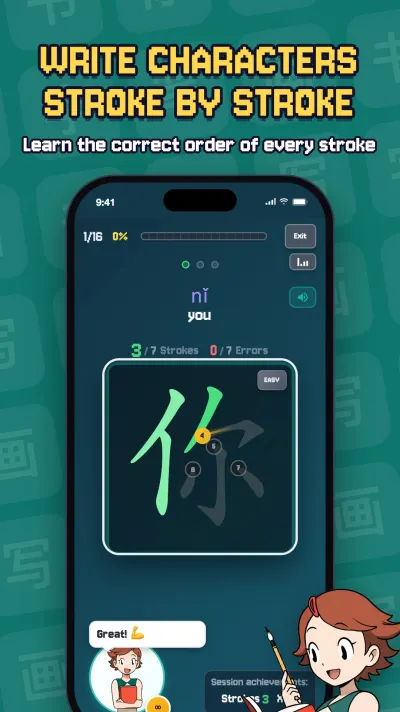
In Macalaoshi you collect characters from HSK 1 to 4 (more than 1300 words and characters in all), and every character you get right goes up a level; what you miss comes back for you to review. The basic family words (爸爸, 妈妈, 哥哥, 姐姐, 弟弟, 妹妹) are on the HSK 1 list, and you can practice writing each one stroke by stroke, in the correct order, while you move through the story with Lili against the Empress. To go on with something more personal, see how to say I love you in Chinese.
The pinyin follows the dictionary; neutral tones can vary by region. The use of each term changes between regions and families.
Improve your Chinese with Macalaoshi Flashcards
Maca Laoshi's app for learning characters, with audio, pinyin and stroke-by-stroke writing.
- 1,300+words and characters
- HSK 1–4by level
- Freeto start





Learn with our songs
We made them for Macalaoshi. Singing along is a fun way to practice pronunciation and review vocabulary.

The Lighthouse of My Heart 我心里灯塔

Time to Shine 发光的时分
Frequently asked questions
How do you say “family” in Chinese?
家 (jiā) is “home” or “family”; 家人 (jiārén) are the family members and 亲戚 (qīnqi) the relatives. 一家人 (yījiārén) means “the whole family”.
What is the difference between 爷爷 and 外公?
爷爷 (yéye) is the paternal grandfather and 外公 (wàigōng) the maternal one. The same goes for grandmothers: 奶奶 (nǎinai) and 外婆 (wàipó). 姥爷 and 姥姥 also exist as colloquial words for the maternal side.
What is the difference between 堂哥 and 表哥?
堂哥 (tánggē) is an older male cousin through your father’s brother, with your surname. 表哥 (biǎogē) is an older male cousin through a female relative, with another surname. The same applies to 堂姐/表姐, 堂弟/表弟 and 堂妹/表妹.
How do I ask how many people are in a family?
你家有几口人? (nǐ jiā yǒu jǐ kǒu rén). 口 is the counter for family members. You answer, for example, 我家有四口人 (there are four of us).
Why do people call me 阿姨 or 叔叔 if I am not their aunt or uncle?
Kinship terms are also polite forms of address: 阿姨 for a woman of your mother’s age and 叔叔 for a man one generation older. It is a way to show closeness and respect.
Maca Laoshi, born in Beijing, has taught Mandarin Chinese for more than 22 years and has had over 1,500 students. Together with her son Manu Shi, who has more than 93,000 subscribers on YouTube, she created Macalaoshi, an app that challenges you to push yourself one character at a time. Few Chinese teachers can show both: their own app and a channel like that.
Sources
- MDBG dictionary (based on CC-CEDICT): pinyin and meaning of the kinship terms, for example 堂哥: “older male patrilineal cousin”, 表哥: “older male cousin through a female relative”, 外孙: “daughter’s son” and 口: “classifier for things with mouths (people…)”.
- Wikipedia: the system distinguishes paternal and maternal lineage and the relative age of siblings; 堂 for the children of a father’s brothers; 表 for other cousins; 外 as a prefix of the maternal line.
This guide in other languages: Español · Português · Français · Deutsch · Italiano · 日本語 · 한국어