Guides › Chinese with AI or a teacher
Learning Chinese with AI and ChatGPT: can it replace a teacher?
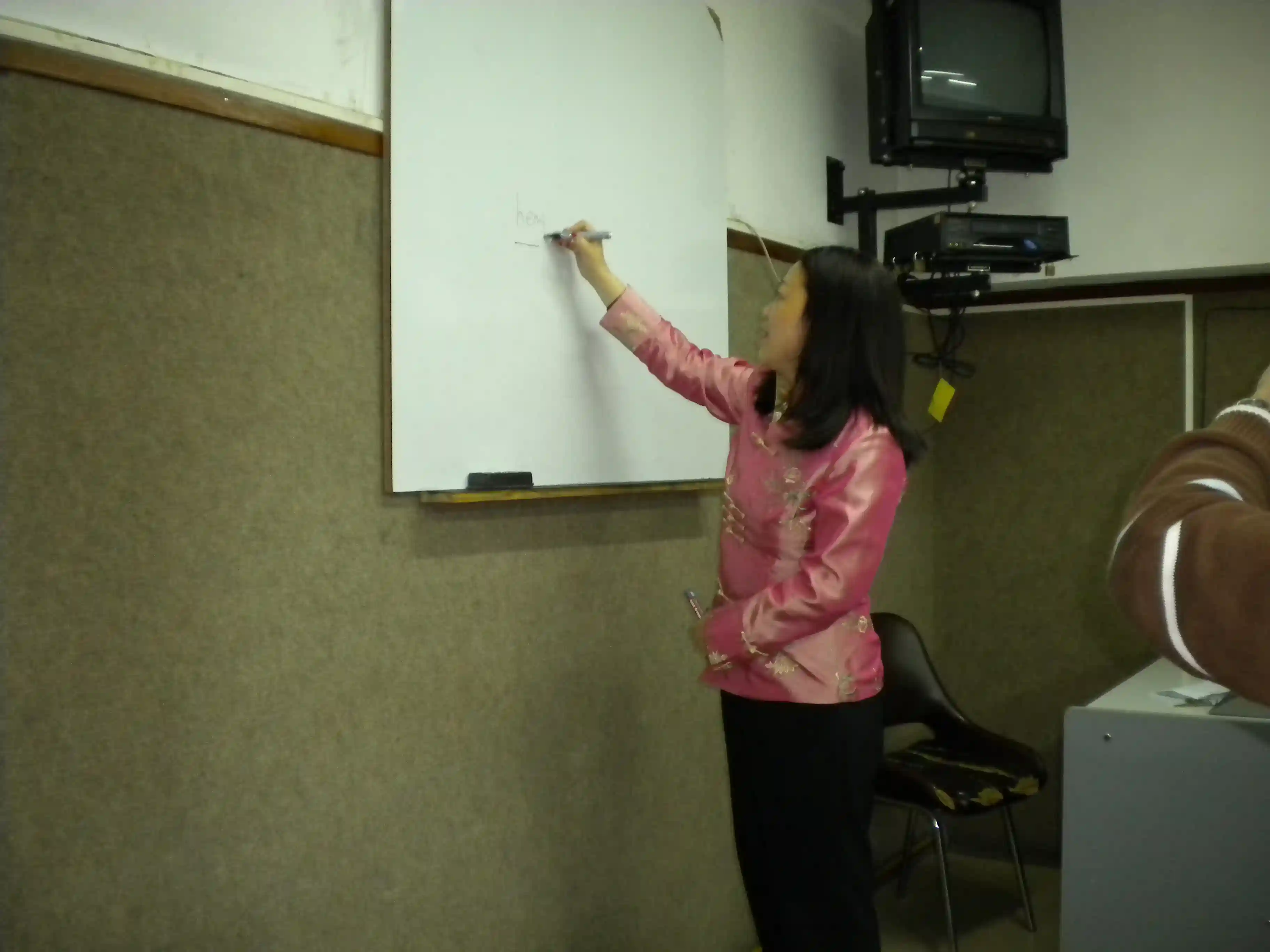
Maca Laoshi, Mandarin Chinese teacher
Updated October 20, 2026 · 8 min read

AI is a great help for studying Chinese: it's available at any hour, endlessly patient, explains grammar and chats with you. But in the hardest parts of Chinese, a real teacher still wins, if only narrowly: a teacher actually listens to and corrects your tones, gives you a method and an order, and keeps you going so you don't give up. What works best is combining the two: AI for questions and practice, a teacher to move forward with direction, and a bit of review every day.
What AI does really well
Credit where it's due: a chatbot like ChatGPT or Gemini is a study partner that never gets tired. You can ask it the same thing ten times and ask for more examples. It's good for:
- Answering questions on the spot, at any hour, without waiting for your next class.
- Explaining grammar with examples at your level.
- Making up practice sentences with the words you're studying.
- Writing texts tailored to you, for example, using only HSK 1 vocabulary.
- Chatting, in writing or out loud, playing a waiter, a shopkeeper or a classmate.
- Correcting sentences you wrote yourself.
A review published in 2023 in RELC Journal (Kohnke, Moorhouse and Zou) sums it up: it answers grammar and vocabulary questions and can adapt a text to a learner's level. At the same time, it warns that its answers aren't always correct.
What it still doesn't handle well
It can be wrong, and sound very sure of itself
OpenAI, the company behind ChatGPT, explains it in its help center: the model can give incorrect answers even when it sounds confident, and this is called a “hallucination”. Google says the same about Gemini. When you study Chinese, always check the pinyin and the tones in a dictionary, especially for characters with more than one reading (多音字 duōyīnzì): 觉 is read jiào in 睡觉 shuìjiào (to sleep) and jué in 觉得 juéde (to think, to feel). The same goes for stroke order and set phrases (成语 chéngyǔ).
It's not a good judge of your pronunciation
When you speak to it, you can't tell whether it's really hearing your tones. According to OpenAI's help center, ChatGPT's Standard voice mode transcribes what you say before responding, and the transcription can fix your mistakes without telling you: a 2025 study (Feng and Tian) found that ChatGPT sometimes “corrected” what beginner learners of Chinese said wrong.
When it gives feedback, it isn't reliable either. In a study published in 2026 with learners of English (Choi, PLOS ONE), ChatGPT gave higher pronunciation scores than human raters and agreed very little with them on individual sounds. And Olle Linge, who runs the site Hacking Chinese, uploaded the same recording of a native speaker from Beijing several times, with no errors at all: ChatGPT found mistakes that weren't there. In Chinese this matters a lot, because changing the tone changes the word (we explain it in the 4 Mandarin tones).
It over-corrects
When correcting, these models tend to rewrite more than necessary: a 2023 study on grammar correction (Fang and others) found that they don't stick to minimal edits. If it rewrites your whole sentence, you can't tell what your mistake was.
It doesn't give you a path or keep you on track
A chatbot answers what you ask. It doesn't decide what you should learn next, it doesn't notice you haven't practiced in two weeks, and it doesn't ask how things went. And in Chinese, where results take months, consistency is half the work.
 Test your Chinese
Improve your Chinese with our app, Macalaoshi Flashcards: 1,300+ words and characters to practice like this.
See the appAI or a teacher: the comparison
| What you need | AI (ChatGPT, Gemini…) | Real teacher | Winner |
|---|---|---|---|
| Available at any hour | Always | During class hours | AI |
| Patience to repeat things | Endless | A lot, but teachers are human | AI |
| Price | Free or cheap | Costs more | AI |
| Explaining grammar with examples | Very well | Very well | Tie |
| Conversation practice | Whenever you want | In class, with a real person | Tie |
| Teaching you things that are correct | Almost always, but sometimes it makes things up | Yes, and knows why | Teacher |
| Correcting your tones and pronunciation | Unreliable | Listens to you and corrects you | Teacher |
| Giving you a method and an order | Answers what you ask | Takes you step by step | Teacher |
| Keeping you from giving up | If you don't message it, nothing happens | Expects you every week | Teacher |
Result: the teacher wins 4 to 3, with 2 ties. It's a narrow win, but in exactly what's hardest about Chinese: the tones, the direction and the consistency. That's why the best answer isn't to choose one, but to combine them.
Find a real teacher
If you can, study with a real teacher, ideally a native speaker, who listens to you and corrects your pronunciation. It's the one thing AI still can't do reliably, and in Chinese, where the tone changes the meaning, it makes a big difference. When you're choosing one, look for:
- Someone who corrects your tones as you speak, not just your grammar.
- A clear order, for example, by HSK level, so you know what comes next.
- Regular classes, at least once a week: a fixed appointment is what keeps you from dropping it.
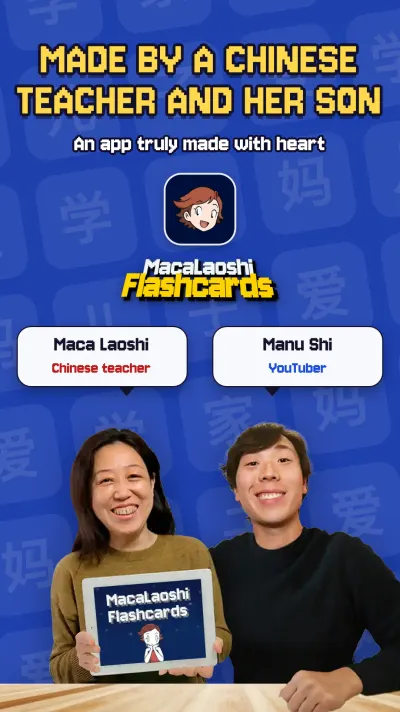
Macalaoshi was created by a teacher. Maca was born in Beijing and has taught Mandarin Chinese for more than 22 years, with more than 1,500 students. She built the app together with her son, Manu Shi, whose YouTube channel (in Spanish) has more than 93,000 subscribers. A teacher with her own app and a channel like that: something very few Chinese teachers can show.
How to use AI without being misled
Between classes, AI is a good practice partner. Change what's in square brackets, state your level and always ask for the format you want:
- To understand grammar: “Explain the difference between 了 (le) and 过 (guo) with 5 examples at HSK 2 level. For each example, write the characters, the pinyin with tone marks and the English translation.”
- To practice your vocabulary: “These are the words I'm studying: [your list]. Write 10 short sentences using only these words and other HSK 1 words. Show me the characters on their own first, and put the pinyin and the translation at the end.”
- To have a conversation: “Talk to me in Chinese as a waiter at a restaurant in Beijing. Use short sentences at HSK 2 level, one per turn, and wait for my reply. When we're done, correct my mistakes and explain them in English.”
- To correct your writing: “Correct these sentences I wrote in Chinese. Change only what's wrong, without rewriting the style, and explain each correction in English: [your sentences].”
Check every new word in a dictionary, like MDBG (free on the web) or the Pleco app. And don't ask the AI to judge your tones: that's what your teacher is for.
The combination that works best
- A teacher for direction and pronunciation.
- AI for questions and practice between classes.
- Review every day, even if it's just 15 minutes: what you don't review, you forget, however much you've chatted. We show you how in how to memorize Chinese characters.
If you're starting from scratch, follow an order, like the one in the 30-day plan. And if you want to compare tools, we review them in the best apps to learn Chinese.
Improve your Chinese with Macalaoshi Flashcards
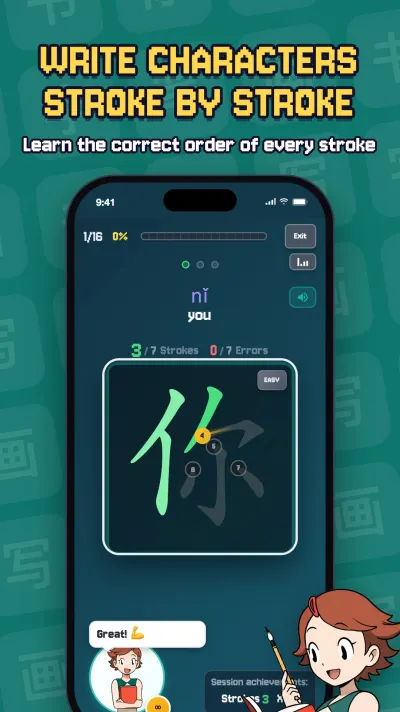
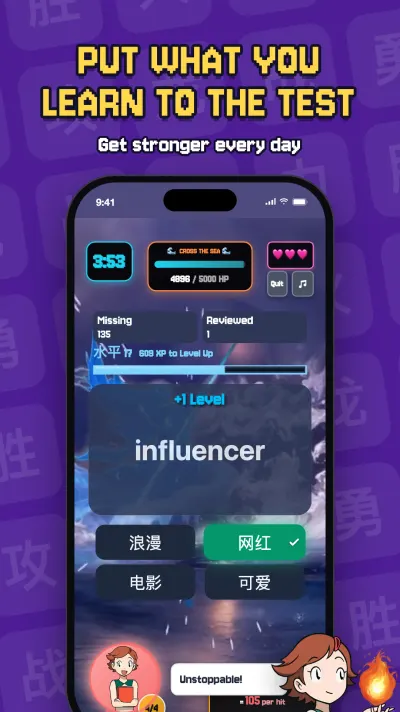
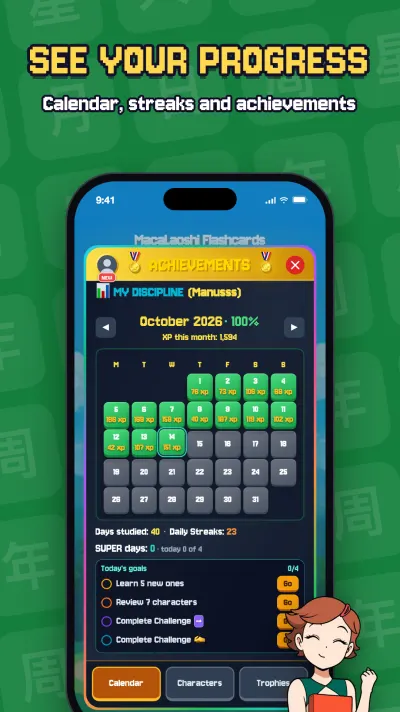
Maca Laoshi's app for learning characters, with audio, pinyin and stroke-by-stroke writing.
- 1,300+words and characters
- HSK 1–4by level
- Freeto start

Learn with our songs
We made them for Macalaoshi. Singing along is a fun way to practice pronunciation and review vocabulary.

The Lighthouse of My Heart 我心里灯塔

Study With You 跟你一起学
Frequently asked questions
Can you learn Chinese with ChatGPT alone?
You can make a lot of progress: it explains, chats and corrects your writing at any hour. But it sometimes gets things wrong, it can't reliably correct your tones, and it doesn't give you a method or keep you on track. What works best is combining it with a teacher and daily practice.
Which is better for learning Chinese, AI or a teacher?
For quick questions and practice, AI is very good and always available. For pronunciation, method and consistency, a real teacher still wins, if only narrowly. Ideally, use both.
Can ChatGPT correct my Chinese pronunciation?
Not reliably. Its feedback may be based on a transcription that quietly fixes your mistakes, and in tests with audio from a native speaker it made up errors. For tones, what works is having a teacher listen to you.
What prompts work for learning Chinese with AI?
Ones that state your level (for example, HSK 1), what you want (an explanation, sentences, conversation or corrections), the format (characters, pinyin with tone marks and an English translation) and that ask it to correct you at the end. This guide has 4 ready to copy.
Can I practice speaking Chinese with ChatGPT's voice mode?
Yes, for conversation practice: you speak, it answers out loud, and you can ask it to speak more slowly. But in Standard mode it transcribes what you say before responding, so it may not catch your tone mistakes.
Maca Laoshi, born in Beijing, has taught Mandarin Chinese for more than 22 years and has had over 1,500 students. Together with her son Manu Shi, who has more than 93,000 subscribers on YouTube, she created Macalaoshi, an app that challenges you to push yourself one character at a time. Few Chinese teachers can show both: their own app and a channel like that.
Sources
- OpenAI: ChatGPT can give incorrect answers confidently (“hallucinations”), so you should verify.
- OpenAI (October 2026): ChatGPT's voice mode and how it transcribes what you say.
- Google: Gemini can hallucinate and present inaccurate information as fact.
- Kohnke, Moorhouse and Zou (2023), RELC Journal: ChatGPT for language teaching and learning.
- EL Gazette (2023): a summary of that review.
- Feng and Tian (2025): when transcribing, ChatGPT sometimes “corrects” beginners' erroneous Chinese.
- Choi (2026), PLOS ONE: ChatGPT scores pronunciation higher than human raters.
- Olle Linge, Hacking Chinese (September 2026): ChatGPT makes up pronunciation errors.
- Fang et al. (2023): when correcting, ChatGPT tends to change more than necessary.
- MDBG: free online dictionary based on CC-CEDICT.
- About us (in Spanish): Maca, born in Beijing, and her son Manu Shi.
- Manu Shi's YouTube channel (in Spanish): more than 93,000 subscribers in October 2026.
This guide in other languages: Español · Português · Français · Deutsch · Italiano · 日本語 · 한국어