Guides › Chinese tattoos
Chinese character tattoos: how to choose characters, avoid mistakes and check the meaning
Maca Laoshi ·
Before getting a Chinese tattoo, check three things: that each character means what you think (many have several senses), that you use one form only (simplified or traditional), and that the stencil is not backwards. Ask a native speaker to review it, and do not trust a machine translator. This guide explains the most common mistakes, with examples you can check in the MDBG dictionary, and gives 20 characters and 15 short phrases with pinyin. For more words with nuance, see beautiful Chinese words.
 Test your Chinese
Improve your Chinese with our app, Macalaoshi Flashcards: 1,300+ words and characters to practice like this.
See the appHow to choose and check a Chinese tattoo, step by step
- Define the meaning in your own language: write in one sentence what you want to say and why. The shorter the better: a single character or a four-character phrase is easier to read and to check.
- Choose the form: simplified (mainland China, Singapore) or traditional (Taiwan, Hong Kong, Macao). Stick to one throughout the design.
- Look up each character and the whole phrase in a dictionary such as MDBG. Read all the meanings, not just the first.
- Ask a native speaker to review it, preferably two different people, and show them the final design, not just copied text.
- Check the stencil on paper before the needle: direction, order and strokes. If the tattoo artist «fixes» a stroke, the character may change.
- Mind the size: characters with many strokes lose detail when small; choose a size that keeps the strokes apart.
Common mistakes in Chinese tattoos
1. Translating word by word with a translator
Chinese is built from words of one or more characters, and many expressions do not mean what each character says on its own. A clear example: 加油 (jiāyóu) translates literally as «add oil», but what it says is «come on!». A machine translator can give a phrase that reads like translated text, or a strange word. Check the whole phrase in a dictionary and ask a native speaker to confirm that it sounds natural.
2. Mixing simplified and traditional forms
A single text should not combine 爱 (simplified) with 愛 (traditional), or write 永不放弃 with a simplified 弃 next to another character in traditional form. Translators and stencil generators sometimes mix forms without telling you. Choose one and check every character.
3. Text backwards or mirrored
Chinese can be read horizontally, left to right (most common today), or vertically, top to bottom with the columns running right to left, according to Wikipedia. When the design is moved to transfer paper or skin, the text can end up reversed. Quick test: once placed on the skin, the stencil should read correctly at a glance; if it only reads correctly in a mirror, the text is reversed. Ask the tattoo artist for a photo of the stencil already placed on the skin, and have your reviewer read it before starting.
4. A single character with several meanings
Many characters have more than one sense, and a lone character with no context does not make clear which one you mean. Four examples from the MDBG dictionary:
- 忍 (rěn) is «to bear, to endure», but it is also in 残忍 (cánrěn), «cruel, ruthless».
- 孝 (xiào) is «filial piety», but the dictionary adds «mourning apparel»; in a tattoo it can read as mourning.
- 信 (xìn) can be «to trust, to believe» or «letter», depending on context.
- 光 (guāng) is «light», but also «only, merely» or «used up».
5. A Japanese kanji that means something else in Chinese
If you copy words from a Japanese dictionary, or from a tattoo made with kanji, the Chinese can say something different. The classic case: 手纸 (shǒuzhǐ) in Chinese is «toilet paper», according to MDBG, whereas 手紙 in Japanese is «letter». More examples:
| Chinese | Pinyin | Meaning in Chinese | Meaning in Japanese |
|---|---|---|---|
| 手纸 | shǒuzhǐ | toilet paper | letter (手紙) |
| 勉强 | miǎnqiǎng | barely; to force | study (勉強) |
| 大丈夫 | dàzhàngfu | a manly man | all right; no problem |
| 娘 | niáng | mother | daughter |
| 汤 | tāng | soup; boiled water | hot water (湯) |
| 工夫 | gōngfu | time; skill; effort | ingenuity; a clever idea (工夫) |
The Chinese meanings are from the MDBG dictionary; the Japanese ones are the usual ones. If your design comes from a kanji or a Japanese list, check it in a Chinese dictionary.
Take a quick breakImprove your Chinese with our app, Macalaoshi Flashcards: 1,300+ words and characters to practice like this.
See the app6. An illegible font or calligraphy style
Very cursive or decorative brush styles distort the strokes, and one character can look like another. Ask for a clear style, such as regular script (楷体, kǎitǐ) or a print font, and check that whoever reviews the design reads it without effort. See also Chinese calligraphy.
Simplified or traditional: 爱 or 愛, 龙 or 龍
The simplified form (爱, 龙) is the standard in mainland China, Malaysia and Singapore, and the traditional form (愛, 龍) is official in Hong Kong, Macao and Taiwan, according to Wikipedia. The meaning is the same: only the writing changes. Note that 愛 has 心 («heart») inside and 爱 does not.
Which to choose? Think about who will read it: for mainland China, simplified; for Taiwan or Hong Kong, traditional. What matters is not mixing them. The tables below give both forms; to understand the difference, see traditional or simplified Chinese.
Reading direction and stencil
Today the most common way is horizontal, left to right; vertical reading, top to bottom with columns from right to left, is the traditional one and is still seen in Hong Kong, Macao and Taiwan (according to Wikipedia). Choose one direction and ask your reviewer whether the design reads well.
Before tattooing, check three things on the stencil: that, once on the skin, it reads correctly (no mirror needed), that the characters are in the right order and that no stroke has been changed. Learning the stroke order helps you spot a badly copied character.
How to ask a native speaker to check it
- Show the final design (the photo of the stencil), not only the text.
- Ask something concrete: 请问这几个字是什么意思? (qǐngwèn zhè jǐ gè zì shì shénme yìsi, «what do these characters mean?») and 这样写对吗? (zhèyàng xiě duì ma, «is it written like this?»).
- Ask whether it sounds natural and what connotations it has, not only whether it is «OK».
- Ask two people. If you use the traditional form, let one of them be from Taiwan or Hong Kong.
- A teacher, a friend or a language exchange will do; a stranger on a forum, less so.
20 single characters with their meaning
A single character is easy to read and to check, but it has several senses. Look at the «What to check» column before choosing. The pinyin and meanings follow the MDBG dictionary.
| Simplified | Traditional | Pinyin | Meaning | What to check |
|---|---|---|---|---|
| 爱 | 愛 | ài | love, to love | The traditional form 愛 has 心 inside; choose one form for the whole design. |
| 家 | same | jiā | home, family | Simple and legible. For «family member» it is 家人. |
| 福 | same | fú | good fortune, luck | It is the «blessing» of good-luck wishes. |
| 勇 | same | yǒng | brave | Uncommon on its own; in speech 勇敢 or 勇气 is more natural. |
| 忍 | same | rěn | to bear, to endure | Careful: it is also in 残忍, «cruel». It is written with 刃 («blade edge») over 心. |
| 信 | same | xìn | to trust, to believe; letter | Three different senses: context decides. |
| 善 | same | shàn | good, kind | Also «good at something». |
| 静 | 靜 | jìng | quiet, still | Written 靜 in traditional. |
| 梦 | 夢 | mèng | dream (while sleeping) | It is the dream of sleep; a dream as a goal is usually 梦想. |
| 心 | same | xīn | heart, mind | Same in both forms; one of the simplest. |
| 道 | same | dào | road; principle; the Dao | Heavy with philosophical weight (the Way of Daoism). |
| 光 | same | guāng | light | Also «only, merely» or «used up». |
| 缘 | 緣 | yuán | fate, predestined affinity | The dictionary adds «cause, karma» and «edge»; the traditional form is 緣. |
| 仁 | same | rén | humaneness, benevolence | One of the five cardinal virtues (五常) of traditional ethics. |
| 义 | 義 | yì | justice, righteousness | Another of the five virtues; traditional 義. |
| 礼 | 禮 | lǐ | courtesy, ritual; gift | Careful with «gift»; another of the five virtues. Traditional 禮. |
| 智 | same | zhì | wisdom | The fourth of the five virtues. |
| 诚 | 誠 | chéng | sincere | Usually found in compounds like 真诚; traditional 誠. |
| 孝 | same | xiào | filial piety | Careful: it also means «mourning apparel». |
| 魂 | same | hún | soul, spirit | According to the dictionary, the soul that can detach from the body: a spiritual concept, so be sure it is what you mean. |
Ready for the hardest one?Improve your Chinese with our app, Macalaoshi Flashcards: 1,300+ words and characters to practice like this.
See the app15 short phrases and words for tattoos
Two or four characters are easier to check than a long sentence. Four-character phrases (成语 and similar formulas) appear in MDBG; if one is a free phrase, the table says so.
| Simplified | Traditional | Pinyin | Meaning | What to check |
|---|---|---|---|---|
| 自由 | same | zìyóu | freedom; free | Short and clear, with no ambiguity. |
| 平安 | same | píng’ān | safe and sound; at peace | Protection and calm; it is also in the beautiful words guide. |
| 希望 | same | xīwàng | hope; to hope | A noun and a verb. |
| 家人 | same | jiārén | family members | Careful: in old usage the dictionary also gives «servant». |
| 永不放弃 | 永不放棄 | yǒngbù fàngqì | never give up | Not a dictionary idiom: a free phrase made of 永不 («never») and 放弃 («to give up»), both in MDBG. |
| 顺其自然 | 順其自然 | shùnqí zìrán | let things take their course | Set expression: do not force, accept what comes. |
| 知足常乐 | 知足常樂 | zhīzú chánglè | whoever is content with what they have is happy | Set expression: the happiness of knowing how to be content. |
| 自强不息 | 自強不息 | zìqiáng bùxī | strive tirelessly | With 厚德载物 it forms the motto of Tsinghua University, according to Wikipedia. |
| 勇往直前 | same | yǒngwǎng zhíqián | advance bravely | Set expression: go forward without fear. |
| 厚德载物 | 厚德載物 | hòudé zàiwù | with great virtue one can carry the world | Second half of Tsinghua’s motto; Wikipedia says it comes from the I Ching. |
| 随遇而安 | 隨遇而安 | suíyù ér’ān | adapt to any circumstance | Set expression: accept what comes with good will. |
| 脚踏实地 | 腳踏實地 | jiǎotà shídì | keep your feet on the ground, be realistic | Literally «feet firmly on solid ground». |
| 宁静致远 | 寧靜致遠 | níngjìng zhìyuǎn | serenity leads far | According to the dictionary, close to «still waters run deep». |
| 天道酬勤 | same | tiāndào chóuqín | Heaven rewards the diligent | Set expression about steady effort. |
| 坚持不懈 | 堅持不懈 | jiānchí bùxiè | to persevere without letting up | Set expression; close to 坚持 but more emphatic. |
If you want words with more nuance than a single character, see beautiful Chinese words: 缘分, 初心, 宁静… grouped by idea. For couple phrases, I love you in Chinese.
How Macalaoshi does it
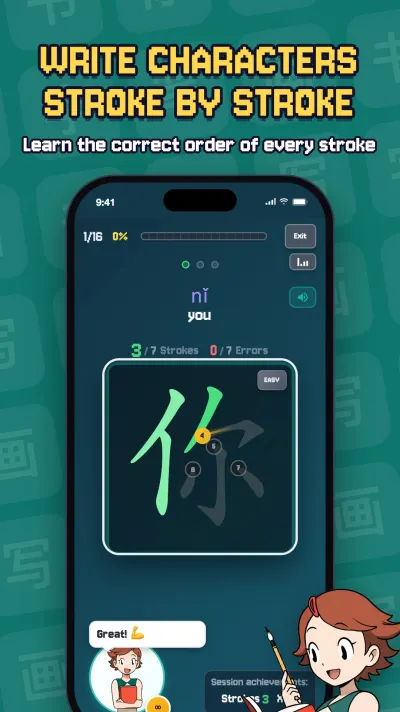
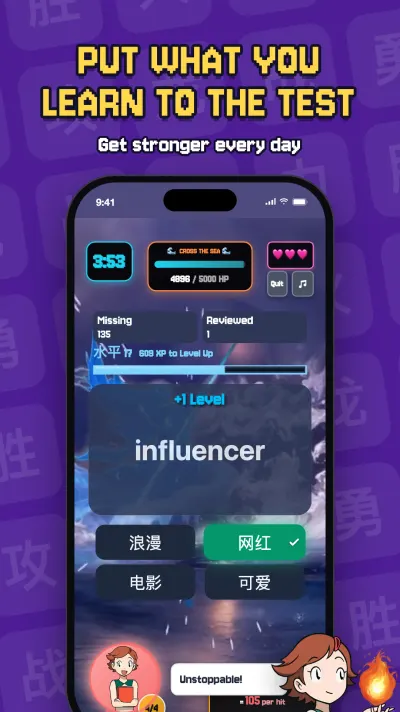
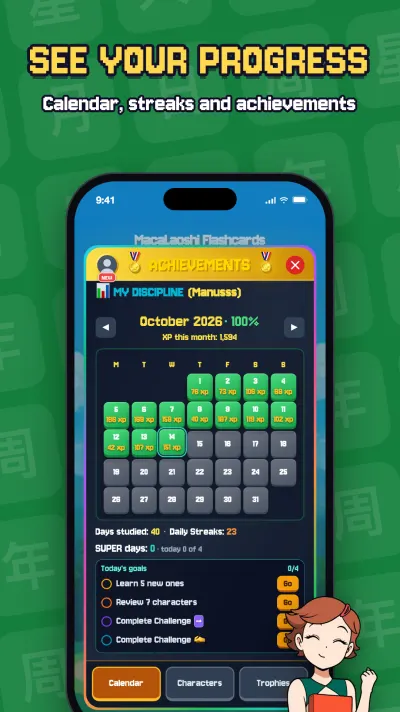
In Macalaoshi you collect characters from HSK 1 to 4 (more than 1300 words and characters in all), and every character you get right goes up a level; what you miss comes back for you to review. You can practice writing stroke by stroke, in the correct order, while you move through the story with Lili against the Empress. Learning to read and write the characters you want to wear on your skin is the best way to make sure they hold no surprises.
The pinyin follows the dictionary; in speech, 一 changes tone depending on the next syllable (for example, 一路 is said yílù). Real pronunciation varies by region and speaker.
Improve your Chinese with Macalaoshi Flashcards
Maca Laoshi's app for learning characters, with audio, pinyin and stroke-by-stroke writing.
- 1,300+words and characters
- HSK 1–4by level
- Freeto start


Learn with our songs
We made them for Macalaoshi. Singing along is a fun way to practice pronunciation and review vocabulary.
The Lighthouse of My Heart 我心里灯塔
Time to Shine 发光的时分
Frequently asked questions
How do I check that a Chinese tattoo is correct?
Look up each character and the whole phrase in a dictionary such as MDBG, ask two native speakers to review it with the final design, and check on the stencil that the direction, the strokes and the form (simplified or traditional) are right.
Is simplified or traditional Chinese better for a tattoo?
It depends on who will read it. Simplified is the standard in mainland China, Malaysia and Singapore; traditional is official in Hong Kong, Macao and Taiwan. What matters is not mixing the two forms.
Why can a Japanese kanji mean something else in Chinese?
Because many words written with the same characters evolved differently. For example, 手纸 in Chinese is «toilet paper» (according to MDBG), whereas 手紙 in Japanese is «letter».
Which characters should I check most carefully?
Those with several senses: 忍 («to endure», but also in 残忍, «cruel»), 孝 («filial piety», but also «mourning apparel») or 信 («to trust» and «letter»). A single character with no context leaves more doubt than a phrase.
What do 自强不息 and 厚德载物 mean?
自强不息 is «strive tirelessly» and 厚德载物 is «with great virtue one can carry the world». Together they form the motto of Tsinghua University, according to Wikipedia.
Maca Laoshi, born in Beijing, has taught Mandarin Chinese for more than 22 years and has had over 1,500 students. Together with her son Manu Shi, who has more than 93,000 subscribers on YouTube, she created Macalaoshi, an app that challenges you to push yourself one character at a time. Few Chinese teachers can show both: their own app and a channel like that.
Sources
- MDBG dictionary (based on CC-CEDICT): pinyin and meaning of the characters and phrases in the tables, for example 手纸: «toilet paper», 孝: «filial piety; mourning apparel», 残忍: «cruel», 五常: «the five cardinal virtues: 仁, 义, 礼, 智, 信», 顺其自然: «to let nature take its course (idiom)».
- Wikipedia (English), Tsinghua University: the motto is 自强不息、厚德载物, derived from a 1914 speech by Liang Qichao that quoted the I Ching.
- Wikipedia (English), horizontal and vertical writing in East Asian scripts: traditionally Chinese is written in columns top to bottom and right to left; today horizontal, left-to-right writing is common.
- Wikipedia (English), simplified Chinese characters: standard in mainland China, Malaysia and Singapore; traditional characters are official in Hong Kong, Macao and Taiwan.
This guide in other languages: Español · Português · Français · Deutsch · Italiano · 日本語 · 한국어